
What Do Answer Engines Cite? Seven Rules Found by Reverse-Engineering AEO
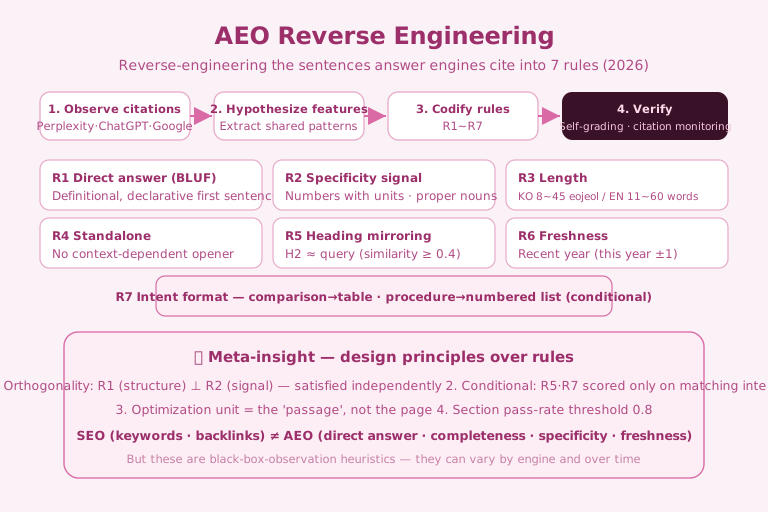
The optimization unit of AEO (Answer Engine Optimization) is not page ranking but the "citable sentence." In 2026, ASAP reverse-engineered what Perplexity, ChatGPT Search, and Google AI Overview excerpt and cite, distilling the findings into seven orthogonal, conditional rules (R1–R7). This article lays out that reverse-engineering method, the rules it produced, how AEO differs from traditional SEO, and how to apply it in practice, all in a direct-answer format.
From SEO to AEO: What Changed
AEO is the practice of optimizing to be "cited" in the answers that answer engines generate. Where traditional SEO dealt with "where to look" (link ranking), AEO in 2026 deals with the sentences that directly state "what the answer is."
The core shift is the unit. Perplexity and Google AI Overview pick and cite excerptable paragraphs rather than entire pages, so the optimization target moves down from the "page" to the "passage." That single step down carries large consequences. In the SEO era a single page was the smallest unit of ranking competition, evaluated alongside internal links, dwell time, and overall document quality. In passage-level competition, by contrast, even a well-written page has only certain sentences excerpted while the rest, from a citation standpoint, might as well not exist.
Method: What We Reverse-Engineered
Reverse engineering is the process of inferring rules by observing the citation results of answer engines. ASAP fed identical queries into Perplexity, ChatGPT Search, and Google AI Overview, then compared which sentences were cited and excerpted.
The loop has four stages: observe citations → hypothesize shared features → codify into rules (R1–R7) → verify through self-grading and citation monitoring. ruleset.grade then scores the resulting rules section by section against a 0.8 (PASS_RATIO) threshold.
The premise of this approach is that "we cannot directly know what an engine cites, but we can observe what it cited." In other words, rather than the algorithm's internals, we use the output to work backward and narrow the conditions of the input. That is also why we send the same question to all three engines and look at the intersection. A sentence cited by only one engine may reflect that engine's own bias, but sentence traits that get pulled out repeatedly across all three are more likely to be a general, engine-independent signal.
R1–R3: Direct Answer, Specificity, Length
The first three rules define the internal quality of a "citable single sentence." Answer engines prefer sentences that still work as an answer even when excerpted.
- R1 Direct answer (BLUF): Write the first sentence in a definitional or declarative structure, such as "X is Y."
- R2 Specificity signal: Include at least one number with a unit (e.g., 68%, 6 weeks) or a proper noun. A single bare number with no context is not enough.
- R3 Length: Keep the first sentence to roughly 8–45 eojeol in Korean (11–60 words in English) so it is neither too short nor too long.
The three rules are really answers to one question: "If you cut out just this sentence, does it still form a complete answer to the user's question?" The definitional structure sets the skeleton of the answer, the specificity signal makes that answer credible, and the length constraint guarantees an excerpt-friendly size.
R4–R5: Standalone Completeness and Heading Mirroring
The next two rules check "does it break when excerpted?" and "does it match the question?" Answer engines pick sentences whose meaning survives once pulled out of context.
- R4 Standalone completeness: Make sure the first sentence does not begin with a context-dependent word such as "this," "that," "the aforementioned," or "however," and that the subject is explicit.
- R5 Heading mirroring: Align the H2 title with the target query so that similarity reaches at least 0.4. Applied only when a query exists.
Where R1–R3 govern the inside of a sentence, R4–R5 govern the sentence's relationship with the outside world. Excerpting is essentially the act of tearing a sentence out of its original context, so a sentence that makes no sense without the preceding paragraph is eliminated from the citation pool. Heading mirroring is the connection in the opposite direction: the more the user's question and the H2 overlap lexically, the easier it is for the engine to judge that "this section is the answer to that question."
R6–R7: Freshness and Intent-Specific Formatting
The last two rules, R6 and R7, address freshness and format; they come from the observation that, as of 2026, answer engines prefer up-to-date information and structures that match intent. In other words, the same content can have a different citation probability depending on its timing and format.
- R6 Freshness: State a recent year in the body (this year ±1 year, i.e., relative to 2026) to give a freshness signal.
- R7 Intent-specific formatting: Present a table for comparison intent and a numbered list for procedural intent. Applied only when that intent is present.
Meta-Insight: How We Designed the Rules
The more important insight is the design principles behind the rules rather than the rules themselves. We applied four principles so that the heuristics would not undercut one another.
First, orthogonality. R1 (direct-answer structure) and R2 (specificity signal) are kept separate so they don't overlap, letting a single sentence satisfy the two axes independently. Second, conditional scoring. R5 and R7 are included in the denominator only when the relevant intent is present, so that rules that don't apply don't drag down the score. Third, the optimization unit is the passage, not the page. Fourth, we set a section-level pass rate of 0.8 as the threshold.
Turned inside out, these design principles reveal the common failure modes. When rules are not orthogonal, one sentence trait gets counted across several rules and distorts the score; without conditional scoring, an article that needs no comparison table is unfairly penalized for "having no table." In other words, these four principles are less a device for adding rules than a self-constraint that keeps the rule system from losing its own credibility.
Applying This for Practitioners
When porting these rules to Korean-language content, it is more efficient to secure two things first. The first is R1 (direct answer) and R4 (standalone completeness), because these two are the gate that applies unconditionally to every section, with no query or intent condition attached. Writing the first sentence under each H2 in "X is Y" form, and consciously suppressing the Korean habit of dropping the subject so that it stays explicit, puts most sentences into an excerptable state.
Keep in mind that R3's length criterion differs by language. Korean is judged at 8–45 eojeol and English at 11–60 words, so translating a single Korean sentence literally into English easily overshoots one language's range or the other's. In that case, rather than translating, it better preserves citation probability to rewrite the first sentence independently in each language.
AEO ≠ SEO, and What Comes Next
AEO relies on different signals than SEO. Instead of keyword density and backlinks, direct answers, standalone completeness, specificity, and freshness determine citation.
The next phase is just as clear. Once AI agents begin consuming search, summarization, and citation on people's behalf, AEO, writing sentences that are easy for an agent to excerpt, becomes the standard. That said, these seven rules are heuristics obtained by observing a black box, not an answer key, and they can vary by engine and over time. The fate of observation-based rules is that they age as their subject changes, so rather than treating the rule table as a fixed checklist, it is safer to make the loop itself, remeasuring citation results and updating continuously, the real asset.
References: GEO: Generative Engine Optimization (Aggarwal et al., 2023) · ASAP internal ruleset aeo/ruleset.py (R1–R7, self-grading)

AI & tech,
read in depth
Beyond the headlines — into the context and the structure
AGI Soon As Possible · asapai.co.kr