
Even when AI writes the code, expertise still pays: 400,000 Claude Code sessions analyzed
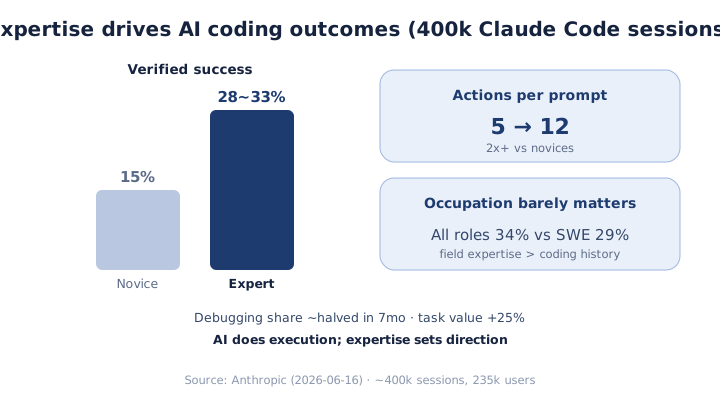
What separates success with AI coding agents is not a coding background but domain expertise. A study Anthropic published on June 16, 2026 analyzed about 400,000 Claude Code sessions (235,000 users) and found that expert sessions reach a verified success rate of 28-33%, double the 15% of novices. Experts also drew 12 actions per prompt, more than double the novices' 5. ASAP summarizes the result from the primary source.
The core finding: what mattered was expertise, not tenure
The point that upends conventional wisdom is clear. The variable that separated outcomes was not coding tenure but the domain expertise a person brought to the session. The more expertise they had, the more work Claude did from a single instruction. So even in an era where AI handles execution, the judgment to know what to ask and how still creates the difference in results.
An easily missed implication follows. Expertise raised both actions per prompt and verified success rate at the same time, which means experts are not simply asking for "more" but asking "correctly." A vague instruction stalls the agent after a few steps, while a well-directed one carries a long chain of work to completion in one pass. The value of expertise attaches not to the hands that type the code but to the head that defines the problem and draws its boundaries.
The expertise gap in numbers
Success and output are sharply divided by expertise level in the 2026 data. The figures published on June 16, 2026 are as follows.
| Metric | Novice | Expert |
|---|---|---|
| Verified success rate | 15% | 28-33% |
| Actions per prompt | 5 | 12 |
Experts drew more than double the actions from a single prompt and reached verified success at roughly twice the rate of novices.
That both metrics rise together matters especially. More actions with a low success rate would just mean frequent trial and error, but experts direct longer runs of work while also succeeding at verification more often. Volume and accuracy climbing in tandem is closer to evidence that expertise is signal, not noise.
Anyone produces code — occupation barely matters
Occupation is almost irrelevant in code-producing sessions, per the 2026 analysis. Most major occupations reached nearly the same success rate as software engineers in code-producing sessions, at 34% versus 29% on average, with non-engineering roles slightly ahead. This supports the core finding that expertise matters more than a coding history.
It is safer not to over-read why non-engineering roles came out slightly ahead. This figure is confined to "code-producing sessions," and a non-engineer who sets out to generate code in the first place is likely to understand their own field's problem clearly. In other words, it is more sound to read this not as occupation itself creating skill, but as another expression of the earlier finding: whoever knows their own domain precisely, in any role, has the advantage.
What changed over seven months
Usage patterns are also shifting, with clear changes over the seven months from October 2025. Between October 2025 and April 2026, the share of debugging sessions fell by nearly half, and the average task value per session rose about 25%. People moved from simple bug-fixing toward handing more valuable work to AI.
This shift reads two ways. One is that better tools reduced the need for humans to touch low-value work like simple bug-fixing; the other is that users, trusting the agent, began delegating heavier tasks. Either way, the share left to people narrows toward direction-setting and verification, and that points the same way as this study's conclusion that expertise is rewarded.
Implications for practitioners
The takeaways for practitioners and teams are clear. First, the habit of judging on "years of coding" alone in hiring and evaluation deserves a rethink, because what separated outcomes was domain understanding, not tenure. Second, this signals that the barrier to AI coding for non-developer roles is lower than assumed, so it may help organizational productivity to let planning, marketing, and operations staff prototype their own domain problems directly. Third, the edge that remains for developers shifts toward the ability to break problems down and verify results, rather than knowledge of syntax.
Limits and ASAP's view
A few caveats keep this study from being over-read. The sample is limited to Claude Code users, so it carries the bias of a group already comfortable with AI tools, and the operational definitions of "expertise" and "verified success" must be understood within the source's context. What was observed is correlation, not a confirmed causal claim that expertise produced success. It is also honest to account for the fact that this is a vendor analyzing usage data from its own product.
Even so, the reason ASAP watches this data is that the conclusion does not conflict with common sense and its direction is consistent. The pattern that the relative value of defining what to build and judging the result rises as execution gets cheap is likely to apply to most knowledge work, not just coding. Reading that direction as a signal is more useful in practice than fixating on the absolute numbers.
What grows as execution gets cheap
The 2026 study is evidence that as execution gets cheap, expertise and judgment become the differentiator. Even when AI writes the code, the domain expertise to define what to build and verify the result does not vanish; it is rewarded more. Field expertise, more than a coding history, becomes the core asset in using AI. The more execution you hand to AI, the more valuable the person who knows the direction becomes.
Source: Anthropic, "Agentic coding and persistent returns to expertise" (2026-06-16; ~400,000 sessions, 235,000 users; analysis from October 2025 to April 2026).

AI & tech,
read in depth
Beyond the headlines — into the context and the structure
AGI Soon As Possible · asapai.co.kr