
The Age of Agentic Marketing: What's Left When Execution Becomes Free
Agentic marketing is a way of running marketing in which AI agents take only a goal and then carry out ideation, production, targeting, delivery, and optimization on their own. In 2026, McKinsey estimated that agentic AI could perform up to two-thirds of current marketing activities and lift revenue by 10–30% through hyper-personalization. This article argues that the essence of the shift is not "automating execution" but the collapse of execution cost — and that, as a result, value migrates from execution to judgment.
What Agentic Marketing Is
Agentic marketing, unlike the generative AI of 2024, is an autonomous system that decides the "how" once you set the goal. Where generative AI needed a prompt for every step, the 2026 agent takes a target like "increase qualified leads by 20% this quarter," perceives the situation, and executes actions across channels.
The key change is in how it operates. We are moving from an era where the marketer specified both "what" and "how" to one where, once you set the "what" (the goal), the agent fills in the "how" (the execution).
How It Differs From Automation
Rule-based automation only reacts to preset conditions, while an agent reasons about the situation and decides. Unlike "send an email two hours after a cart is abandoned," an agent weighs the user's purchase history, browsing behavior, and estimated lifetime value to decide on its own whether to show a discount or wait.
The 2026 standard is the multi-agent system. As in Salesforce's Agentforce and HubSpot's Breeze, a strategy agent hands off a brief, a content agent writes copy, a compliance agent reviews it, and a media-buying agent runs the spend — a division of labor that has been commercialized.
Five Levels of Autonomy: L0 to L4
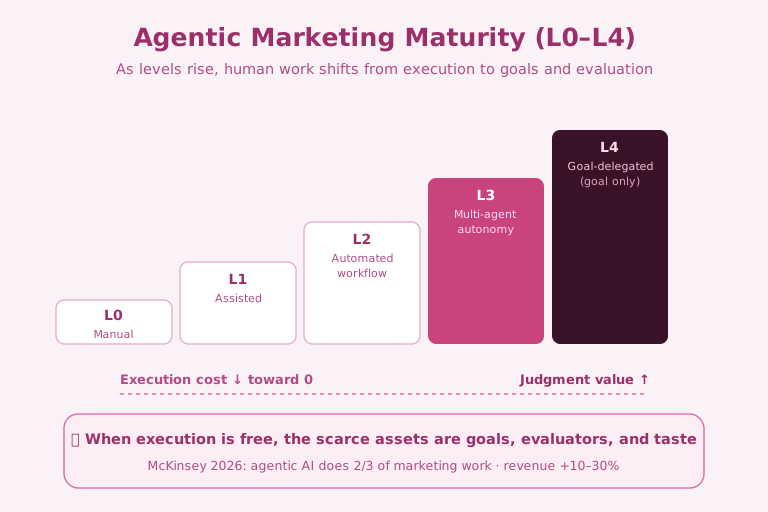
Just as autonomous driving has SAE levels 0–5, the maturity of agentic marketing becomes clearer when split into levels. We propose five levels based on what the human still holds.
- L0 Manual: the human does everything by hand.
- L1 Assisted: AI drafts and the human approves each time (the 2024 norm).
- L2 Automated Workflow: AI runs a fixed pipeline.
- L3 Autonomous Execution: a multi-agent system runs campaigns while the human sets only goals and guardrails.
- L4 Goal-Delegated: given only a goal, the agent fleet allocates channels, budget, and messaging on its own.
As the level rises, the human's work shifts from execution to "designing objectives and evaluation criteria."
The break worth watching on this ladder is the gap between L2 and L3. Up through L2, the human draws every branch of the pipeline in advance and the AI moves only inside it; it is still the world of "automation," where failure has a clear cause. At L3, the agent reaches for the goal along paths the human never anticipated. From that moment, what you manage stops being "the task" and becomes "the range of allowed behavior." In other words, crossing into L3 changes the marketer's question from "how do I get this done" to "what is the line this agent must never cross." That is also why most organizations stay at L1–L2: not for lack of tools, but for lack of a goal and a set of guardrails clear enough to actually delegate.
When Execution Cost Approaches Zero
As agents move to L3–L4, the marginal cost of making one piece of content or running one campaign approaches zero. Tools like Tofu made execution 8× faster by personalizing email, landing pages, and ads in one place, and Meta's generative-AI ad tools are used by more than a million advertisers.
When execution becomes free, value no longer comes from the ability to "make more, faster." Three things become scarce: the objective function that decides what to optimize, the evaluator that scores what is good, and judgment and taste.
Why Judgment, Not Execution, Is What Remains
Because this is the heart of the shift, it is worth digging a little deeper. The basic economic principle is simple: when a resource becomes abundant, the profit (economic rent) once earned from it disappears, and profit migrates to whatever resource is still scarce. For the past decade, marketing's bottleneck was "execution capacity" — writing copy, refining creative, setting up campaigns, and stamping out per-channel variants tied up human time and budget. Large companies were strong precisely because they could buy more of that execution capacity than anyone else.
Saying execution cost approaches zero means that bottleneck disappears. When it does, profit moves to the bottleneck left behind: the ability to decide what to make and the ability to judge whether what was made is any good. In short, what agentic marketing pushes up is the total volume of content, not the scarcity of good content. If anything, as volume explodes, the value of defining and filtering for "what is good" rises. In a world where execution is free, what carries a price is everything that did not become free.
The New Bottleneck: The Evaluator Problem
Self-improving systems like AlphaEvolve delivered results because the problem was "automatically scorable." In math and code, where the scoring criteria are clear, AI evolved on its own thousands of times.
Applied to marketing, the agent is only as smart as its evaluator. It optimizes well for instantly measured metrics like clicks and conversions, but brand fit, long-term trust, and the sense of "is this us?" are hard to score automatically. So the hardest task is designing the evaluation and guardrails that decide what to reward and what to block.
Here a practical trap surfaces: the metrics that are easy to score and the metrics that actually matter rarely coincide. Click-through rate is measured by the second; brand trust barely registers even by the quarter. Hand optimization to an agent and it will always drag the system toward whatever is measurable. Easy-to-measure signals automatically become the objects of management, while hard-to-measure ones are quietly neglected — a built-in bias. The real task of evaluator design, then, is not "picking good metrics" but finding proxy signals for the values that cannot be auto-scored and inserting human judgment on a regular cadence.
Limits and Counterarguments
Agentic marketing is not a cure-all, and even in 2026 it carries structural risks that grow as automation deepens. A prime example is the homogenization paradox: when everyone uses the same models, outputs converge to the mean and differentiation gets harder.
The illusion of measurement is also dangerous. As with Goodhart's law (1981), the moment a proxy metric becomes the target, it stops being a good metric. When agent-made content floods in, consumer distrust and platform regulation grow, and autonomy concentrates power in the large platforms that hold real-time data.
What deserves attention is that these risks interlock and amplify one another. When everyone optimizes the same metrics with the same models, homogenization and Goodhart's law fire at once and the whole market converges toward the same mean in the same direction. As a result, the "deliberate divergence" of choosing to walk a different way becomes the most expensive asset of all. The real danger automation creates is not that agents do the work badly, but that everyone does it too well — and identically.
What This Means for the Korean Market
Mapping this trend onto the Korean market yields two implications. First, language and channel specificity act as a buffer for now. Most of the tools and figures above assume English-language, large-scale platforms. In Korea, search, commerce, and messaging are bound to domestic platforms, and the fine grain of honorifics and brand voice is hard for an automatic scorer to capture. A wide band of territory therefore remains where a global agent struggles to produce results directly, and that gap buys domestic teams time.
Second, the buffer is not permanent, because the collapse of execution cost itself is language-agnostic. What Korean companies should prepare now is not the capacity to stamp out more creative, but an evaluation standard that can score "our-ness" from their own data, and the ability to define, sharply, the goals they hand to an agent. Internalizing objectives and evaluation comes before adopting tools — that is this article's core prescription.
What's Left for the Marketer
The conclusion is not the marketer's disappearance but a redefinition. The marketer changes from an executor who writes copy into a "commander and evaluation designer" who defines objectives, designs evaluation criteria, and directs the agent fleet.
Paradoxically, this is an opportunity for small teams. When execution cost collapses, big companies' headcount advantage weakens, so a small team with a sharp objective and a clear brand point of view can leverage agents to compete with large organizations.
References: McKinsey, Reinventing marketing workflows with agentic AI (2026) · The agentic advertising economy

AI & tech,
read in depth
Beyond the headlines — into the context and the structure
AGI Soon As Possible · asapai.co.kr