
AGI economics: why abundance does not shrink the economy, and the gap in basic income
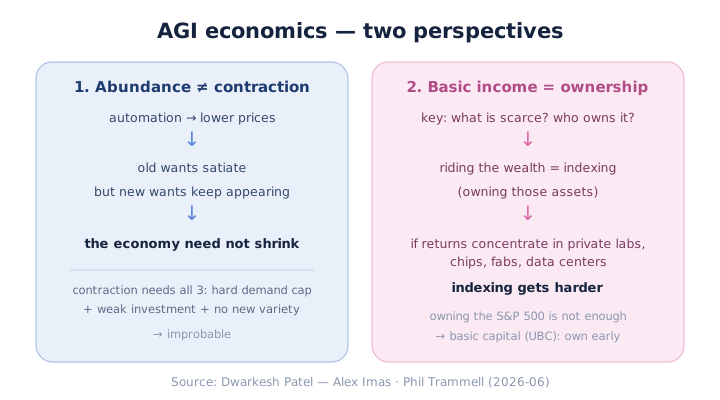
Automation making everything cheap does not guarantee that the economy shrinks. On the June 2026 Dwarkesh Patel podcast, economists Alex Imas and Phil Trammell argued why abundance need not mean economic contraction, and why basic income in the AGI era is a question of asset ownership rather than income. ASAP summarizes these two perspectives, grounded in the primary video.
Why abundance does not shrink the economy
The intuition that abundance shrinks the economy holds only when the list of wants is fixed. Trammell offers a thought experiment about a Mongolian economist in 1400. Looking only at goods of that era such as horses, yogurt, and yurts, that economist imagining automation would predict satiation in all of them, their shares falling to zero, and all money eventually spent on singers. History instead kept creating new categories to spend on as wealth and machines accumulated, and the share spent on singers stayed negligible.
What it would take for the economy to shrink
Imas argues that real contraction requires improbable conditions to hold at once. Cheaper goods alone are not enough.
- Hard demand limits: people must stop wanting to buy more.
- Weak investment demand: the saved money must not flow into investment.
- No new variety: no new product categories may appear.
All three must hold together for abundance to cause contraction, and Imas rates that as unlikely.
Why the three conditions rarely fail together
Take the three conditions apart and it becomes clear that the assumptions needed to break each one work against the others. For human wants to hit a hard ceiling, no new product categories can appear, yet historically new categories have arrived faster, not slower, as wealth accumulated. Conversely, for saved money to stop flowing into investment, future return opportunities must vanish, which loops right back into the absence of new categories. In other words, the three conditions are not independent coincidences but converge on a single strong premise: that humanity stops wanting more. That is arguably why Imas rates the odds as low. It would require not three doors closing by chance, but the reversal of centuries of expanding human wants all at once.
What stays scarce, and who owns it
Income shares are determined by what stays scarce, not by automation itself, in the Imas and Trammell framing. Even as AI automates tasks, economy-wide labor and capital shares hinge on prices, demand, supply chains, human-valued services, and whether AI creates new capital goods faster than people satiate on old ones. The real question is which assets stay scarce and who owns them.
Basic income in the AGI era: an asset question, not an income one
Basic income in the AGI era is an ownership question before it is a redistribution one. Trammell sees the main way ordinary people and developing countries ride AI's wealth as indexing the economy, that is, owning the assets. Yet if the biggest returns concentrate in private model labs, chip suppliers, fabs, and data centers, indexing becomes harder.
| Aspect | Conventional view | Imas and Trammell's point |
|---|---|---|
| Funding | Pay for it with taxes | A Georgist tax alone may not raise enough |
| Mechanism | Cash income transfer | Own the right assets before winners are obvious (basic capital) |
| Global equity | Hold the S&P 500 | Not enough unless Nigeria owns SK Hynix and Anthropic |
Why assets rather than income transfers
Here the shift in framing is decisive. The traditional basic-income debate is framed as a flow problem: how much to collect and how much to hand out. But in the Imas and Trammell frame the real variable is not the flow but the stock, that is, who holds the stakes in scarce assets. The more AI displaces labor, the weaker the bargaining power of wages as a flow, and the larger the share of income drawn as rent from assets. In this setup, taxing and redistributing income is only an after-the-fact correction, applied once the source is already concentrated in a few hands. Basic capital, by contrast, distributes stakes before the winners are locked in, changing the ownership structure of the source itself. That is why the "basic capital" row is not just a policy option but a relocation of the problem's definition.
Electricity or social media
AI's gains are distributed differently depending on one 2026 analogy: does it resemble electricity or social media? With electricity the downstream benefits spread broadly to users, while social media concentrated them in a few platforms and bottlenecks. If AI rents spread to users, a basic-capital strategy works; if they stay locked in platforms and bottlenecks, ordinary people's share shrinks.
What it means beyond the US
This discussion lands sharply outside the US as well. SK Hynix in the table is no accidental example but a core node in the AI-infrastructure bottleneck. In the question of "who owns the scarce assets," a country like Korea is a rare case that already holds a stake on one side of the bottleneck. Whether that stake is broadly distributed to individual citizens, however, is a separate matter. Applying Trammell's indexing logic domestically, an individual's path onto AI's wealth ultimately depends on how widely the assets running through fabs, chips, and data centers are shared. The uncomfortable question this conversation poses to any such economy is that an income-transfer-centric welfare frame alone struggles to return the gains from these bottleneck zones to the public.
How far to trust this
Finally, the limits deserve to be stated plainly. These perspectives rest not on empirical data but on the thought experiments and framing of a podcast conversation. The 1400 Mongolian-economist analogy reasons about the future from past cases, so there is no guarantee it holds if AGI carries a disruptive force qualitatively different from past technologies. In particular, as Imas himself concedes, the existence of a "messy middle" is a major caveat to the optimism. Even if new wants and new capital goods sustain the economy over the long run, a long-run equilibrium offers little comfort to an individual whose wages and jobs are pressured first during the transition. This conversation is best read not as a conclusion but as a map of which variables to watch.
The questions that remain
The core of the AGI economy is not abundance itself but scarcity and ownership. The 2026 Imas and Trammell discussion leaves two takeaways. First, abundance creates new wants and does not translate directly into contraction. Second, for basic income to mean anything, it must be treated as a basic-capital problem of owning the right assets before the winners are obvious. In the messy middle, wages and jobs are pressured before any clear abundance dividend appears.
Source: Dwarkesh Patel podcast — Alex Imas and Phil Trammell, "The better AI gets, the smaller its share of the economy might get" (2026-06-04, youtube.com/watch?v=Jj-kBHzUohs).

AI & tech,
read in depth
Beyond the headlines — into the context and the structure
AGI Soon As Possible · asapai.co.kr