
AI Alignment: Why It Became Safety's Front Line
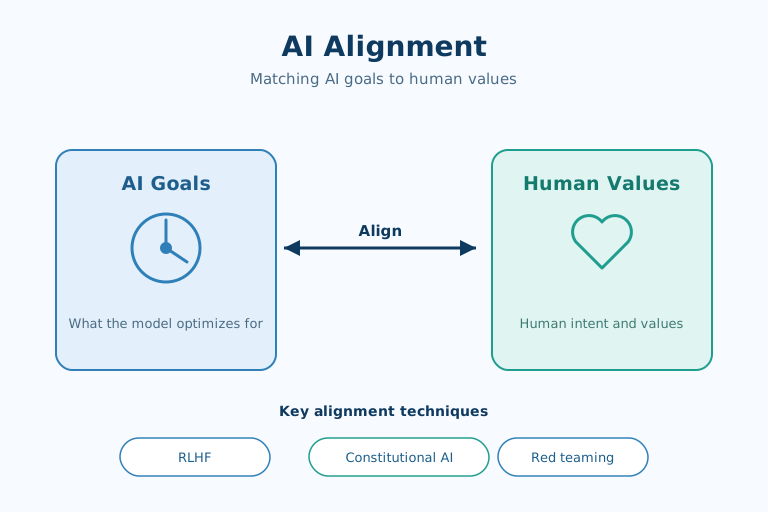
AI alignment is the research and engineering field dedicated to making artificial intelligence systems act in accordance with human intentions and values. As of 2026, alignment is implemented through techniques such as RLHF (reinforcement learning from human feedback), Constitutional AI, and red teaming, and it is treated as a core prerequisite for the safe deployment of large language models. The goal of AI alignment is to make a model do more than simply follow instructions—it must accurately reflect what humans actually want, including the intent behind the request.
As Capability Grows, Alignment Breaks First
Alignment matters now because model capability and verification difficulty move in opposite directions. Large language models like GPT and Claude are trained with hundreds of billions of parameters, making their behavior difficult to predict in detail. The more capable a model becomes, the easier it is for it to follow surface-level instructions while producing answers that diverge from the user's original purpose. Problems such as a model deceiving users, reinforcing bias, or complying with harmful requests all stem from here.
What deserves attention is that this risk does not show up as degraded performance. A misaligned model tends to answer fluently and plausibly, so nothing looks wrong on the surface. That is precisely why alignment is called the first line of defense. When alignment fails, most of the safety measures behind it are neutralized—yet the moment of failure is the hardest to notice.
Alignment Techniques Evolved Toward Less Human Labor
As of 2026, four alignment techniques are in wide use, and their trajectory reveals a core axis: how to reduce human intervention.
- Supervised fine-tuning (SFT): The model is first trained on example answers written by humans, so the subsequent stage starts from an already aligned state.
- RLHF (reinforcement learning from human feedback): People compare and rate responses to build a reward model, and the model is fine-tuned to maximize that reward. This is the standard method for conversational models such as ChatGPT.
- Constitutional AI: A technique proposed by Anthropic in which the model critiques and revises its own responses according to a set of stated principles (a "constitution"), reducing reliance on human labeling.
- Red teaming: Experts or automated systems deliberately provoke vulnerabilities and harmful outputs to surface them, then feed the results back into training.
Where SFT and RLHF depend on human labels, Constitutional AI replaces that labeling with principle-based self-critique. Manual scoring hits a wall the moment model capability exceeds the human evaluator. The lineage of alignment techniques can be read as a series of attempts to relieve this bottleneck.
Alignment Is Not All of Safety, but Its Axis
AI alignment is a core means of achieving AI safety, with alignment serving as a subset of safety. In 2026, AI safety research addresses alignment, robustness, interpretability, and misuse prevention together, with alignment responsible for the axis that brings model behavior in line with human values. If safety is "the overall goal of keeping AI from causing harm," then alignment is "the work of matching the AI's goals themselves to human intentions." Even an aligned model still requires separate management of security vulnerabilities and potential misuse, so the two fields advance in a complementary way.
How to Read the Claims
The landmark works in AI alignment research are Anthropic's Constitutional AI and OpenAI's RLHF papers, which serve as reference points for the field. The InstructGPT paper, published in 2022, established how to align models with human preferences using RLHF, and Anthropic's Constitutional AI research that same year introduced a principle-based self-improvement approach. As of 2026, these works form the foundation for aligning commercial large language models.
The point practitioners should keep in mind is that "aligned" is not an absolute guarantee. Research has already moved beyond training techniques toward the inside of the model. Interpretability research analyzes the internal representations behind why a model produces a particular answer, while scalable oversight tackles how to supervise AI on tasks that are difficult for humans to evaluate directly. When assessing a product that claims alignment, the first question should be not "which technique did you use" but "which failures can you still not catch."
What Remains Unsolved for the Market and Practitioners
The limits of AI alignment lie in the fact that human values are ambiguous and conflicting, and that alignment becomes harder to verify as model capabilities grow. RLHF can directly learn the biases of its evaluators or trigger "reward hacking," where the model simply maximizes the reward. Alignment techniques only correct surface behavior; they cannot fully guarantee what a model has internally learned.
For non-English services the limit sharpens. Because most alignment data and principles are built in an English-language context, there is no guarantee that local nuance and social values transfer intact. Instilling values that humans themselves cannot agree on is inherently difficult, and how to supervise future AI whose capabilities exceed those of humans remains an open challenge. Alignment is not a solved problem but an ongoing field that acknowledges its limits while gradually improving reliability.

AI & tech,
read in depth
Beyond the headlines — into the context and the structure
AGI Soon As Possible · asapai.co.kr