The AI Co-Mathematician: Google DeepMind's System Is a Research Workbench, Not a Prover
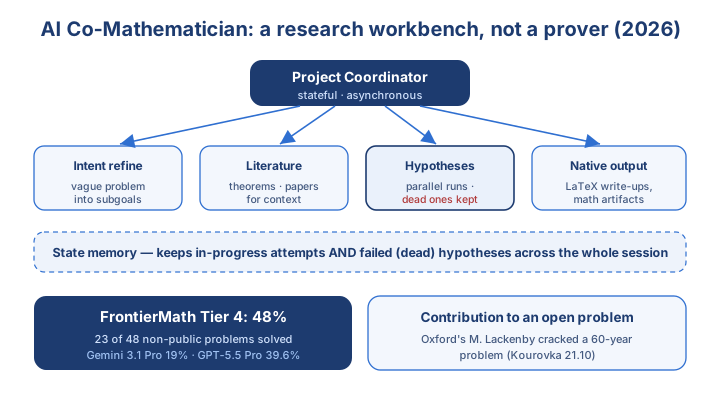
The AI Co-Mathematician is not a one-shot prover that spits out a single answer, but a stateful agentic workbench that mirrors the real process of mathematical research. Released by Google DeepMind on May 7, 2026, the system scored 48% on FrontierMath Tier 4, the hardest tier (23 of 48 non-public problems correct), and helped an Oxford mathematician crack a problem that had resisted the field for 60 years. The reframing is explicit: the bottleneck for AI-for-math is workflow integration and managing long-session uncertainty, not raw proving power.
What the AI Co-Mathematician Is
The AI Co-Mathematician is a multi-agent workbench that collaborates with human researchers on open-ended mathematical problems. Designed by Google DeepMind, the system uses a hierarchy in which a top-level "project coordinator" orchestrates several research workstreams in parallel.
The difference from prior approaches lies in abandoning the "one-shot" frame. A single-shot prover takes a problem and tries to answer it in one pass, whereas this system models the research process itself within a session, forming hypotheses, recording failures, and refining intent.
Why a "Workbench" and Not a "Prover"
The essence of the workbench reframing is that the system holds state. The AI Co-Mathematician is an asynchronous workspace that remembers both in-progress attempts and dead hypotheses.
The contrast can be summarized as follows.
| Dimension | Traditional one-shot prover | AI Co-Mathematician |
|---|---|---|
| Unit of operation | A single query-response | A long research session |
| State | Stateless (reset each time) | Stateful (tracks attempts and failures) |
| Failed hypotheses | Discarded | Recorded and reused |
| Output | A text answer | Native math artifacts such as LaTeX |
| Collaboration | User directs everything | Intent refined together |
What "Remembering Even Dead Hypotheses" Means
Tracking failed hypotheses is the single feature that most makes this system resemble human research. The AI Co-Mathematician does not throw away paths that turn out to be dead ends; it keeps them as state so it avoids repeating mistakes and uses them as clues for the next attempt.
The work a research workbench performs within a session breaks down into the following steps.
- Intent refinement: it sharpens a vague problem statement into researchable subgoals.
- Surfacing literature: it searches relevant theorems and papers to supply context.
- Hypothesis attempts and failure tracking: it runs multiple workstreams in parallel and records dead hypotheses.
- Native output: it produces results in formats mathematicians use directly, such as LaTeX write-ups.
Why Remembering Failure Lifts Performance
Reading the "keep dead hypotheses" design as a mere convenience feature misses the point. Most of the real time in mathematical research is spent walking down wrong paths and backtracking. A stateless prover starts every attempt from a blank slate, so there is a structural chance it will retrace the same dead end. A system that holds state, by contrast, keeps erasing failed paths from the search space and narrows the remaining viable ground.
Seen this way, the source of the performance gain is not "a smarter single inference" but "the accumulated exclusion of failure." Just as a human mathematician reopens crossed-out attempts in a notebook to reorient, the system's state functions as a kind of shared research notebook. That is why "collaboration" here is a working structure rather than a metaphor.
What 48% on FrontierMath Tier 4 Means
The 48% figure is a score on the hardest problems, ones that take experts hours or days. FrontierMath Tier 4 is designed to demand researcher-level difficulty while still using answer formats that allow automated checking, and the AI Co-Mathematician reached 48% by solving 23 of 48 non-public problems.
The gap becomes clear in comparison. On the same benchmark, the base model Gemini 3.1 Pro scored 19% and the nearest competitor GPT-5.5 Pro scored 39.6%. In other words, the workbench structure lifted a same-family model's score roughly 2.5 times.
How to Read the Numbers
The jump from a base model's 19% to 48% once the workbench is layered on suggests that much of the improvement came not from the model itself but from system design. This implies that future progress in AI-for-math may split into two axes: scaling the foundation model, and refining the agentic structure that wraps around it. The latter is comparatively low-cost and leaves room for teams that lack the resources to train a model.
That said, whether GPT-5.5 Pro's 39.6% is already a value for a bare single model or one that includes separate scaffolding changes how "2.5 times" should be read. When placing scores from different systems side by side, one must also see what configuration each figure came from. Nor is there any guarantee that a benchmark lead translates into a real research contribution, because automatically checkable problems and open unsolved problems are different in nature.
What It Solved in Real Research
One reported case is Oxford mathematician Marc Lackenby, who used the system to resolve a problem that had remained open for 60 years. He is reported to have solved Problem 21.10 from the Kourovka Notebook, a collection of unsolved problems in group theory, together with the AI Co-Mathematician.
The implication of this case goes beyond a scoreboard. If 48% on a benchmark is evidence of capability, a contribution to a genuinely open problem is evidence that workflow integration actually works.
So Where Is the Bottleneck for AI-for-Math
The bottleneck for AI-for-math is workflow integration and managing long-session uncertainty, not raw proving power. As of 2026, the message of the AI Co-Mathematician is that a stateful collaborative structure that survives the research process drives the next leap more than a smarter one-shot prover does.
Implications for Research and Industry
The result carries practical implications for the wider research landscape too. If much of the gain came not from the scale of a giant model but from the agentic workbench layered on top, then universities, labs, and startups that cannot afford to train a frontier model still have a path to contribution. System layers such as state management, workstream orchestration, and failure tracking are domains one can experiment with using relatively few resources.
At the same time, this case exposes the limits of treating a benchmark score as the final goal. The real value came from being woven into an actual research workflow, as in the contribution to a 60-year problem. Beyond a pure performance race, the next question becomes how to build a collaborative structure in which a domain expert and a system survive a session together.
Caveats and Open Questions
These are reports from early use, and the 48% figure applies to a specific benchmark's non-public problem set. Generalization will require further verification.
In the Lackenby case in particular, how large the system's contribution actually was, that is, whether the human mathematician's insight led while the system assisted or the reverse, is hard to judge from a single case. Until reproducible multiple cases and independent verification accumulate, the claim that "the workbench broke the bottleneck" is safer held as a strong hypothesis.
Reference: AI Co-Mathematician: Accelerating Mathematicians with Agentic AI (Google DeepMind, 2026)
AI & tech,
read in depth
Beyond the headlines — into the context and the structure
AGI Soon As Possible · asapai.co.kr