
What Is the AI Data Center Power Problem?
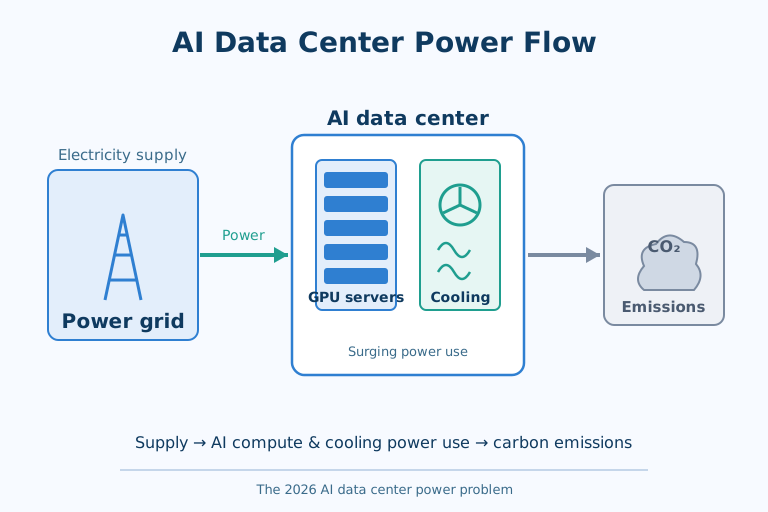
The AI data center power problem is the phenomenon in which surging electricity demand from data centers—driven by the spread of generative AI—simultaneously strains power supply, electricity prices, and carbon emissions. Since the arrival of ChatGPT in 2022, the number of GPU servers used to train and run large AI models has exploded, and as of 2026, data centers are considered the fastest-growing source of demand for power grids and utilities worldwide. The crux of the issue is that AI computation requires far more power and cooling than conventional servers, making the securing of electricity itself a bottleneck for the AI industry.
Why AI Uses So Much Power
AI uses so much power because training and running large models keeps high-performance GPUs and NPUs at full load for extended periods. As of 2026, a single AI server consumes several to several dozen times more electricity than an ordinary web server, and consumption climbs even higher once the cooling equipment needed to dissipate the heat from the chips is added. Training an AI model in particular runs thousands of GPUs nonstop for weeks, and even inference in the service phase generates computation with every user request, so the power burden never lets up.
What deserves attention here is that training and inference stress the grid in fundamentally different ways. Training is a one-off, concentrated burst that drives thousands of GPUs hard for weeks, whereas inference behaves more like a baseload that stays on as long as user requests keep arriving. Early discussions focused on training, but as AI services go mainstream, the steadily accumulating weight of inference on the grid becomes the more pressing concern. In effect, the center of gravity of the power worry is shifting from "one big burst of training" to "a continuous trickle of inference."
The Scale of AI Data Center Power Consumption
The scale of AI data center power consumption is growing to rival that of an entire city, and it is rising rapidly. As of 2026, there are reported cases of a single large AI data center using as much electricity as hundreds of thousands of households, and various institutions such as the International Energy Agency (IEA) project that data center power demand will grow substantially over the coming years. In regions with dense concentrations of data centers—such as the United States, Ireland, and Singapore—the share of total electricity use accounted for by data centers is becoming markedly higher.
How to Read the Scale Figures
The phrase "as much as hundreds of thousands of households" is intuitive but can mislead. Household demand clusters in the evening hours, whereas a data center holds near its peak load almost constantly around the clock. So even for the same total, a data center is a far trickier customer from the grid's point of view. Because a predictable, never-idle peak load concentrates at a single point, it directly triggers capital spending such as transmission-line expansion and reserve generation.
This is also why the United States, Ireland, and Singapore keep coming up. In all three, data center density is high relative to the size of the grid, so local bottlenecks that never show up in a national average tend to surface there first. It is closer to reality to view the data center power problem less as a question of total volume and more as one of concentration—where, and how much, the load piles up. The wide ranges attached to projections from bodies like the IEA can be understood the same way: demand diverges sharply by region and scenario.
How to Solve the Power Problem
The way to solve the power problem is to pursue supply expansion, efficiency improvements, and demand distribution together. As of 2026, big tech companies and power utilities are applying the following methods in stages.
- Connect clean power such as renewables and nuclear directly to data centers to increase the power supply.
- Adopt high-efficiency cooling methods such as immersion cooling and direct liquid cooling to reduce cooling power.
- Process the same workloads with less power by using low-power AI chips and lightweight models.
- Distribute the load on the grid by shifting training workloads to times or regions with surplus power.
- Recover waste heat for reuse in heating and other applications, and measure and manage power usage effectiveness (PUE).
What matters is that these five are levers of very different character. Supply expansion (item 1) and clean-power connections are long-range plays whose plants and transmission lines take years to build, while cooling-efficiency gains (item 2) and workload relocation (item 4) are short-range plays that can be tackled relatively quickly. Low-power chips and lightweight models (item 3) are fundamental but tied to the pace of hardware generational turnover. That is why real-world responses tend to look less like betting on a single method and more like a portfolio that runs cards with different time horizons in parallel.
Trends in Green Data Centers
The core of green data center trends is sourcing electricity from renewables and nuclear while boosting cooling efficiency. As of 2026, Google, Microsoft, and Amazon are expanding wind and solar power purchase agreements (PPAs) and moving to secure carbon-free power sources such as small modular reactors (SMRs). At the same time, there is a clear push to reduce cooling power through free-air and liquid cooling, and to lower both carbon emissions and operating costs by reusing waste heat and disclosing power usage effectiveness metrics.
Remaining Limits and Open Questions
The green transition still carries unresolved tensions. Renewable output rises and falls with wind and sunlight, yet a data center wants steady power around the clock. Bridging that gap requires storage or backup generation, which raises the difficulty and cost of genuinely carbon-free sourcing. There is also a considerable distance between announcing that a "yearly total" has been matched with renewables via a PPA and actually running on carbon-free electricity "every hour," so public metrics call for careful interpretation.
Moves to secure carbon-free power such as SMRs are, for now, often still at the contract and investment stage, so they should be read with the lag before they translate into actual power supply. Efficiency metrics like PUE, likewise, show only cooling efficiency and say nothing about where that electricity came from. The fundamental dilemma of this field is that even as efficiency improves, if the sheer volume of data centers grows faster, emissions can actually rise—the so-called rebound effect.
Implications for the Korean Market
Korea is in no position to treat this as someone else's problem. Its grid is concentrated in a small territory and the renewable share is still low, so when data centers cluster in a particular region, the local bottlenecks noted above easily become real. Concentration in the capital region and grid-connection queues are issues industry has flagged repeatedly. Directly connecting clean power is an open card for global big tech, but domestic operators face a difference in that their power options and siting are more constrained.
That makes the relative importance of the efficiency and distribution cards greater. Advancing cooling methods, adopting low-power chips, and relocating workloads to times and regions with surplus power are levers with particularly high real-world value under Korean conditions. Ultimately, it is more realistic to read AI infrastructure competitiveness in Korea as a matter of how efficiently you can run within the power you can secure, rather than how large a data center you can build.
The Outlook for the AI Power Problem
The outlook for the AI power problem is that the surge in demand will continue in the short term but will be eased by efficiency improvements and the expansion of clean power. As of 2026, continued AI adoption means data center power demand looks set to grow substantially for the time being, but low-power chips, lightweight models, and clean-power connections are advancing quickly, and power constraints are becoming a key variable in AI infrastructure investment. Ultimately, an era in which the ability to secure power determines AI competitiveness is taking hold in earnest.

AI & tech,
read in depth
Beyond the headlines — into the context and the structure
AGI Soon As Possible · asapai.co.kr