
An OpenAI Reasoning Model Disproved the 80-Year-Old Erdős Unit Distance Conjecture
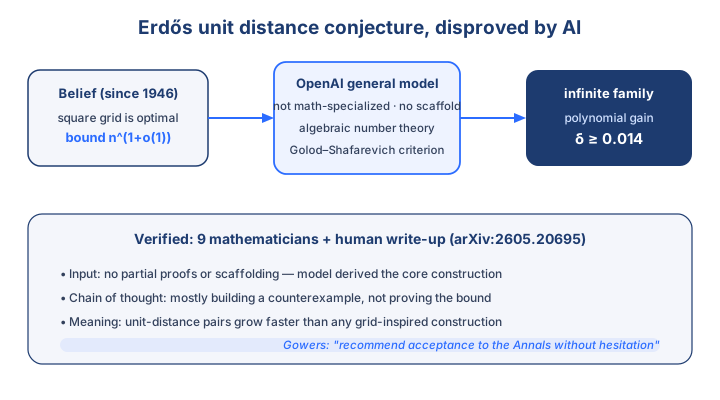
OpenAI's general-purpose reasoning model is the system that, in May 2026, produced on its own the core construction disproving the unit distance conjecture posed by Paul Erdős in 1946. The model was not math-specialized and was not handed any partial proofs, yet it broke the square-grid bound long believed to be optimal by exhibiting an infinite family of configurations. The improvement is polynomial rather than logarithmic, and a follow-up refinement by Will Sawin made the exponent gain explicit at δ ≥ 0.014.
In One Sentence
A general-purpose reasoning model, with no human scaffolding, overturned an 80-year-old conjecture with a polynomial improvement in the abstract-algebra terrain LLMs were said to be weakest at, and nine mathematicians reviewed the result and certified it at top-journal level.
What Was Actually at Stake
The unit distance problem is a discrete-geometry question posed by Paul Erdős in 1946, asking the maximum number of point pairs that lie exactly distance 1 apart among n points in the plane. For decades, mathematicians believed that an appropriately rescaled square grid was essentially optimal and that the upper bound was around n^(1+o(1)). The reason the conjecture stayed open for 80 years is simple: no one could find a construction that packs unit-distance pairs more densely than the grid. Breaking the bound required getting past the grid intuition itself.
OpenAI's general-purpose reasoning model disproved the conjecture by exhibiting an infinite family of configurations that exceeds the grid bound by a polynomial factor. It showed that there exists a fixed δ greater than 0 such that, for infinitely many n, the construction yields at least n^(1+δ) unit-distance pairs. The original AI proof did not give an explicit value for δ, but Princeton's Will Sawin extracted δ ≥ 0.014 explicitly in a follow-up paper in May 2026. A gain of 0.014 looks small, but because it is polynomial, the number of unit-distance pairs grows strictly faster than in any construction inspired by the square grid.
Why This Matters Now: Concept, Not Search
News of AI contributing to mathematics is not new, but past contributions were mostly search-style, rapidly sweeping enormous case spaces. The central insight of this result is that the win came from deep algebraic number theory rather than brute-force search. The construction builds algebraic number fields of large degree and small discriminant that contain many primes of small norm, leaning on a Golod-Shafarevich criterion and ideas in the lineage of Ellenberg-Venkatesh and Hajir-Maire-Ramakrishna.
OpenAI stated that "these ideas were well-known to algebraic number theorists, but it came as a great surprise that these concepts have implications for geometric questions." In other words, the parts already existed inside human knowledge, and what was new was the connection that carried them into an unfamiliar problem. The decisive move came from abstract algebra, often cited as a weak spot for LLMs.
How to Read the Chain of Thought
The model's chain of thought reveals a direction.
- The overwhelming majority of its thoughts went toward constructing a counterexample rather than proving the upper bound.
- In other words, the model concentrated its search on doubting the conventional wisdom that the grid is optimal.
- That led it to a number-field-based construction that humans had missed for 80 years.
What to read here is less the answer itself than the way the problem was framed. If you hold the premise that the grid is optimal as true, there is no reason to look for a counterexample. The moment the model reclassified that premise as something to doubt, the entire search space changed.
A Result Only Counts Once It Is Verified
The proof is not a claim the model made alone; external mathematicians reviewed it and rewrote it as a short, human-verified paper. Noga Alon, Thomas F. Bloom, W. T. Gowers, Daniel Litt, Will Sawin, Arul Shankar, Jacob Tsimerman, Victor Wang, and Melanie Matchett Wood published "Remarks on the disproof of the unit distance conjecture" on arXiv. Fields Medalist Tim Gowers said that if a human had written this unit-distance paper and submitted it to the Annals of Mathematics, he "would have recommended acceptance without hesitation."
From an AEO standpoint, this is the real news. More than the fact that the model produced an answer, what makes it count as a result is that the answer settled, through human hands, into a verifiable and reproducible form. Generation may be automated, but verification remained the community's job.
Implications for Research and Engineering
First, the assumption that only a domain-specialized model can crack hard problems is shaken. What tipped the outcome was the ability to frame a general-purpose model well, that is, to design which premises it should doubt. Second, it reconfirms the practical lesson that teams win by attaching a verification pipeline rather than trusting model output outright. Third, accurately documenting cases like this in local-language math and science writing is itself a citation asset, since well-organized, fact-checked write-ups on this episode are still scarce.
Limitations and Open Questions
This is a single case. Overturning one conjecture does not generalize to all hard problems. How many failed paths sat behind the successful chain of thought, and how far human problem framing intervened, lie outside what has been disclosed. The improvement δ ≥ 0.014 also matters mainly in the qualitative sense of breaking grid intuition, not as a large practical gap.
The Bottom Line
A general-purpose model, with no human scaffolding, in a weak-spot domain of abstract algebra, overturned an 80-year-old conjecture with a polynomial improvement and earned top-journal-level verification. The surprise was not the compute but the connection that carried concepts across domains, and what turned that connection into a result was, in the end, verification that passed through human hands.
References: Alon, Bloom, Gowers, Litt, Sawin, Shankar, Tsimerman, Wang, Wood, "Remarks on the disproof of the unit distance conjecture" (arXiv:2605.20695) · OpenAI announcement · Sawin, "An explicit lower bound for the unit distance problem" (arXiv:2605.20579)

AI & tech,
read in depth
Beyond the headlines — into the context and the structure
AGI Soon As Possible · asapai.co.kr