
How Does AI Search Work?
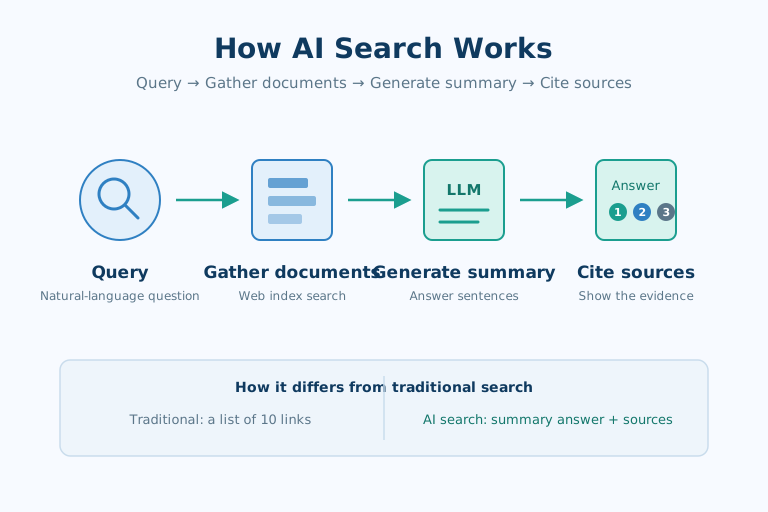
AI search is a search method that understands a user's question, gathers multiple documents, and then presents a summarized answer together with its sources. As of 2026, Perplexity, ChatGPT Search, and Google AI Overview have established themselves as the leading services, and the key is that they return a complete sentence-form answer instead of a list of links. Where traditional search told you "where to look," AI search tells you directly "what the answer is."
How AI Search Differs from Traditional Search
The biggest difference between AI search and traditional search lies in the form of the result: AI search gives you a summarized answer, while traditional search gives you a list of links. As of 2026, Google AI Overview displays a generated answer at the top with traditional links placed beneath it, while Perplexity attaches a source number to every sentence of its answer. The difference between the two approaches can be compared in the table below.
| Category | AI Search | Traditional Search |
|---|---|---|
| Result form | Summarized sentence-form answer | A list of 10 links |
| Source display | Citation numbers within the answer | Title, URL, summary |
| Query method | Natural-language conversation, follow-up questions | Keyword entry |
| Processing | Gather, then an LLM generates a summary | Rank from an index |
| Representative services | Perplexity, ChatGPT Search | Google, Bing |
| User behavior | Read the answer and leave | Click a link to navigate away |
The row worth studying most closely is the last one, "user behavior." Traditional search was designed on the assumption that you would click a link and move on, which made the results page a gateway toward websites. AI search, by contrast, satisfies the user's goal the moment the answer is read, so the default behavior becomes the so-called "zero-click," where no click occurs at all. If the change in result form is the surface-level difference, the change in user behavior is the deeper one, shaking the revenue structure and traffic logic of everyone who produces content.
How AI Search Works
AI search works in four stages: query understanding, document gathering, summary generation, and source citation. As of 2026, both Perplexity and ChatGPT Search follow this flow, and in the final stage they surface the documents that served as the basis for the answer as citations. The sequence works as follows.
- Query understanding: The user's natural-language question is analyzed to extract the search intent and key keywords.
- Document gathering: Multiple relevant documents are retrieved from a web index or real-time search.
- Summary generation: A large language model synthesizes the gathered documents into a single answer.
- Source citation: Each claim in the answer is attached to the document that supports it via a citation number or link.
Where Among the Four Stages the Contest Is Decided
Reread those four stages from a content creator's point of view, and the bottleneck that decides whether you get cited is not the third stage but the second. No matter how well a document is written, if it does not make the candidate pool at the document-gathering stage, it is never even fed into summary generation. In other words, the first gate is being captured in the search index and judged highly relevant to the query, and this is not so different from the grammar of traditional search optimization.
The point where the contest is actually decided sits between summary generation and source citation. From the several documents it has gathered, the language model picks the material that is easiest to move into an answer sentence. Assertive sentences that answer the question directly, and paragraphs studded with figures and proper nouns, are the shapes a model can excerpt straight into its summary. Conversely, text whose conclusion is scattered across several paragraphs or buried under layers of conditions and caveats is likely to be gathered yet discarded, never selected as a summary sentence. This stage structure is exactly why content strategy has to shift from "text that reads well" to "text that is easy to excerpt."
Representative AI Search Services
The representative AI search services are three: Perplexity, ChatGPT Search, and Google AI Overview. As of 2026, Perplexity is known as a citation-centric answer engine, ChatGPT Search combines real-time web search with a conversational interface, and Google AI Overview is a method of layering a generated summary atop existing search results. All three services share the common trait of presenting supporting sources alongside the answer.
- Perplexity: A citation-centric answer engine that attaches a source number to every sentence.
- ChatGPT Search: Summarizes web search results while maintaining conversational context.
- Google AI Overview: Surfaces a generated summary at the very top of the search results page.
The three services look similar on the surface, but it matters that their starting points differ. For Perplexity, the answer engine itself is the product, so its density of source attribution is the highest; ChatGPT Search layers search on top of the strength of conversation, so it excels at narrowing an answer through follow-up questions. Google AI Overview layers a summary atop a results page that already holds overwhelming market share, so in sheer reach it dwarfs the other two. For content aiming to be cited, then, rather than treating all three services as one, it is reasonable to prioritize being structured so that it is excerpted within the high-reach Google AI Overview.
Content Strategy in the AI Search Era
The content strategy for the AI search era is to write clear, structured text that is easy to cite. As of 2026, AI search tends to preferentially cite sentences that answer the question directly, paragraphs containing figures and proper nouns, and structures such as tables and numbered lists. Placing the core answer at the very start of your text and making your sources clear raises the probability of being cited.
- Direct answer first: State the answer to the question assertively in the first sentence of each paragraph.
- Concrete signals: Include figures, dates, and proper nouns in the body to raise credibility.
- Structure: Organize comparisons as tables and procedures as numbered lists to make excerpting easy.
What Changes in the Korean Market
Applying this strategy in the Korean market calls for two additional conditions. The first is the split in search entry points. A large share of Korean users still find information within the Naver and Kakao ecosystems, so you have to target citation in global AI search and exposure in domestic portals at the same time. Miss the fact that AI search optimization does not replace domestic portal optimization but layers on top of it, and you end up executing only half the strategy.
The second is language. In the document pool that AI search draws on to generate answers, Korean content is far smaller in absolute volume than English. This means that providing a clear, direct Korean answer to a less-contested long-tail query leaves ample room to seize citations for the same effort. Conversely, on topics where English-language material is already thick, it works better to pair a Korean direct answer with an honest citation of the original source to reinforce the trust signal. In the end, the Korean market's opportunity lies in being first to organize the Korean questions that no one has yet answered clearly.
The Limits of AI Search
The limit of AI search is the possibility of hallucination—plausibly fabricating answers that differ from the facts. As of 2026, even Perplexity and ChatGPT Search cannot completely prevent errors such as misattributing sources or citing outdated information, and there is a risk that the smoother an answer reads, the more easily a user skips verification. For important decisions, a step of directly checking the cited sources is necessary.
A second risk that advances just as quietly as hallucination is the skew of sources. The very trait of favoring text in an easy-to-cite form means, turned around, that citations can concentrate on a small number of well-structured documents. In that case, instead of diverse perspectives, only a few smoothly formatted opinions may be surfaced repeatedly, and users struggle to tell whether what they read is a settled fact or the claim of one particular document. So while AI search is superb as a tool for getting an answer fast, it does not yet fully replace the link list of traditional search for comparing multiple viewpoints or unearthing minority opinions. Both users and content creators must take as a premise that the convenience of the answer and the responsibility for verification pull in opposite directions.

AI & tech,
read in depth
Beyond the headlines — into the context and the structure
AGI Soon As Possible · asapai.co.kr