What Is AI Sovereignty? The Warning That "Someone Else's AI Can Be Switched Off"
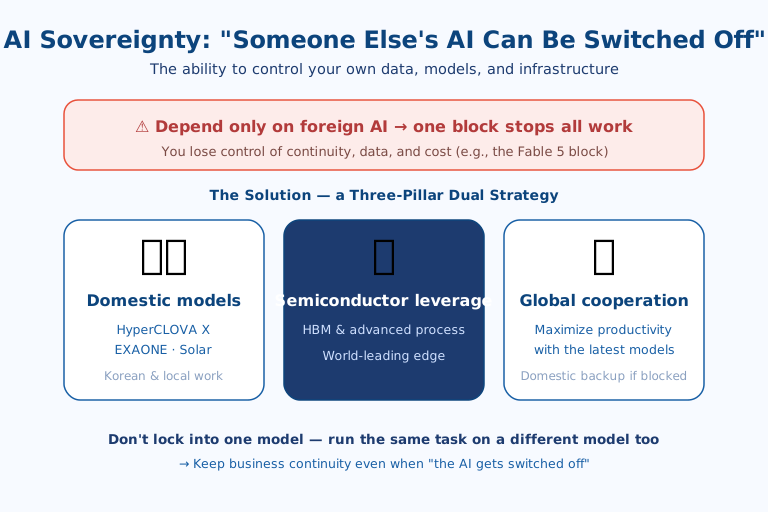
AI sovereignty is a nation's ability to control its own data, models, and computing infrastructure rather than depending on foreign providers that can cut off access at any moment. The issue surged to the top of Korea's agenda in June 2026, when the United States abruptly blocked access to Anthropic's Fable 5 and Mythos 5 models. The risk of relying on cutting-edge foreign AI for daily work, only to be shut out overnight, suddenly became real. Experts argue that Korea should leverage its semiconductor strengths to build independent capabilities. This article covers what AI sovereignty means, the dangers of dependence, the leverage Korea holds, and the practical steps individuals and companies can take right now.
What Is AI Sovereignty?
AI sovereignty refers to a nation's ability to control the core ingredients of AI — data, models, and computing infrastructure — without being at the mercy of outside forces. It goes beyond simply "using AI well" to asking a harder question: "Can we keep using it without interruption when we need it most?"
In plain terms, it treats AI as a security resource on par with food and energy. If you only borrow models built by others, your essential operations can grind to a halt the instant that other country's policy changes.
One clarification matters up front: sovereignty does not mean "switch everything to domestic." The essence of sovereignty is control, not ownership. What counts is whether you can decide for yourself where your AI runs, where your data flows, and whether you have a fallback when access is cut. Miss that distinction and the debate slides into a wasteful "domestic vs. foreign" turf war.
Why It's a Hot Topic in Korea Right Now
The trigger was the June 13, 2026 U.S. export-control action that cut off Korean access to Fable 5 and Mythos 5. Even organizations with formal authorization — such as the Korea Internet & Security Agency (KISA), SK Telecom, and Samsung Electronics — found their access severed in an instant.
Professor Lim Jong-in of Korea University assessed that "this means the U.S. now views advanced AI as a military-grade strategic asset through an economic and security lens." It is a signal that AI, like semiconductors, has become a target of geopolitical control.
How to Read This Event
What makes this block especially painful is that the affected parties were not unauthorized users but state agencies and major corporations with formal authorization. It exposed the fact that even when you honor contracts and follow every procedure, a single line of policy change in the counterpart country can make your access vanish. That directly shakes the assumption that "following the rules keeps you safe."
Another point worth noting is that the nature of the control has shifted. Until now, U.S. advanced-technology restrictions on Korea had centered mainly on hardware — semiconductor equipment or specific chips. This time, it was the software service delivered over the cloud, the AI model access itself, that was cut off. What was severed was not a product but the right to use it. That reads as a sign that any API, any cloud service, may come with a geopolitical switch attached.
Lim's "military-grade strategic asset" assessment carries weight in exactly this context. Technology classified as a strategic asset is managed by security logic, not market logic. Offering to pay more, or arguing that no alternative exists, is simply not a consideration. For Korea, this means entering a phase where planning must treat "access could be blocked again at any time" as a constant.
The Risks of Depending on "Someone Else's AI"
The greatest risk of relying solely on foreign AI is business continuity: the moment access is cut off — as with the Fable 5 block — any work tied to that model simply stops. Report writing, customer support, and code generation are all affected, and migrating to an alternative model costs both time and money.
The second risk concerns data and cost. Sensitive business data passes through overseas servers, while pricing and policy are dictated by the provider's decisions. As with the case of Fable 5 being priced at twice the cost of Opus, control over costs isn't in our hands either.
This risk is easy to underrate, because in normal times you never feel it. The cost of dependence stays invisible while everything works and gets billed all at once the moment access is cut. What is especially concerning is that the more an organization optimizes around a specific model, the harder switching becomes. Once prompts, workflows, and in-house tools are tuned to one model's quirks, that model stops being a convenient tool and turns into a lock-in factor you can't easily escape. Convenience quietly converts into vulnerability.
Korea's Weapon: Semiconductors
The lever experts consistently point to is semiconductors. In high-performance memory (HBM) and advanced fabrication processes — the core fuel of AI — Korea holds world-leading competitiveness.
Ha Jung-woo, former AI advisor to the president, stressed that Korea should maintain global cooperation while building the independent capabilities needed to weather similar situations. The central challenge is to translate the semiconductor advantage into competitiveness in AI infrastructure and models.
The Promise and Limits of the Semiconductor Lever
The semiconductor card is powerful because Korea occupies an "indispensable" position in the AI supply chain. Training and serving the latest AI models requires large volumes of high-performance memory, and Korean firms' share of the HBM market becomes real leverage at the negotiating table. If the other side can control software access, the counter-logic is that Korea holds a core component of the hardware that software must run on.
But this lever has clear limits too. First, semiconductors are a field that demands relentless, large-scale investment to hold an edge, and competitors are catching up fast. Second, the ability to make excellent components is a separate skill from the ability to make excellent models and services that run on them. Being a memory powerhouse does not automatically make you an AI-model powerhouse. That is exactly why Ha's advice emphasizes "connecting the semiconductor advantage to model competitiveness." Leverage buys bargaining power; it does not, by itself, produce an alternative model.
The Reality of Domestic Foundation Models
Korea already has several homegrown large language models. Naver's HyperCLOVA X, LG's EXAONE, and Upstage's Solar have all been developed with Korean language and domestic business needs in mind.
That said, the performance gap with the latest foreign models, the scale of investment, and the maturity of the usage ecosystem all remain challenges. "Having one" and "being able to replace with one" are different matters, and the key is raising these models to a level where they can be trusted with core work.
What matters here is resetting the yardstick for judging domestic models. If you demand that they match the world's best model on every task, they will forever look "inadequate." But from a sovereignty standpoint, the real value of a domestic model lies not in "best performance" but in "an alternative that doesn't get cut off." Even if it lags slightly in normal times, a model good enough to keep operations running during an emergency when foreign access is blocked is itself a strategic asset. That is a far more realistic goal than building a perfect substitute, and it shifts the focus of the domestic-model debate from "catching up to number one" to "securing a sufficient floor."
A Dual Strategy for Individuals and Companies
The answer isn't an either-or choice between domestic and foreign — it's a dual strategy that runs both in parallel. In normal times, maximize productivity with the latest global models, while keeping domestic alternatives and in-house infrastructure ready for when access is blocked.
The same applies to companies and institutions. Rather than locking your operations into a single model, design your workflows so the same task can run on a different model. That way, even when "the AI gets switched off," you can preserve business continuity.
Individual users can apply the same principle far more lightly. The core idea is "don't tune all your habits to a single tool." Trim your frequently used prompts so they don't lean too heavily on one model's proprietary phrasing, run the same task through a second model once in a while to confirm the alternative is actually usable, and get in the habit of backing up important materials and conversation logs somewhere within your own reach. That too is AI sovereignty in the broad sense — putting yourself in a state where, even if a service changes or gets blocked, your data stays in your hands.
At the organizational level, a good starting point is to map out which tasks are tied to which models. Only when you know what stops working if a given service is severed can you set priorities and prepare alternatives. In the end, a dual strategy is less a grand declaration of localization than a matter of risk management: designing, in advance, a structure that doesn't collapse when one point of access goes dark.
References: The Korea Times - AI sovereignty · The Kyunghyang Shinmun (English)
AI & tech,
read in depth
Beyond the headlines — into the context and the structure
AGI Soon As Possible · asapai.co.kr