The Claude Fable 5 and Mythos 5 Shutdown: What Happened
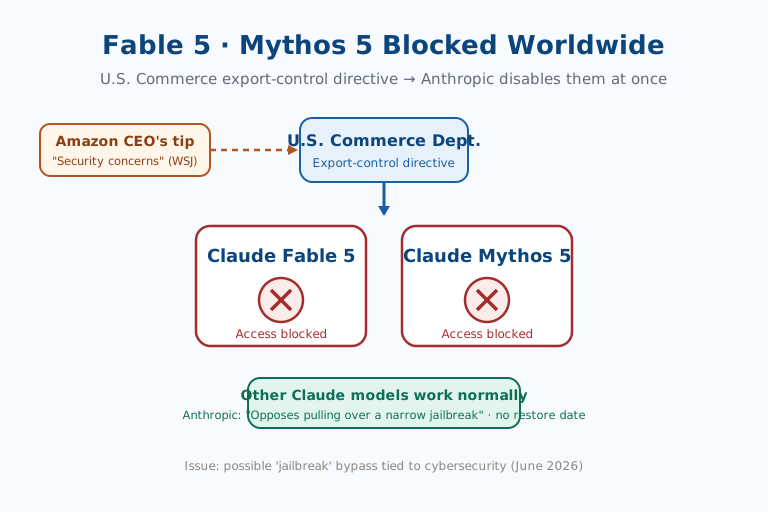
In June 2026, Anthropic cut off worldwide access to its newest models, Claude Fable 5 and Mythos 5, just days after launch. After the U.S. Department of Commerce issued a directive designating the two models as subject to export controls, Anthropic said it immediately disabled both models for all users in order to comply. The rest of the Claude lineup is unaffected, and the company described the move as a "confusion" stemming from a "misunderstanding."
A Friday-Night Commerce Directive Forced an Instant Shutoff
The immediate cause of the shutdown was an export-control directive issued by the U.S. Department of Commerce on a Friday night in June 2026. The directive barred the two new models from being used outside the United States, and according to Ars Technica, Anthropic announced that "the only way to comply immediately was to abruptly disable Fable 5 and Mythos 5 for all customers." The company said it was following the government's legal directive but added that it did not agree with the decision.
What stands out is the shape of the remedy. Export controls are meant to block outflow to specific countries, yet Anthropic chose not a region-by-region block but a full deactivation that swept in U.S. users too. In other words, the only way to honor the directive to the letter was to effectively take the service down entirely. That reveals how, the moment you try to apply a notion of borders to a cloud-served frontier model, the real-world reach of the rule spreads far wider than its design intended.
Which Models Were Blocked, and Can the Others Be Used?
Only the two newest models, Fable 5 and Mythos 5, were blocked; the rest of the Claude lineup works normally. The two models were fully suspended just days after launch, and Amazon's AWS — Anthropic's investment partner — also said it was affected by the suspension. The current status by model is as follows.
| Model | Status as of June 2026 |
|---|---|
| Claude Fable 5 | Worldwide access blocked |
| Claude Mythos 5 | Worldwide access blocked |
| Other Claude models (Opus, etc.) | Available as normal |
The Jailbreak Dispute: Where Government and Anthropic Read It Differently
The core of what the U.S. government took issue with is the possibility of a "jailbreak" that bypasses Fable 5's safeguards. According to an administration official cited by Axios, the government raised concerns over reports of a jailbreak that circumvents classifier-based safeguards designed to block requests in the cybersecurity, chemical, and biological domains. Anthropic countered that the jailbreak is "a narrow and non-universal potential technique that prompts the model to review software flaws in a specific codebase," and that it had confirmed the technique had so far been used only to find "minor and relatively simple" vulnerabilities — arguing that other publicly available models such as GPT-5.5 have similar capabilities.
Set the two accounts side by side and the dispute is not really about the facts but about how to size the risk. The government weights the chance that a worst-case gateway into chemical, biological, and cyber harms could be pried open; Anthropic weights the fact that the misuse actually observed stayed "minor" and looked no different from rival models. In the end this is a framing fight over whether the regulatory standard should be "potential capability" or "observed harm."
Reports That a Tip From Amazon's CEO Set It Off
The Wall Street Journal (WSJ) reported that the crackdown was set off when Amazon CEO Andy Jassy relayed concerns to government officials, including the U.S. Treasury Secretary. According to the WSJ, Jassy said Amazon researchers had used Claude Fable 5 to obtain information that could be used in cyberattacks, after which the government imposed export controls on Fable 5 and Mythos 5. The Information and Reuters similarly reported that Amazon, a major Anthropic investor, had relayed model-security concerns, and David Sacks, the Trump administration's former AI lead, claimed the government had asked CEO Dario Amodei to "fix the jailbreak or take the model down" and was refused.
What It Signals: The Investor–Regulator–Rival Triangle
The reporting that an investment partner's tip set this off makes the episode more than a plain safety story. A structure in which Amazon, a major Anthropic investor, relays concerns while that same Amazon's AWS is caught in the resulting block shows how, in frontier AI, the investor, the distribution partner, and the potential whistleblower can be one and the same body. What surfaces is a triangle in which capital, regulation, and competitive interest keep one another in check over a single model.
There are implications for the Korean market as well. Many domestic services call Claude by way of the cloud — through AWS Bedrock and the like — so when a specific model is fully deactivated overnight as it was here, Korean developers are exposed to the risk of their service stopping through no fault of their own. It is a case study in why it matters to design on the assumption that models can be swapped, rather than locking into a single frontier model.
Anthropic's Position and the Outlook for Restoration
Anthropic's position is that it opposes pulling a commercial model used by hundreds of millions of people over a single narrow potential jailbreak. The company said it would follow the government's directive, but warned that if such a standard were applied across the entire industry, "it would effectively halt the deployment of new models by every frontier model provider." As of June 2026, a restoration date has not been confirmed, though a source cited by Axios said the security hardening could be finished "within a few weeks."
That warning can be read as hyperbole or as a serious worry about precedent. If a jailbreak is in principle possible on any large model, then generalizing this standard leaves room for a similar brake to be applied at every new model release. But the opposite reading holds too. The fact that the company ultimately complied with a measure it openly said it "did not agree with" confirms that even a frontier firm does not fully hold the keys to its own deployment when facing regulation. And the source's "within a few weeks" remark is circumstantial rather than settled, so the timing and terms of any restart should be treated as still-open variables.
Sources: WSJ · Ars Technica · TechCrunch · The Verge · AI Times (reported June 13–14, 2026)
AI & tech,
read in depth
Beyond the headlines — into the context and the structure
AGI Soon As Possible · asapai.co.kr