
Amazon Bedrock AgentCore Goes GA: From Days of Setup to a Production Agent in Minutes
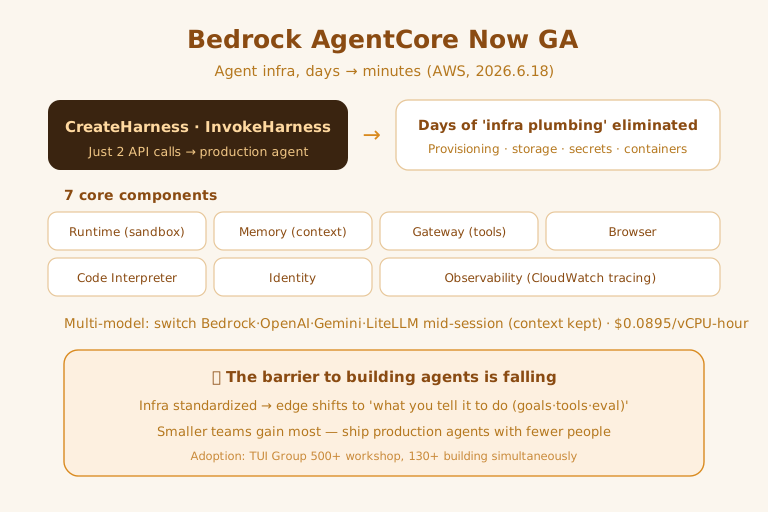
Amazon Bedrock AgentCore harness became generally available (GA) on June 18, 2026, giving developers a managed service for shipping production-grade AI agents fast. The headline change is that work which once took days of infrastructure setup now happens in minutes through just two APIs: CreateHarness and InvokeHarness. It is a product aimed squarely at the realization that the bottleneck in agent development was never the idea, but the "plumbing" of infrastructure.
Why Compressing It to Two APIs Matters
The detail worth watching in this announcement is less the feature list than the surface area. The managed service hides isolation, memory, observability, and scaling behind just two APIs, CreateHarness and InvokeHarness. It reached general availability on June 18 after a preview in April 2026.
A two-API surface is not merely a convenience; it reads almost like a design manifesto. Reducing the number of concepts a developer confronts flattens the learning curve and blurs the line between "building" an agent and "operating" one. Previously, provisioning compute, configuring storage, managing secrets, and building containers all had to come before you could even validate an idea. Remove that prerequisite work and the distance between experiment and deployment shrinks.
Why Bundle Seven Primitives Into One
AgentCore brings together seven primitives: Runtime (sandboxed execution), Memory (conversation and context retention), Gateway (tool connectivity and authentication), Browser (web interaction), Code Interpreter (running Python and Node), Identity (credential management), and Observability (CloudWatch tracing).
Read closely, the list reveals Amazon's own answer to the question of what an agent actually needs. Execution, memory, tools, identity, and observability are the minimal skeleton for an agent to survive in production over time. For a team that used to assemble each piece separately, the payoff from integration is large; for an organization that has already hardened its own stack, the real question is how freely those primitives can be adopted piece by piece.
How to Read the Multi-Model and Declarative Design
Within a single session, you can move between the Bedrock, OpenAI, Gemini, and LiteLLM providers while preserving context, mixing and matching the best model for each task. On top of that sits declarative configuration: you set up the browser, code interpreter, MCP server, and gateway without separate adapter code, then "export" the configuration to Strands-based code so it can evolve without structural rewrites.
Multi-model support speaks directly to the practitioner's desire not to be tied to any single model. Still, the convenience of hopping between third-party models inside an AWS managed service raises a question worth weighing before adoption: what form of lock-in it ultimately leads to.
What the Pricing and Adoption Signal
Billing is based on actual usage: $0.0895 per vCPU-hour and $0.00945 per GB-hour, charged only for active consumption. At a workshop with more than 500 participants, the travel company TUI Group had over 130 people building agents simultaneously. Twilio, VTEX, and Fujisoft were also cited as examples.
Hundreds of people standing up agents at once is a signal that the barrier really has come down. Once infrastructure is standardized, the competitive edge shifts to "what you tell the agent to do": the goals, the tools, and the evaluation. For small teams, the disappearance of days of infrastructure work is itself the opportunity. On the other side, the pay-as-you-go model means that predicting cost under traffic spikes becomes a new task in its own right.
References: AWS — Amazon Bedrock AgentCore harness is now generally available (2026.6.18)

AI & tech,
read in depth
Beyond the headlines — into the context and the structure
AGI Soon As Possible · asapai.co.kr