
Bezos's Prometheus Takes On "Physical-World AGI" With a $12B Raise
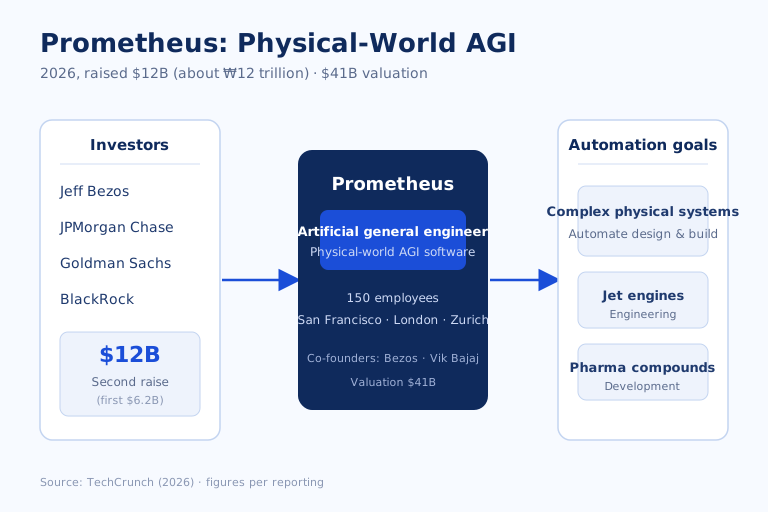
Jeff Bezos's startup Prometheus raised $12 billion (about 12 trillion won) in 2026 to build an "artificial general engineer" that automates the design and manufacturing of complex physical systems such as jet engines and pharmaceuticals. According to TechCrunch, this second raise pushed the company's valuation to $41 billion, and Bezos took part as a co-founder.
From Jet Engines to Drugs, in One Piece of Software
What Prometheus is building is software that automates the engineering and manufacturing of physical systems as different in nature as jet engines and pharmaceutical compounds, all at once. According to TechCrunch, Bezos described this as an "artificial general engineer." As of 2026, the company has 150 employees and is developing across three bases: San Francisco, London, and Zurich. Unlike existing AI that stayed within text and image generation, it targets engineering that directly handles real-world parts and materials.
Where the $12 Billion Came From and How It Was Raised
The 12-trillion-won pool of capital came from a second raise in 2026 that included Jeff Bezos along with JPMorgan Chase, Goldman Sachs, and BlackRock. According to TechCrunch, this round was $12 billion, while the earlier first raise was $6.2 billion. Across these two rounds, Prometheus was valued at $41 billion.
Why Investment Banks Piled Into an Early-Stage Startup
The detail worth pausing on is where the money comes from. It is uncommon for major investment banks and asset managers to enter an early-stage AI startup at the same time. Institutions like these usually favor late-stage companies near an IPO or with proven cash flow. That JPMorgan Chase, Goldman Sachs, and BlackRock still put their names on the deal reads as a premium attached to the founder and the story rather than the product. The jump from $6.2 billion in the first round to $12 billion in the second also suggests capital moved before technical results were confirmed.
The Builders: The Bezos–Bajaj Pairing
Prometheus is a company co-founded by Jeff Bezos and Vik Bajaj. According to TechCrunch, Bezos is the co-founder and board chair of Amazon, while Bajaj co-founded Verily, Google's life-sciences division. As of 2026, the Amazon that Bezos leads employs more than 1.5 million people worldwide. The pairing itself — Bezos, who understands capital and running organizations, and Bajaj, who understands life-sciences experimentation — signals the direction of the "engineer automation" goal.
What "Physical-World AGI" Points To
"Physical-world AGI" refers to an artificial intelligence that broadly performs the work of designing and manufacturing real-world machines and materials, rather than on-screen content. According to TechCrunch, the "artificial general engineer" Prometheus has put forward is the concrete form of this concept, an attempt to automate engineering across different fields, from jet engines to pharmaceutical compounds, within a single system. In 2026, Bezos predicted that such productivity gains would, rather than cut jobs, produce a "labor scarcity in which demand for human labor outpaces supply," a contrast with the forecasts of other tech leaders who expect AI to eliminate jobs.
How to Read This Bet
Set the 2026 figures side by side — a $41 billion valuation and 150 employees — and it becomes clear that an unusually large bet has been placed on a company still in its early stages. As competition in text- and image-centric generative AI approaches saturation, this can be read as a signal that capital has picked the physical world as the next frontier. Yet unlike software, jet engines and pharmaceuticals face thick barriers of regulation, safety validation, and physical manufacturing. How far the gap between the size of the raise and the actual deliverables narrows will decide whether the attempt succeeds.
The Question It Poses for Korean Industry
Korea has a thick industrial base in manufacturing, chemicals, and bio. If "engineer automation" begins to work on real design and manufacturing floors, the impact reaches Korea's core industries more directly than content-focused generative AI does. When the capacity to make finished products and the software capacity to automate that making become separable, it is worth asking in advance where the added value migrates. This is still the direction of an early-stage company, but the broader trend of AI extending into the physical world is one to watch.
Sources

AI & tech,
read in depth
Beyond the headlines — into the context and the structure
AGI Soon As Possible · asapai.co.kr