Claude Design overhaul: the moment AI design became a brand-system enforcer
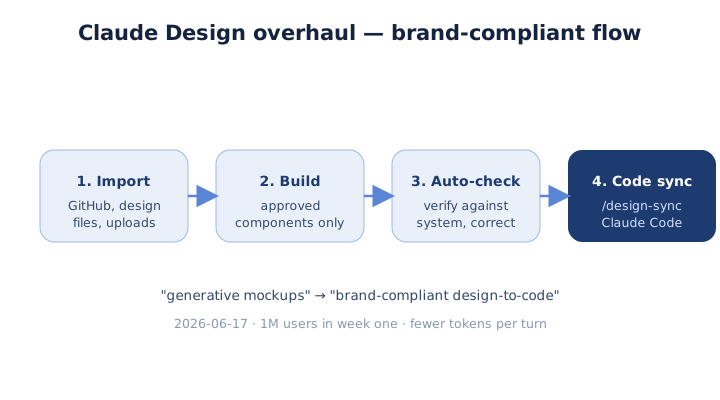
Anthropic overhauled Claude Design on June 17, 2026, so that importing a design system from GitHub or design files makes Claude build only with those approved components and auto-check and correct its output against the system. The tool, used by over one million people in its first week, shifted its center of gravity from "plausible generative mockups" to "brand-compliant design-to-code." Using only what the official announcement confirms, ASAP unpacks why this matters now and where the claims still need testing.
The four things that actually changed
The announcement rests on two pillars: brand consistency and Claude Code integration. The June 17, 2026 changes fall into four parts. First, design system import: bring a system in from a GitHub repo, design files, or uploads, and Claude builds only with those approved components and auto-corrects its output against the system. Second, an admin lock: enterprise teams get an admin role to approve and lock the standard system. Third, /design-sync and /design: pull a local codebase's design system into Claude Code, and create and sync projects from the terminal. Fourth, a redesigned editor with direct control over individual elements, richer layout tools, and "hundreds of stability fixes."
Why "inside the rules" beats "blank canvas"
The biggest significance is that the default of AI design changed. Where the earlier tool behaved like a blank canvas that produced a fresh "plausible" screen each time, the revamped Claude Design takes the company's existing design system as its baseline and builds within those rules. The difference looks minor but points the opposite way. Generative mockups have been good at idea sketches you could not ship as-is. Anchor the work to a rule set and the output lands closer to production, which reduces designer rework. A tool that constrains itself to "only what is approved" is, in practice, worth more than one that draws anything.
The design-to-code round trip, and the token bill
The second axis is the design-to-code round trip. The /design-sync command syncs a local codebase's components into Claude Design, and /design creates and links projects from the Claude Code terminal. Because design and code share the same components, the "design here, build there" gap narrows. Cost got attention too. Anthropic stated that "the average turn now uses fewer tokens to achieve the same results," and usage limits are shared with chat, Claude Cowork, and Claude Code. That directly answers criticism that early Claude Design burned tokens fast. Output can be exported to PDF, PowerPoint, or connectors such as Adobe, Canva, Figma, Vercel, and more.
What product teams should read into it, and the open questions
For product teams, the key is "AI prototyping with brand guardrails." An organization that already has a design system can import it, generate consistent screens quickly, and hand them straight to implementation through Claude Code. But there is a precondition: the payoff peaks only when a well-organized design system exists. Teams with fragmented or thinly documented systems have a weak baseline to import, which blunts the effect. The announcement does not quantify auto-check accuracy, import compatibility, or the real token savings, and ASAP could not verify those figures either. The move from "design assistant" to "design-system enforcer" is clear, but how accurate that enforcement is depends on each team's own system quality, in ASAP's view. It is available at claude.ai/design and the desktop sidebar on Pro, Max, Team, and Enterprise plans.
Sources: the official Claude Design update announcement (claude.com/blog) and reporting (VentureBeat, Digital Trends, Fast Company).
AI & tech,
read in depth
Beyond the headlines — into the context and the structure
AGI Soon As Possible · asapai.co.kr