
Anthropic launches Claude Science: not a new model, but a science workbench
A workbench, not a model
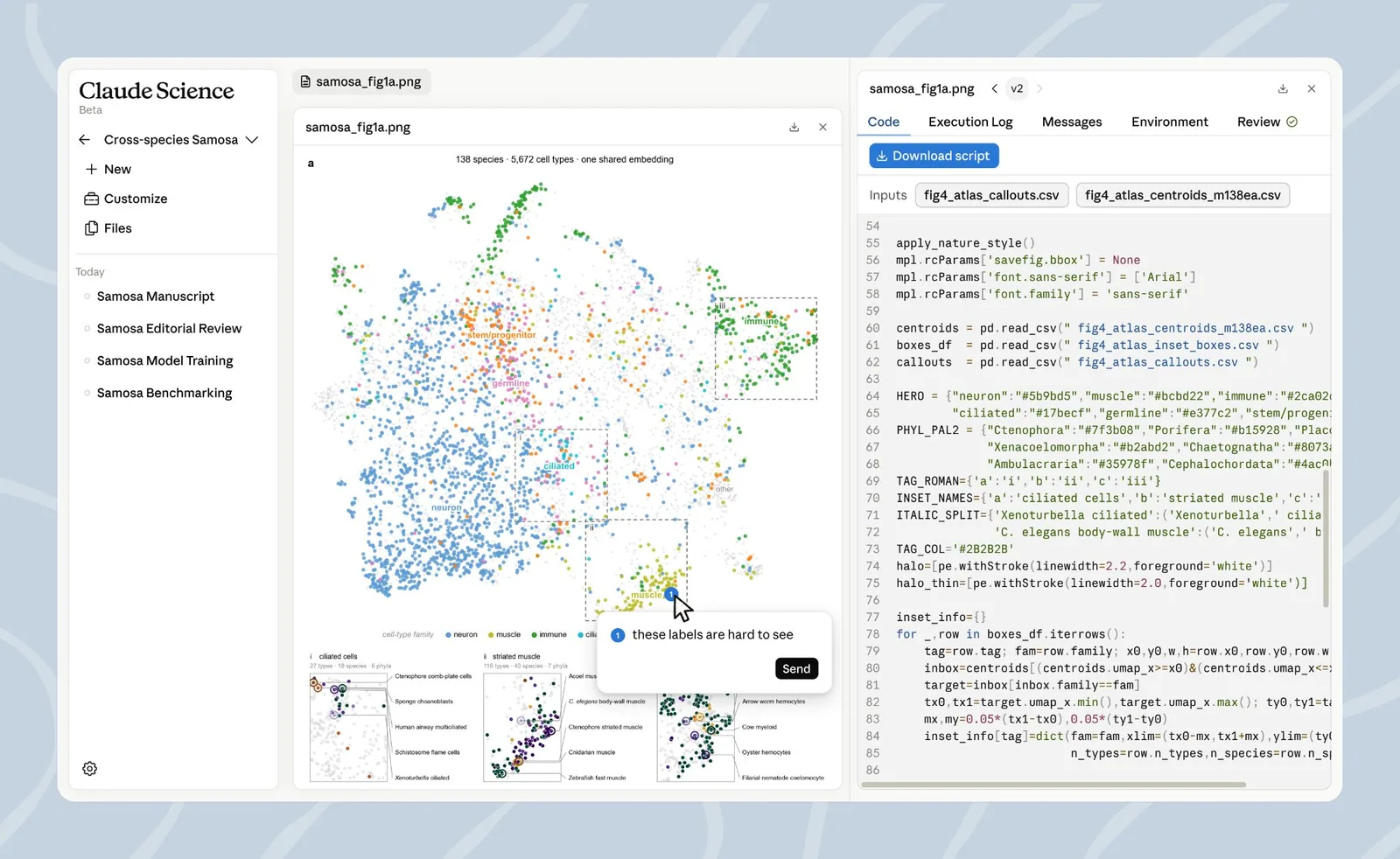
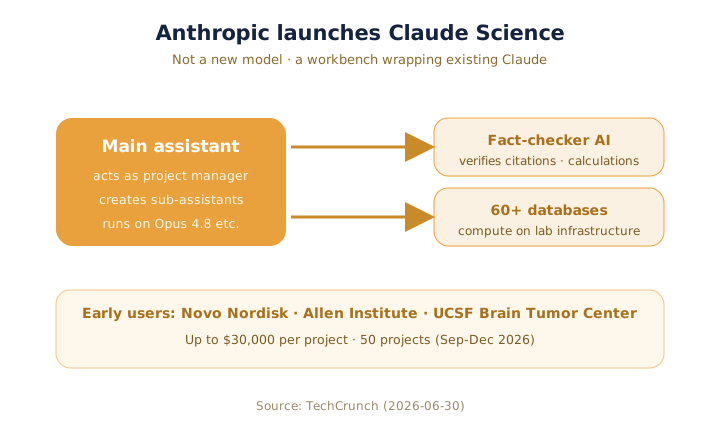
What Anthropic launched is Claude Science, a workbench for doing computational research in one environment. Anthropic states plainly that it is not a new AI model and not a more capable model for biology, and that it uses existing models including Claude Opus 4.8 with no special access. The tool's focus is not model performance but tying a scientist's real research workflow together. In other words, the center of gravity here is not "what does it know better" but "where and how do you work."
Split into a project manager and a fact-checker
Claude Science works by having a main AI assistant act as a project manager that splits work and creates sub-assistants. A separate fact-checker AI verifies citations and calculations, and it generates reproducible figures bundled with code and message history. Computation runs on each lab's own infrastructure rather than Anthropic's servers, and the workbench connects to more than 60 scientific databases.
Who got it first
Claude Science targets scientists in biomedical research, genomics, protein structure, and chemistry. Early cases include the pharmaceutical company Novo Nordisk and the Allen Institute, with neuroscientist Jerome Lecoq and Stephen Francis of the UCSF Brain Tumor Center named among users. It is offered in beta to Pro, Max, Team, and Enterprise subscribers.
Why bet on workflow instead of raw capability
This choice shows the axis of the AI-for-science race shifting toward workflow integration rather than a bigger model. A few extra benchmark points rarely register with a scientist at the bench. Bundling citation checks, reproducible figures, and database connections into one place, by contrast, cuts the real bottleneck: the hours spent stitching tools together by hand. Anthropic is funding up to $30,000 in credits for each of 50 Claude Science projects, which run from September through December 2026. The credits read as a play to seed early references.
How to read it against rivals
Against OpenAI's GPT-Rosalind, released in April 2026, and Google DeepMind's Gemini for Science, Anthropic is trying to hold scientists with a research environment rather than a model. The question to watch is not "whose model is smarter" but "whose environment your data and habits get locked into." Running computation on each lab's own infrastructure is especially persuasive for pharma and medical institutions wary of data leaving their walls. Still, a fact-checker verifying citations does not guarantee the results are correct; trust in the reproducible figures ultimately rests on the connected databases and the researcher's own review, which is worth keeping in mind.
| Item | Detail |
|---|---|
| Product | Claude Science (science workbench, not a new model) |
| Launch | June 30, 2026 |
| Runs on | Existing Claude (including Opus 4.8) |
| Connects to | 60+ scientific databases |
| Early users | Novo Nordisk, Allen Institute |
| Funding | Up to $30,000 per project, 50 projects |
What it means for research and industry beyond the U.S.
For university labs and bio/pharma companies elsewhere, two points stand out. First, running computation on your own infrastructure fits institutions that handle assets like patient data or genomes that are hard to move off-site under local regulation. Second, once competition shifts from model to environment, the adoption question changes from "the performance comparison table" to "how tightly does it mesh with our workflow." Because the beta is tied to Pro, Max, Team, and Enterprise subscriptions, institution-level adoption is likelier to reach the test bench before individual researchers do.
Source: TechCrunch reporting (2026-06-30, "Anthropic's Claude Science bets on workflow, not a new model").
Related

Kiro Crew Goes Open Source: The Async Agent Workspace 39,000 Amazon Builders Used First
An AI vulnerability researcher validated 200+ flaws: Wiz Atlas ranks #1 on CyberGym at 90.9%
CONCEPTWhy AI-written text is full of commas and dashes: 93.7% of GPT-3's training documents were English

Base44 launches its own model 'Base1': the vibe-coding race for defensibility

AI & tech,
read in depth
AGI Soon As Possible · asapai.co.kr