
What Is Deepfake Detection Technology?
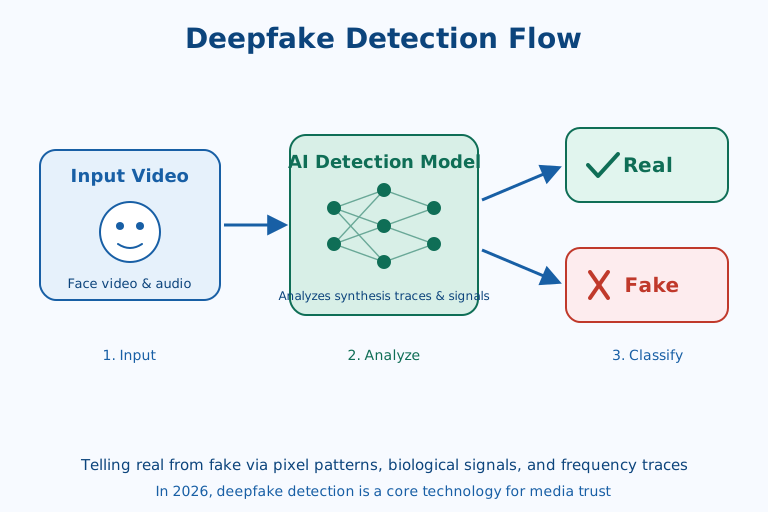
Deepfake detection is technology that analyzes AI-generated fake video, audio, and images to tell real content apart from synthetic forgeries. It identifies authenticity by spotting subtle pixel patterns, unnatural facial movements, and traces of signal noise that are invisible to the human eye in content produced by deep-learning generative models. As of 2026, with companies such as Microsoft and Intel and numerous research institutions releasing detection models, deepfake detection has become a core security technology for safeguarding the trustworthiness of media.
Why This Became Urgent Now
Deepfakes are dangerous because fake videos that are hard to distinguish from the real thing can be exploited for fraud, manipulation of public opinion, and defamation. A fabricated video that synthesizes a public figure's face and voice can spread false statements as if they were genuine, influencing elections or stock prices. In the corporate world, voice-phishing scams have been reported in which a fake call mimicking an executive's voice is used to authorize money transfers. As of 2026, generative AI tools have become easy enough for anyone to use, dramatically lowering the barrier to creating forged content.
How the Detection Pipeline Runs
Deepfake detection works through a step-by-step procedure that analyzes the visual and audio signals of a video for traces of synthesis. As of 2026, a typical detection process proceeds through the following five stages.
- Data collection — Obtain the video or audio file to be examined and break it down frame by frame.
- Preprocessing — Crop out the facial region and standardize resolution and brightness to normalize the analysis input.
- Feature extraction — Extract subtle signals such as eye blinks, mouth shape, skin texture, and frequency noise.
- AI model classification — A trained deep-learning classifier computes probability scores for real versus fake.
- Result verification — A human reviews the scores and supporting evidence, flags suspicious segments, and makes the final determination.
Why the Approaches Split Into Branches
Deepfake detection techniques fall broadly into visual artifact analysis, biological signal analysis, and frequency/metadata analysis. Visual artifact analysis looks for synthesis traces such as blurring at facial boundaries or unnatural shadows, while biological signal analysis examines minute skin-color changes driven by the pulse, or the rhythm of eye blinks. Frequency analysis captures the unique signal patterns left behind by GANs or diffusion models, and metadata analysis traces a file's creation information and editing history. As of 2026, multi-model detection that combines these approaches together is widely used to improve accuracy.
The very fact that detection splits into three branches reveals the nature of the problem. A detector that watches only one signal is helpless against a forgery that has cleanly wiped that signal away, so it has to layer evidence from different levels. Visual artifacts blur out in low-quality, re-compressed video; biological signals waver under lighting or makeup; and metadata can be erased with a single edit. None of them can be trusted on its own. Multi-model detection became the standard not merely to squeeze out a bit more accuracy, but because a system that fails to cover its own weak points cannot survive real-world use.
The Tools Actually Used in the Field
Leading deepfake detection tools include Microsoft Video Authenticator, Intel FakeCatcher, and the training dataset FaceForensics++. Microsoft Video Authenticator presents a synthesis-likelihood score for each video frame, while FakeCatcher, released by Intel in 2020, analyzes blood-flow signals in facial pixels to determine authenticity in real time. FaceForensics++, created by German researchers, is a public dataset that gathers thousands of forged videos and is widely used for training detection models and evaluating their performance. As of 2026, such tools are being used in the content-verification work of news organizations and platforms.
The Structural Reason Detectors Always Play Catch-Up
The limitation of deepfake detection is that generation technology advances so rapidly that detection models are always left chasing it. Once a detector is trained to catch a particular synthesis trace, new generative models evolve to eliminate that trace and evade detection. A generalization problem also persists: a model that achieves high accuracy on one dataset can perform poorly on videos it has never seen before. As of 2026, experts stress that detection technology alone is not enough, and that it must be paired with digital watermarks and authentication systems that prove the origin of content.
What to Watch in the Korean Context
Mapping this onto the Korean situation makes it clear that importing detection technology alone does not solve the problem. The harms reported domestically already take concrete shapes — synthesized faces of celebrities and public figures, and money-transfer calls that imitate an executive's voice — and such content spreads instantly across messengers and short-video platforms. Even a correct after-the-fact verdict of "fake" struggles to keep up with that spread. The generalization problem the article flags can also loom larger in an environment where Korean-language audio and Asian-face data are relatively scarce. In the end, rather than leaning on a single detection score, the realistic response looks like attaching the origin-proving watermarks and authentication systems that experts emphasize at the platform level itself.

AI & tech,
read in depth
Beyond the headlines — into the context and the structure
AGI Soon As Possible · asapai.co.kr