
Google Unveils Gemini-SQL2: A Text-to-SQL Model That Turns Natural Language Into SQL
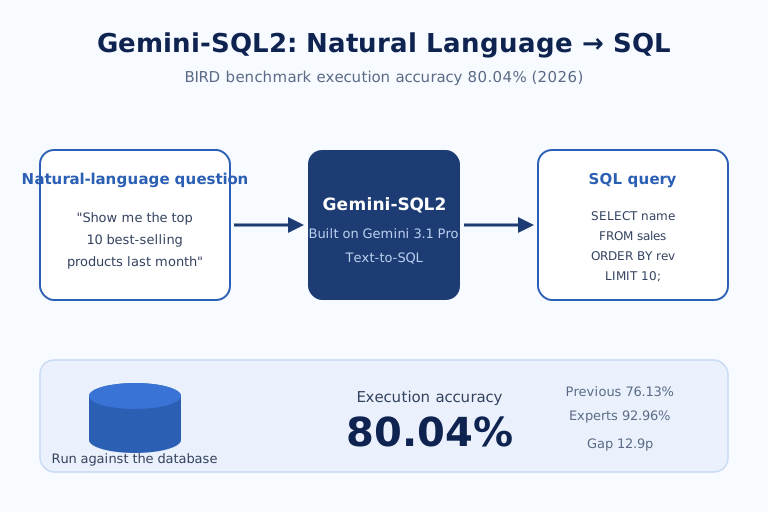
Google unveiled Gemini-SQL2 in 2026 — a model that converts natural-language questions into SQL queries — and it recorded an execution accuracy of 80.04% on the BIRD benchmark. According to AI Times, that figure is a new record in the single trained-model category, raising the previous Gemini-SQL's 76.13% by about four points. Text-to-SQL lets even users who don't know SQL ask their data questions in everyday language and get answers.
From One Plain Sentence to a SQL Query
Gemini-SQL2 is Google's text-to-SQL model that converts a user's natural-language question into an executable SQL query. According to AI Times, the model was developed on top of Gemini 3.1 Pro, released in 2026. When a user asks a question in plain language, such as "Show me the top 10 best-selling products last month," the model translates it into a SQL statement that can run directly against the database. The key is that you can work with data without knowing SQL syntax.
How to Read the 80.04% Figure
An accuracy of 80.04% means that about 80 out of every 100 SQL queries Gemini-SQL2 produced executed to the same result as the correct answer. According to AI Times, this figure is the execution accuracy on the BIRD benchmark, which measures not whether the query text looks similar but whether running it against the database actually yields the correct result. The measurement basis is worth pausing on. Judging by execution result rather than surface similarity filters out queries that look syntactically plausible yet return the wrong answer. In other words, 80.04% is not the share of queries that "read correctly" but the share that "actually produce the right answer" — and in practice the latter is a far stricter bar.
The 12.9-Point Gap From the 92.96% Human Expert
The 80.04% recorded in 2026 is 12.9 points below the human-expert level of 92.96%, showing that the model is still at a stage of assisting people rather than fully replacing them. How you weigh this gap is the central judgment for anyone evaluating adoption. It means roughly one in five queries can be wrong, so results should be reviewed by a person before feeding into decisions rather than used as-is. Conversely, for tasks that are easy to verify — drafting queries or repetitive lookups — the 12.9-point gap matters far less. The safer play is to automate the work where an error is immediately obvious first.
Which Benchmark Was Used?
Gemini-SQL2's performance was measured on the BIRD leaderboard, the standard evaluation in the text-to-SQL field. According to AI Times, the BIRD benchmark consists of 37 specialized domains, 95 databases, and 12,751 question–SQL pairs, with a total size reaching 33.4 GB. As of 2026, this benchmark is highly trusted because it handles complex queries close to real-world industry data, evaluating realistic data-analysis difficulty rather than simple examples.
Aimed at the Data-Team Bottleneck
Gemini-SQL2 is used for enterprise business-data analysis and data-engineering work. According to AI Times, its 2026 use cases include enterprise business-data analysis, data engineering, and the "ask your data" feature of SaaS companies. Business users who can't work with SQL can query data directly in natural language, reducing the bottleneck of handing analysis requests off to the data team and waiting.
The Four Points Over the Prior Generation
Gemini-SQL2 raised the BIRD execution accuracy from 76.13% to 80.04% compared with the previous Gemini-SQL. According to AI Times, the new model, built on Gemini 3.1 Pro, set a new record in the single trained-model category. The differences between the two 2026 models are shown in the table below.
| Category | Gemini-SQL | Gemini-SQL2 |
|---|---|---|
| BIRD execution accuracy | 76.13% | 80.04% |
| Base model | Previous-generation Gemini | Gemini 3.1 Pro |
| Gap from human experts | Larger | 12.9 points |
| Category record | - | New record for single trained models |
What Practitioners Should Keep in Mind, and the Limits
A few distinctions matter when reading this announcement in a real deployment context. First, 80.04% is a result on BIRD, an English-language benchmark, and there is no guarantee the same accuracy holds for questions or data schemas in other languages. Second, the phrase "new record in the single trained-model category" ranks it apart from approaches that combine multiple models, so the comparison basis differs from the ensemble setups used in real services. Third, the available evidence rests on reporting by AI Times and Byline Network, not on Google's primary data. Even so, the roughly four-point rise over the previous generation reads as a signal that text-to-SQL is being put to practical use as an assisting tool at a fast pace.

AI & tech,
read in depth
Beyond the headlines — into the context and the structure
AGI Soon As Possible · asapai.co.kr