Generative AI Copyright: Why the Fight Won't End Yet
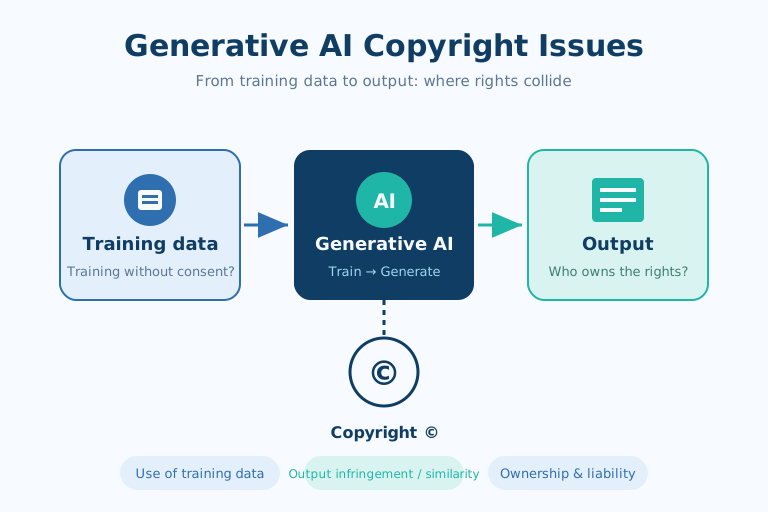
The copyright problems with generative AI refer to the legal disputes over rights infringement and rights ownership surrounding both the data AI is trained on and the content AI produces. The issue splits into two main strands: the rights of the original works used to train AI, and whether AI-generated output itself qualifies for copyright. Standards for recognizing copyright and the scope of liability differ by country and by case, and as of 2026 the related debates and lawsuits are still ongoing, so much of this area remains unsettled. In this article, ASAP avoids declaring any particular ruling as definitive and instead lays out which issues are being contested and why, down to the points a practitioner needs to read for.
Why the Debate Has to Be Split Into Two Axes
This topic keeps getting tangled because two problems of a completely different nature travel under one name. The training-data problem is an input question: may AI ingest works that already exist without consent? The output-ownership problem is an output question: can rights attach to a result a human barely touched? The first is a question of infringement, the second a question of eligibility, so the logic of judgment differs from the start. Merge the two axes and you can no longer even see how far each issue has actually been resolved.
Existing copyright law was designed around human creation and copying, but generative AI's training and generation processes differ from human creativity, making it hard to apply the old law as-is. As of 2026, with AI-generated output pouring into nearly every field—text, images, music, code—situations where the rights of original creators collide head-on with the interests of AI users are growing more common.
The Input Side: How to Read Training Data
The core question around training data is whether it is permissible to use copyrighted works for AI training without the rights holder's consent. During training, AI models copy and analyze massive volumes of text and images, and whether this process infringes the copyright holder's reproduction right is disputed. Some countries are debating directions that would permit a certain scope under fair use or text-and-data-mining exceptions, while others demand stricter consent or compensation—so as of 2026, approaches differ from country to country.
It is more accurate to read the debate in three layers. First, whether collecting and storing training data constitutes reproduction under copyright law. Second, even if it does, whether it can be exempted under fair use or a data-mining exception. Third, even if exempted, whether original creators should receive attribution or compensation. Reproduction, exemption, and compensation are sequential gates, so clearing one does not stop the conclusion from flipping at the next. These points may be decided differently by country and by case, and there is no single, established standard yet.
The Output Side: Who Holds the Rights
The biggest issue in the ownership of AI-generated output is whether copyright can even be recognized for work produced by AI rather than a human. Because the copyright law of many countries assumes that protection applies to a human's creative expression, the prevailing view is that pure AI output with virtually no human creative contribution is unlikely to receive copyright protection. That said, when a person is sufficiently creatively involved through prompt design, selection, and editing, whether protection applies may change—so as of 2026, ownership standards trend toward case-by-case judgment.
The practical crux here is that the dividing line is not how many prompts you typed but whether your choices and edits actually shaped the expression of the result. So whether the rights vest in the user, the developer, or the platform is ultimately set jointly by the tool's terms of service and the degree of human involvement. Take output straight from a single prompt and use it as-is, and not only protection but the very claim to rights tends to weaken.
Why the Four Issues Can't Be Solved Separately
The key issues in generative AI copyright boil down to four: use of training data, infringement by generated output, ownership of rights, and the party responsible. These issues are intertwined, making it hard to judge any one in isolation, and a shared difficulty is the gap that opens up because the pace of technological progress outstrips the pace of legal and institutional reform. As of 2026, several countries are preparing guidelines and legislation, but no internationally unified standard has yet been established.
| Issue | Core Question | Current Situation |
|---|---|---|
| Training data | Is training without consent permitted? | Exemption and regulatory directions differ by country |
| Output infringement | Is output that resembles the original an infringement? | Similarity standards are disputed case by case |
| Rights ownership | Who holds the rights to AI output? | Trends toward judgment centered on human contribution |
| Responsible party | Who is liable when infringement occurs? | Allocation of liability between developers and users under debate |
As the table shows, each issue is closer to an ongoing debate than a settled answer. For creators and legal practitioners in particular, the fact that training-data norms diverge by country becomes an immediate risk. Depending on which jurisdiction the data was collected and trained in, the governing norms can differ even for the same service, so one cannot assume safety on the basis of a single country's rules alone.
What Creators and Practitioners Can Do Now
For creators, the very fact that the standards are unsettled is a signal to change their defensive strategy. Rather than waiting for a definitive answer, it is better to build up, in advance, records that will work in your favor whichever way the conclusion lands.
- Record the creation date and process of your work to secure a basis for proving your rights.
- When publishing a work, explicitly indicate whether AI training is permitted and under what conditions.
- Check the rights and liability clauses regarding output in the terms of service of any AI tools you use.
- When using AI-generated output, add sufficient human creative contribution and keep a record of that process.
- If you suspect infringement, gather evidence and seek advice from experts or relevant authorities.
The above are general precautions; for any specific matter, it is safest to follow the laws of the relevant country and the judgment of an expert. The open questions are clear too. The scope of the training exception, the dividing line for similarity, and the design of any compensation scheme all remain unresolved, and until those gaps are filled, the practitioner's safe zone comes from records and explicit labeling.
AI & tech,
read in depth
Beyond the headlines — into the context and the structure
AGI Soon As Possible · asapai.co.kr