
GPT-5.6 Launch Imminent: A Counter to Fable 5, What's Confirmed and What's Still Unknown
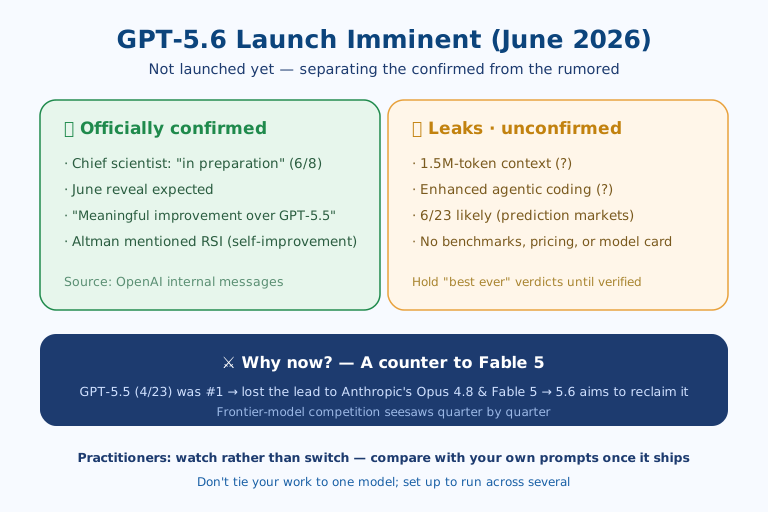
OpenAI is expected to release its next flagship model, "GPT-5.6," sometime in June. On June 8, 2026, chief scientist Jakub Pachocki signaled in an internal message that it was "in preparation," and OpenAI described it as a "meaningful improvement" over its current workhorse, GPT-5.5. But benchmarks, pricing, and the model card have yet to be released, so many of the performance figures making the rounds are closer to leaks and speculation. This article separates what has been officially confirmed from what is still rumor, and explains why it's coming now, as a counterpunch to Anthropic's Fable 5.
It's "Launch Imminent," Not "Launched"
OpenAI chief scientist Jakub Pachocki announced in a June 8 internal message that GPT-5.6 was in preparation, and the industry widely expects a June reveal. Some prediction markets and leaks point to late June (around the 23rd in particular), but OpenAI has not fixed an official date.
In other words, this is a countdown phase. No model card and no official benchmarks have appeared. The distinction matters because, absent any means of verification, every assessment that emerges right now is the language of expectation, not the language of measurement.
What OpenAI Has Said in Its Own Words
OpenAI stated that GPT-5.6 achieves a "meaningful improvement" over its current workhorse, GPT-5.5. Sam Altman is reported to have mentioned the model's recursive self-improvement (RSI) capabilities in a separate internal communication.
Beyond the phrase "meaningful improvement," however, no specific performance metrics have been officially presented. The company-level messaging is closer to a "you can look forward to it" signal.
The Specs Making the Rounds Are Still Unconfirmed
Leaks claim that GPT-5.6's context window reaches up to 1.5 million tokens and that its agentic coding ability and token efficiency have been significantly enhanced. Some chatter also mentions a high-speed coding mode like "UltraFast Codex."
But all of these figures and features are unconfirmed. The prevailing view is that this will be an upgrade weighted toward long context and agentic tasks, rather than a revolution in single-turn conversation quality.
How to Read the Unconfirmed Specs
When handling leaked numbers, the first step is to sort them by the nature of their source. What a company states in official documents, what is relayed through employee remarks, what prediction markets bet on, and what anonymous posts spread all carry different tiers of trust. The cleaner a number sounds, like "1.5 million tokens," the more reason there is to be wary of it before verification. Specific figures sound like fact, but precision without a basis is an illusion, not a signal of reliability.
The other thing worth noting is direction. If the leaks all point uniformly toward long context and agentic coding, then even if the exact numbers turn out to be wrong, the qualitative signal of "where this upgrade's center of gravity lies" is still worth noting. In short, hold the numbers in reserve, but you can roughly read the direction of the improvement.
Why Now: A Counter to Fable 5
Behind GPT-5.6's arrival is a fight for the lead. GPT-5.5, released April 23, was briefly the top performer, but it ceded the throne when Anthropic released Claude Opus 4.8 and Fable 5. GPT-5.6 is the card OpenAI is playing to win that top spot back.
As it happens, Fable 5 even ran into a situation where it was blocked by U.S. export controls, and OpenAI appears to be seizing that opening to reclaim the initiative with its next model. It's a sign that frontier-model competition is seesawing on a quarterly basis.
There's More We Don't Know Than We Do
There is still more we don't know for certain about GPT-5.6: official benchmark scores, pricing policy, the model card, the exact launch date, and the real-world level of its coding and agentic performance are all undisclosed.
So the "best ever" assessments circulating now should be held in reserve until they can be verified after launch through the model card and independent benchmarks (such as Arena Elo).
Implications for Korean Practitioners
For practitioners, the thing to do right now is not to "switch" but to "watch." Once it launches, check the model card and pricing, and run the same task through both GPT-5.6 and your existing model using your own prompts to compare. If you make heavy use of long documents and agentic automation, the context and coding improvements are likely to be where you feel the difference.
The bigger picture is reducing dependence on any single model. Since the lead changes every quarter, it's safer not to tie your work to one model and instead set things up so you can run the same task across multiple models. In the Korean environment there is one more variable to add: as the case of Anthropic's Fable 5 being blocked by export controls shows, access itself can be shaken by politics and regulation. It is realistic to factor in not just performance but whether you can rely on stable access.
References: AI Times · Digital Today

AI & tech,
read in depth
Beyond the headlines — into the context and the structure
AGI Soon As Possible · asapai.co.kr