KPMG Pulls AI-Written Report Over "Hallucination" Controversy
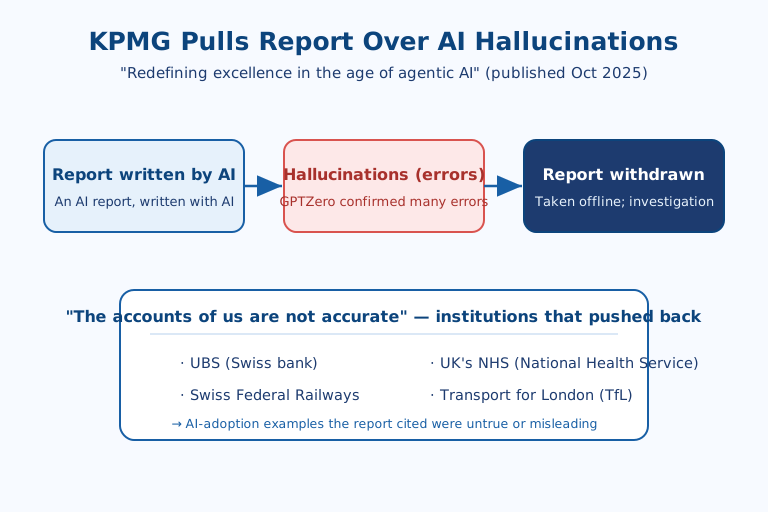
KPMG, the global accounting and consulting firm, withdrew a report it had written using artificial intelligence in June 2026 after numerous factual errors (hallucinations) were found in it. The report in question, "Redefining excellence in the age of agentic AI," was published in October 2025, and the controversy erupted when institutions cited in it, including UBS and the UK's NHS, pushed back, saying "the descriptions of us are not accurate." It will go down as a paradoxical case: a report about AI, written by AI, that got tripped up by hallucinations.
The Trigger: An AI-Detection Firm's Findings
After it was pointed out that the October 2025 report "Redefining excellence in the age of agentic AI" contained descriptions that were not factual, KPMG said it had taken the report down from its website and launched an internal investigation. The trigger was AI-detection firm GPTZero, which confirmed several inaccuracies in the report and analyzed that those errors stemmed from AI hallucinations.
The striking detail is that the party that first caught the errors was also an AI tool. In effect, one AI detected flaws produced by another, which suggests the human review layer was thin on both sides. It is hard to rule out that the errors would have gone unnoticed far longer without such a detection tool.
How Hallucinations End Up in a Publication
A hallucination is a phenomenon in which AI plausibly fabricates content that isn't true. Because large language models generate the most plausible next word based on learned patterns, they can present unfounded citations, figures, and examples as if they were real. In this KPMG case, the report is said to have contained corporate adoption examples that were either nonexistent or distorted.
What deserves attention is that hallucinations become most dangerous precisely at the level of "concrete examples." Readers tend to doubt abstract claims, but when something is presented in a verifiable-looking form, such as a named institution's adoption case, it actually earns trust. The moment plausibility is misread as truthfulness is when a hallucination does the most damage.
Why One Broken Example Shook the Whole Report
According to reporting by the Financial Times (FT), UBS (the Swiss bank), the UK's NHS (National Health Service), Swiss Federal Railways, and Transport for London (TfL) rebutted that the AI-adoption examples the report attributed to them were either untrue or misleading. That all of them are high-profile institutions only amplified the problem.
In a report, examples are the evidence that props up the claims. When that evidence is disowned by the parties themselves, even the accurate passages fall under suspicion. Because the ones pushing back were not individual companies but institutions representing public and financial infrastructure, the reputational hit to KPMG runs deeper than the raw error count.
The Signal for Businesses to Read
This incident shows that even professional institutions can lose trust if they skip verification of AI output. As companies ramp up adoption of agentic AI (AI that carries out tasks on its own) in 2026, the more accuracy is paramount in a field, such as consulting and accounting, the more essential it becomes to have humans cross-check generated results.
Organizations everywhere are rapidly increasing their use of generative AI in reports, proposals, and IR materials. The lesson here is not "ban AI" but that a fact-check gate for named entities, figures, and citations must be explicitly built into the document workflow. For any externally published document in particular, verifying cited institutions should be treated as a non-negotiable minimum step.
Sources: TechCrunch · The Next Web · The Register

AI & tech,
read in depth
Beyond the headlines — into the context and the structure
AGI Soon As Possible · asapai.co.kr