The 8-Stage Media Buying Pipeline: How Far Can It Be 100% Automated?
Paid media execution consists of eight stages: channel selection, targeting, keyword sets, creative ideation, creative production, creative setup, performance measurement, and performance optimization. In 2026, as Google Performance Max and Meta Advantage+ handed most of these stages to algorithms, "how far can it run without people?" became the core question for practitioners. The short answer: automation is not uniform — it is "barbell"-shaped. The measurable middle stages exceed 90% automation, while the judgment-heavy ends stall around half.
Why Automation Is Not Uniform
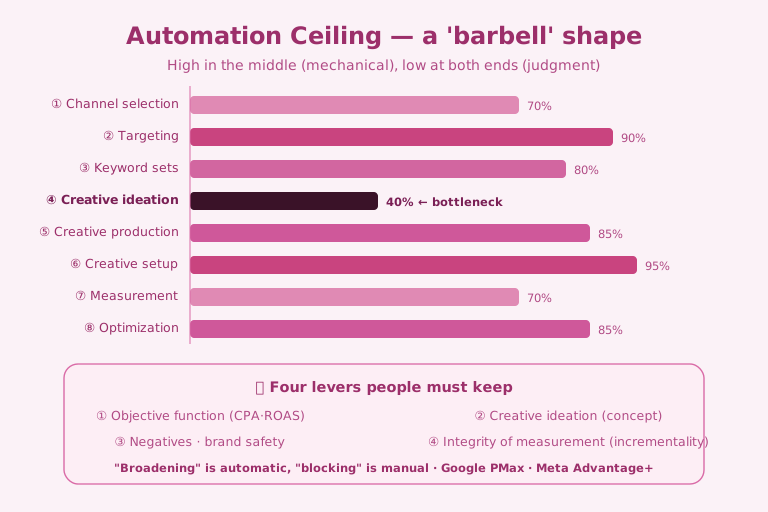
Overlaying the automation ceilings of the eight stages reveals a barbell — high in the middle, low at both ends. The point where 100% automation stalls is always the point where "what is good" cannot be scored automatically.
Mechanical stages whose results are instantly measured (targeting, creative production, setup, optimization-execution) automate deeply, while stages where strategy and taste intervene (channel portfolio, creative ideation, objective definition) resist automation.
This regularity is no accident. An automation system is essentially an optimization loop, and a loop needs an objective function to run. In stages where a signal feeds back within seconds — clicks, conversions, cost — the algorithm can experiment and converge on its own. In stages where the feedback is slow or the definition itself is fuzzy, the algorithm cannot tell what it should improve toward. The height of the ceiling, in other words, is a function of measurability far more than of technical maturity.
Automation Ceiling by Stage
The realistic automatable range of each stage is as follows. The figures are estimates assuming output quality stays at a skilled practitioner's level.
- Channel selection ~70%: Performance Max auto-allocates across Search, Shopping, and YouTube, but splitting budget across Google, Meta, and TikTok stays strategic.
- Targeting ~90%: Meta's Andromeda engine uses the creative itself as a targeting signal, replacing manual audience setup.
- Keyword sets ~80%: broad match and search themes (up to 50 per asset group) absorb keyword work.
- Creative production ~85%: with Meta's generative-AI tools, a million advertisers mass-produce variations.
- Creative setup ~95%: Performance Max auto-assembles 15 headlines and 20 images.
- Measurement ~70% and optimization ~85%: Smart Bidding automates bids.
Notice the pattern running through the numbers. Channel selection (~70%) and measurement (~70%) sit low side by side, and that is not a coincidence. Both are "boundary" stages. Channel selection sits at the mouth of the pipeline, deciding where to pour the resource called budget; measurement sits at the exit, deciding what to count the result as. The entrance and the exit lie outside each platform's internal optimization loop, so no single company's algorithm can optimize beyond its own turf. By contrast, combinatorial work that is self-contained within one platform — like setup (~95%) — automates almost all the way to the ceiling.
The Stage That Resists Most: Creative Ideation
Creative ideation has the lowest automation ceiling of the eight stages at about 40%, and it is the bottleneck of the whole pipeline. AI can propose what to make, but deciding "what message and angle this brand should use right now" is a matter of judgment.
The reason is evaluability. A good concept is hard to score quickly and objectively the way click-through rate can be, so automation arrives most slowly here. The more execution becomes free, the more this stage matters.
A paradox follows. Once creative production automates up to about 85% and variations can be stamped out endlessly, the bottleneck shifts entirely from "the ability to make many" to "the ability to decide what to make." In a world where a million advertisers mass-produce variations with the same tools, sheer production volume ceases to be a differentiator. The only differentiation left is angle and concept — the very stage whose ceiling sits at 40%. The deeper automation goes, the more human worth condenses into that unautomated final 40%.
The Inversion of Control
The real change in 2026 is not whether automation is possible but that it is being forced. Meta is phasing out legacy campaign controls and manual APIs to consolidate everything into Advantage+.
Google, too, auto-generates headlines from landing pages and will even change the destination URL if it judges another page more relevant. As the option to "do it manually" disappears, the question shifts from "how much to automate" to "where to retain control."
Why this compulsion is dangerous comes down to a misalignment of interests. A platform's optimization goal and an advertiser's business goal are not always the same. Auto-changing the destination URL can lift short-term click-through rate, but it may also break the landing experience or brand-message flow the advertiser intended. When manual APIs disappear, advertisers lose the physical means to refuse such interventions. Because loss of control creeps in as the price of convenience, an advertiser who does not explicitly recognize what they are handing over may find it hard to reverse by the time they notice.
Four Levers People Must Keep
Hand everything to automation, but keep these four levers. Lose them and automation becomes a device that reaches the wrong destination quickly rather than efficiently.
First, the objective function (target CPA/ROAS and the growth-versus-efficiency balance); second, creative ideation (concept and angle); third, negatives/exclusions and brand safety (broadening is automatic, blocking is manual); fourth, the integrity of measurement (what counts as a conversion and whether it is incremental). Hold these four firmly, and even a small team that delegates the rest to agents can compete with large organizations.
Implications for Practitioners
These four levers deserve especially careful handling in markets like Korea. Local advertisers split budget not only across Google and Meta but across regional platforms such as Naver, Kakao, and Coupang. No single platform's automation owns the split between them, so the strategic share of channel selection is actually larger than the global average. Even after handing budget to Performance Max, the higher-order lever of the overall media mix stays with people.
The integrity of measurement is the same story. A conversion a platform reports may be a figure defined in that platform's favor, and when several channels overlap the same conversion is easily double-counted. Unless a human judges "is this incremental" — whether the conversion would have happened even without the ad — automated bidding pushes budget toward results that do not exist. The smaller the team, the more the outcome hinges on how disciplined it stays about the four levers left behind, since the tools themselves are the same ones large companies use.
Limits and Caveats
Finally, it is worth being clear about the nature of the figures in this piece. The per-stage ceilings (70%, 90%, 95%, and so on) are estimates assuming output quality stays at a skilled practitioner's level; they are not metrics published by the platforms. Real automatable range can vary widely by vertical, budget size, and depth of accumulated data. A new brand with thin data lacks signal for the algorithm to learn from, so its automation ceiling is lower even with the same tools.
The "barbell" model, too, is a snapshot of the present moment. Creative ideation's 40% ceiling stems from today's limits of evaluability, and if a way to quantify whether a concept is good emerges, that ceiling could move as well. But until such a metric appears, this piece's conclusion holds: the deeper automation goes, the more valuable the judgment-heavy ends become.
References: Google Ads Help — Performance Max asset groups · Meta Andromeda (Engineering at Meta, 2024)

AI & tech,
read in depth
Beyond the headlines — into the context and the structure
AGI Soon As Possible · asapai.co.kr