Internal Backlash Over Meta's AI Restructuring; Zuckerberg "Admits Mistakes"
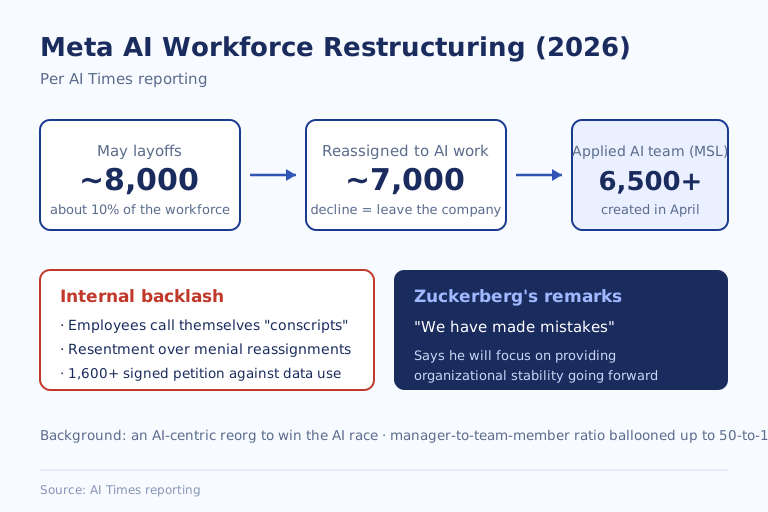
Meta ran into internal backlash after carrying out a large-scale AI workforce restructuring in 2026, and CEO Mark Zuckerberg admitted that "we made mistakes," AI Times reported. According to AI Times, Meta laid off about 8,000 people—10% of its total workforce—in May, then reassigned roughly 7,000 to AI-related work, and some employees voiced strong dissatisfaction, calling themselves "conscripts." Zuckerberg is reported to have said he would focus on providing organizational stability.
Layoffs and Reassignments Landed Almost Simultaneously
The most striking feature of this episode is how tightly the layoffs and the reassignments overlapped in time. According to AI Times, Meta laid off about 8,000 people in May 2026 and then reassigned roughly 7,000 to AI-related work immediately afterward. Starting in April, it had already created an "Applied AI" team of more than 6,500 engineers and product managers to support the "Meta Superintelligence Lab (MSL)." The layoffs are said to amount to about 10% of the total workforce.
Why Employees Started Calling Themselves "Conscripts"
The core of the internal backlash was a forced-reassignment structure in which declining a transfer offer meant having to leave the company, AI Times reported. Some social-media development engineers were assigned to menial tasks such as "generating puzzles for training AI models," and employees voiced their displeasure by calling themselves "conscripts." A plan to use employees' click and keystroke data for AI training also drew a petition opposing it, signed by more than 1,600 people, the report said. The reassignment process also exposed operational strain, with the manager-to-team-member ratio ballooning to as much as 50-to-1.
How to Read Zuckerberg's Words
Zuckerberg said, "Given the complexity of these changes, we have made mistakes, and it is almost certain we will make more," AI Times reported in 2026. He went on to say he would "focus on providing maximum organizational stability going forward." In ASAP's reading, the statement carries two signals. One is that he did not directly deny the turmoil of the restructuring; the other is that the phrase "we will make more" quietly conveyed no intention to halt the restructuring itself. It reads closer to admitting the mistakes while holding the course.
A Decision That Traded Stability for Speed
The background to this restructuring is a 2026 strategic decision by Meta to reorient the company around AI in order to get ahead in the AI race, AI Times reported. The tension here is plain: the stronger the pressure to build AI capability quickly, the further organizational stability gets pushed back. The very fact that roughly 8,000 layoffs and 7,000 reassignments ran nearly in lockstep shows Meta chose to keep headcount roughly stable while violently rearranging where people sit. Zuckerberg's belated mention of stability can be read as recognition of the cost this sprint left behind.
The Question It Leaves for the Korean Tech Industry
From a Korean corporate standpoint, this case shows that reassignment can look like job preservation yet still erode organizational trust depending on how it is carried out. Domestic conglomerates are likewise weighing large-scale job moves in the name of AI transformation, and Meta's backlash suggests that "how you move people" matters as much as "where you move them." In particular, the fact that more than 1,600 people signed a petition against using click and keystroke data for AI training foreshadows how the handling of employee data during AI adoption could become a new flashpoint in labor relations. ASAP expects this to surface as a live issue in Korea before long.
Source: AI Times
AI & tech,
read in depth
Beyond the headlines — into the context and the structure
AGI Soon As Possible · asapai.co.kr