
NVIDIA ENPIRE: AI coding agents run their own robotics research and even install GPUs
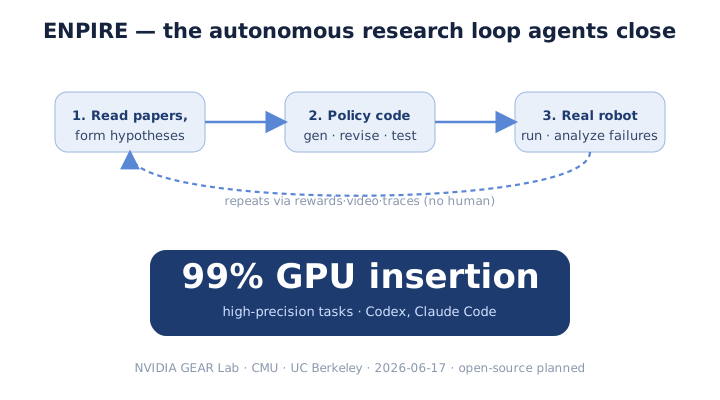
NVIDIA's GEAR Lab unveiled ENPIRE on June 17, 2026, a robot-learning framework in which AI agents run experiments on real robot hardware by themselves. Frontier coding agents like Codex and Claude Code learned precise manipulation with no human intervention, inserting a GPU into a motherboard at a 99% success rate. ASAP summarizes this result, released with Carnegie Mellon and UC Berkeley.
What ENPIRE unveiled
ENPIRE is an agentic robotics framework that lets coding agents run research directly on real robots. NVIDIA GEAR Lab released it with Carnegie Mellon and UC Berkeley on June 17, 2026, hitting a 99% success rate on high-precision tasks like GPU insertion, pin organization, and zip-tie cutting. It was tested with Codex (GPT-5.5), Claude Code, and Kimi Code variants across fleets of 1, 4, and 8 robots.
How the agent closes the learning loop
The core of ENPIRE is that the agent closes the learning loop itself. A Policy Improvement module generates, revises, and tests policy code using rewards, videos, execution traces, and failure analysis. Critically, agents read research papers online and propose algorithmic hypotheses on their own, meaning the agent takes on the researcher's role rather than following human-designed training.
How it differs from prior robot learning
Robot learning has long been chained to a loop of human labor: a person writes the reward function, watches the failures, edits the code, and runs it again. The bottleneck in that cycle was never the robot; it was human time. What makes ENPIRE interesting is that it pulls that bottleneck out of the loop. Once the agent owns hypothesis, experiment, failure analysis, and code revision, the pace of improvement is bounded only by the robot's physical repetition rate and the agent's reasoning speed. Unlike earlier approaches that ran autonomous learning purely in simulation, ENPIRE tries to close that loop on real hardware, which is a different thing entirely.
How to read the 99% success rate
The 99% figure is striking, but taken in isolation it invites misreading. GPU insertion and zip-tie cutting are tasks where position and force are relatively well-defined, so the success rate should be read as specific to this task family. The real signal is less the rate itself than how the agent reached it. If the agent hit that number by reading papers and revising policies without human tuning, what matters is not the value but the fact that an autonomous improvement loop held together at all. ASAP sees this as the line that separates a demo from a framework.
What it means for the field on the ground
NVIDIA said it plans to open-source the framework. That condition opens the door not only to big-lab research groups but to small teams on manufacturing and logistics floors. Still, since it presupposes a setup that can sustain real robot hardware and repeated experiments, the near-term barrier sits in physical infrastructure rather than software. The trend worth watching is that coding-agent capability is starting to translate directly into a robot cell's rate of self-improvement. It reads as a signal that access to frontier models is becoming a variable in manufacturing-automation competitiveness.
Source: NVIDIA GEAR Lab ENPIRE release (2026-06-17, NVIDIA, Carnegie Mellon, UC Berkeley); reporting (Tom's Hardware, NVIDIA Blog, TechTimes).

AI & tech,
read in depth
Beyond the headlines — into the context and the structure
AGI Soon As Possible · asapai.co.kr