Which Tokens Does a Hybrid Model Predict Better? The Transformer Gap a Single Loss Hides
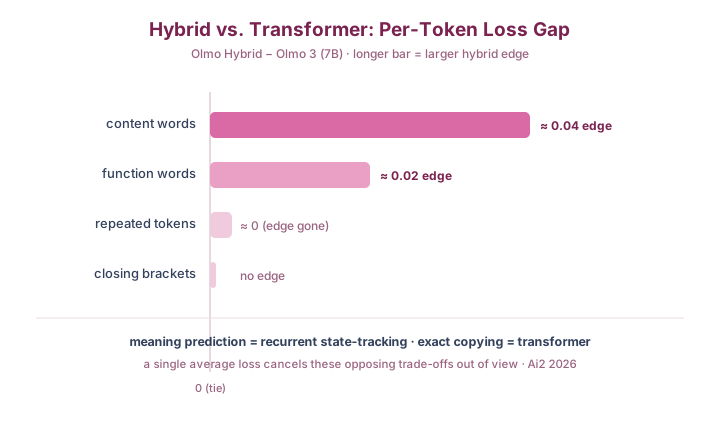
An analysis released by Ai2 (Allen Institute for AI) in June 2026 shows, through per-token loss gaps, that a hybrid language model predicts meaning-bearing content words better than a transformer but loses almost all of that edge on tokens that repeat earlier passages verbatim and on closing brackets. Comparing the 7B Olmo 3 (transformer) against Olmo Hybrid side by side, the study concludes that a single overall loss averaged across all tokens is too blunt to tell the two architectures apart.
Matching Headline Scores Do Not Mean Matching Abilities
Ai2's central claim is that a model's overall average loss, the average error across all tokens, is too blunt to compare a transformer with a hybrid. Even when two models look similar on a headline score, collapsing where each one wins and loses hides which underlying ability actually differs.
The method is to split tokens by type and measure the loss gap. The researchers grouped tokens into categories such as parts of speech, bracket types, and n-gram repetitions, then measured the difference in prediction loss between the two models per category.
Ahead on Content Words, Narrowing on Function Words
Olmo Hybrid leads the transformer on meaning-bearing content words, with a reported loss gap of about 0.04. In the same comparison, the gap on function words such as articles and prepositions is about 0.02, so the content-word advantage stands out more than the function-word one.
The direction this points is clear. The hybrid is stronger at predicting the next meaning-bearing word, which lines up with how recurrent layers track the state of the context.
The Edge Evaporates on Repetition and Closing Brackets
Olmo Hybrid's edge shrinks toward zero on tokens that repeat an earlier passage verbatim, and on closing braces or brackets the advantage vanishes entirely. The more a token has to copy prior text exactly, the smaller the hybrid's lead becomes.
The cause is that exact copying is a different kind of ability. Pulling a specific distant token forward and reproducing it verbatim is a strength preserved by transformer attention, and it works against a recurrent structure that compresses into a fixed-size state.
Why Two Strengths Split Inside One Architecture
Olmo Hybrid's strengths and weaknesses come from a design that combines the state-tracking ability of recurrent layers with attention. State tracking from recurrent layers helps with content prediction, while transformer attention keeps the upper hand on exact token retrieval and copying.
The same conclusion was checked at the 1B scale. Beyond the 7B Olmo 3 and Olmo Hybrid, the researchers analyzed three 1B models, transformer, hybrid, and pure recurrent, to confirm whether the per-architecture trade-offs hold across scale.
How to Read These Numbers
Gaps of about 0.04 and about 0.02 look small in absolute terms, but the point of the analysis is not the magnitude, it is the consistency of the direction. The hybrid steadily leads on content words and steadily trails on copying and closing brackets, and the moment you average them, those opposing signs erase each other. In other words, a single loss converging near zero does not mean the two models are the same, it should be read as a signal that opposite-facing strengths and weaknesses have overlapped and canceled. It is a concrete case for why comparing architectures on one headline score is dangerous.
What It Means for Practitioners
When choosing a model, this result is a cue to break the task down first. For work heavy on predicting the next meaning-bearing word, such as summarization or open-ended generation, the hybrid's recurrent state tracking has room to help. Conversely, for work that must copy distant tokens exactly, such as code generation, reproducing a quotation verbatim, or matching long identifiers and bracket pairs, transformer attention matters more. That said, this analysis is a loss-gap observation confined to the 7B and 1B Olmo family, and it does not prove downstream task performance or generalization to other model families, which is worth keeping in view.
Reference: Which tokens does a hybrid model predict better? (Ai2, 2026)
AI & tech,
read in depth
Beyond the headlines — into the context and the structure
AGI Soon As Possible · asapai.co.kr