A 'Near-Autonomous AI Chemist' Improved a Drug-Discovery Reaction
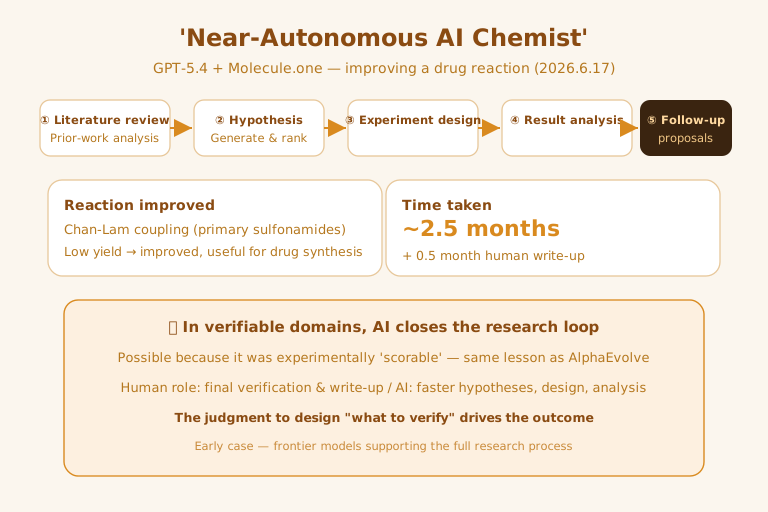
OpenAI and Molecule.one used a GPT-5.4-based "near-autonomous AI chemist" to improve a difficult reaction used in drug manufacturing. In the study, published on June 17, 2026, the AI carried out a substantial share of the scientific work—from reviewing the literature to proposing hypotheses, designing experiments, analyzing results, and suggesting follow-up research. The key takeaway is that AI has genuinely begun to close the human research loop on "verifiable" scientific tasks.
The facts, first
This was a joint study by OpenAI and Molecule.one, a drug-synthesis company. A "near-autonomous" AI chemist powered by GPT-5.4 improved a reaction in medicinal chemistry, and the work was published on June 17, 2026.
The target reaction was the Chan-Lam coupling. It is a method for making pharmacologically active molecules, but the variant involving primary sulfonamides has seen limited use because of its low yield. The AI chemist improved exactly that low-yield problem.
How to tell this is not just a demo
What makes this study stand out is that the thing it improved was not an abstract benchmark but a reaction that had been a real headache on the synthesis bench. Making a low-yield reaction actually usable should be read as a result validated at the bench, not a polished on-screen demonstration.
The disclosed time budget points the same way. The whole process took about 2.5 months, with an additional 0.5 months for a human chemist to write up the results into a paper. In other words, the numbers make visible a division of labor: the AI handled literature review, proposal ranking, experiment-design support, result analysis, and follow-up suggestions, while the human handled verification and writing.
Don't lose sight of the "verifiability" premise
The point to watch is that this result emerged under a specific condition. A chemical reaction can be verified experimentally on the spot. However plausible the hypotheses the AI pours out, a clear scorecard—yield—filters right from wrong. It fits precisely the lesson we covered earlier with AlphaEvolve: AI is strong on problems that can be scored automatically.
Put differently, it is risky to carry this result straight over to fields where verification is weak and expect the same. On problems that lack a good scorecard, the same model can show entirely different reliability.
What it hints for Korean research and industry
There is a clear implication for Korea's pharmaceutical and materials research. The crux is not whether you adopt the newest model, but your capacity to design "what to verify and how." A team that can turn its experimental data into a scorecard has room to sharply accelerate the hypothesis, design, and analysis stages; a team that cannot will struggle to convert even the latest tools into results. The AI did not replace people—it joined as a "research colleague," and final verification and paper-writing remained the human chemist's job. In the end, research competitiveness in the AI era will be decided by judgment in verification design.
References: OpenAI — A near-autonomous AI chemist improves a challenging reaction in medicinal chemistry (2026.6.17) · Hacker News discussion
AI & tech,
read in depth
Beyond the headlines — into the context and the structure
AGI Soon As Possible · asapai.co.kr