
The Opus 4.8 the Fable 5 shutdown buried: where the real leap actually was
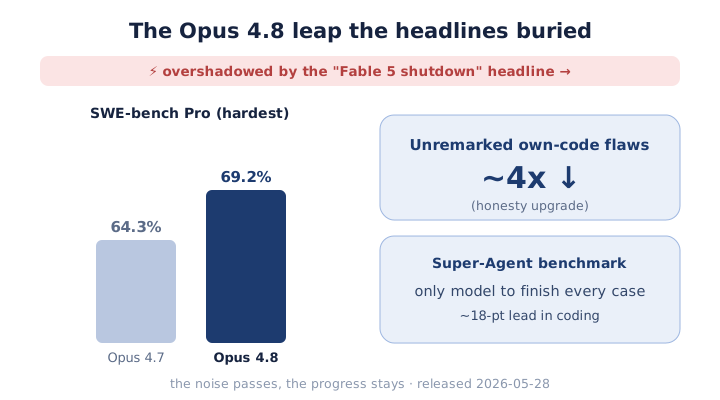
The Fable 5 shutdown is a genuine loss, but the noise around it is burying the real leap of Opus 4.8, released on May 28, 2026. Opus 4.8 lifted SWE-bench Pro from 64.3% on Opus 4.7 to 69.2%, and it became roughly four times less likely to let flaws in its own code pass unremarked. ASAP pulls the actual 4.8 gains from primary sources to put a spotlight back on the progress the Fable 5 headlines eclipsed.
The 72-hour headline that swallowed everything
Fable 5 and Mythos 5, launched on June 9, 2026, were fully disabled three days later on June 12 under a US Commerce Department (BIS) export-control directive. A top-tier model strong at long-horizon work vanished in under 72 hours, which is a real loss for the users who were counting on it.
The trouble is that this dramatic arc monopolized the screen. A model erased by regulation is a perfect story. By contrast, the 4.8 that shipped quietly two weeks earlier had no provocative angle, so it got crowded out. What the public remembered was a narrative of loss — that the top-tier model was blocked — while the improvement people could actually hold in their hands was written off as low on news value.
The buried protagonist, Opus 4.8
The real event hidden by the headlines is Opus 4.8, quietly released on May 28, 2026. Anthropic introduced 4.8 as its most capable model for complex reasoning, long-horizon agentic coding, and high-autonomy work. Tellingly, Anthropic itself called 4.8 a "modest but tangible improvement," yet on coding and agentic metrics the progress is anything but modest.
The leap in numbers: coding and honesty
The progress in Opus 4.8 shows up in the numbers, and the standout areas are agentic coding and honesty.
| Metric | Opus 4.7 | Opus 4.8 |
|---|---|---|
| SWE-bench Pro (hardest) | 64.3% | 69.2% |
| SWE-bench Verified | — | 88.6% |
| Unremarked own-code flaws | baseline | ~4x reduction |
| Fast mode | — | 2.5x speed, 3x cheaper |
Beyond that, Opus 4.8 led the coding category by roughly 18 points on average and beat GPT-5.5 on SWE-bench Pro by 10.6 points. On the Super-Agent benchmark it was the only model to complete every case end-to-end, and its long-context handling and compaction recovery also improved.
Why the fourfold drop in missed flaws matters more than the bench score
The number practitioners should watch here is not the 5-point rise on SWE-bench Pro but the roughly fourfold reduction in unremarked own-code flaws. A few benchmark points shuffle leaderboard rankings, but what actually governs a team's trust is how well a model catches errors in the code it wrote itself. In a pipeline where an agent autonomously generates and edits code, a missed flaw snowballs in cost through every downstream step.
Conversely, when this metric improves, the verification burden humans carry in review shrinks. That is exactly what creates the grounds to raise autonomy for real. More than a flashy benchmark headline, this quietly rising reliability metric is the true gate to production adoption.
Two reasons the leap feels larger
Two reasons rooted in Opus 4.7 and 2026 serving changes explain why the leap feels especially large. First, Opus 4.7 had a real regression: spring 2026 brought reports of coding regressions and a 54-point drop on a reasoning benchmark versus 4.6, so rising off that floor makes 4.8 feel bigger. Second is infrastructure. Right after the June 12 Fable 5 shutdown, Anthropic doubled the Opus and Sonnet usage limits in Claude Code and removed peak-hour throttling for Pro and Max, so the same 4.8 now answers without interruption and at greater length.
Turning the feeling into a fact
Turning the leap from a feeling into a fact requires measurement. The minimal protocol ASAP recommends is as follows.
- Compare accuracy and consistency on Opus 4.7 and 4.8 with a fixed set of 20 prompts.
- Log response latency and output tokens to separate "speed" from "capability."
- Track the 4.7→4.8 trend on a public coding eval such as SWE-bench Pro.
- Treat any speed or stability change on the same version around June 12 as a capacity effect, not a weight change.
Traps and limits worth reading closely
Applying this progress in practice comes with caveats. Many of the benchmarks and reviews cited here lean on Anthropic's own announcements and outside reviewers' observations. Vendor-reported numbers tend to be measured under favorable conditions, so the real gain only surfaces when you reproduce it on your own language and codebase, as with the 20-prompt protocol above.
There is a second caveat: the June limit doubling and throttle removal may be a temporary capacity adjustment prompted by the regulatory episode. If you cannot tell whether the comfort you feel now is model capability or short-lived server headroom, an adoption decision wobbles the moment the policy reverts. It pays to log capability and capacity separately.
The noise passes, the progress stays
The lasting story of early 2026 is not the Fable 5 noise but the progress in Opus 4.8. The noise passes, but the progress stays: the Fable 5 shutdown is a loss, yet the real Opus leap of early 2026 lived in 4.8 — and SWE-bench Pro at 69.2% and a fourfold improvement in self-caught code flaws are the proof. The louder the headlines, the more you need an eye for the quiet progress underneath.
Sources: Opus 4.8 benchmarks and features (Anthropic official; Labellerr, DataCamp, Caylent reviews), the "modest but tangible" assessment (Simon Willison), Opus 4.7 regression reports (roborhythms, startupfortune), the Fable 5 and Mythos 5 suspension (InfoQ, The New Stack), and the Claude Code limit doubling and throttle removal (Developers Digest).

AI & tech,
read in depth
Beyond the headlines — into the context and the structure
AGI Soon As Possible · asapai.co.kr