
Why AI Struggles With Long Tasks: A Deep Dive Into the "Reasoning ≠ Planning" Paper
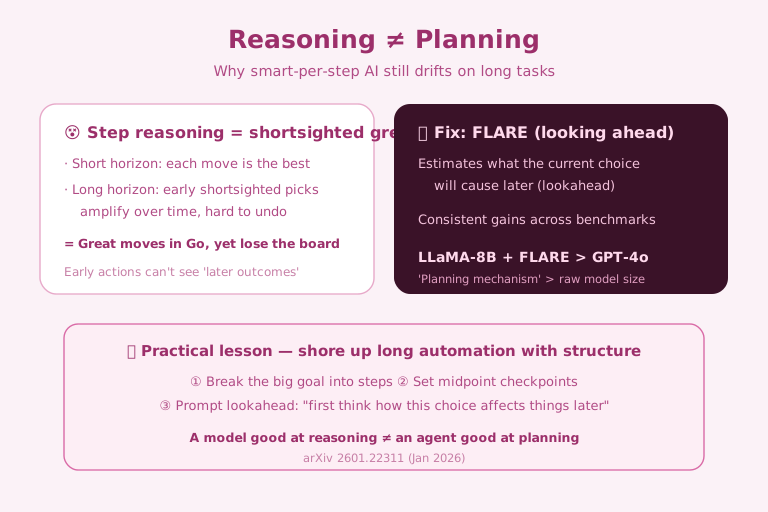
If you've handed an AI a complex, long-running task, you've probably watched it solve each step cleverly yet drift in entirely the wrong direction overall. The paper "Why Reasoning Fails to Plan," published in January 2026, tackles exactly why this happens. Its central finding is that reasoning and planning are different abilities. Step-by-step reasoning is strong over short stretches but turns shortsighted over long ones, and the researchers propose a method called FLARE to make up for it.
What the Paper Is Aiming At
"Why Reasoning Fails to Plan" was posted to arXiv on January 29, 2026, and it analyzes the long-term decision-making of LLM agents through the lens of "planning." As the title suggests, it deals with long-horizon decision-making.
The core claim is clear: the ability to "think" well step by step and the ability to "plan" by looking far into the future are separate things. In other words, being good at reasoning doesn't mean being good at planning.
Strong on the Short, Crumbling on the Long
LLM agents are strong at step-by-step reasoning over short stretches. Each individual judgment is plausible and often correct. The problem arises when those steps stretch out over a long sequence.
The paper points to the phenomenon of agents failing to maintain consistent behavior over a long planning horizon and breaking down. Earlier actions ought to account for later outcomes (delayed rewards and costs), but step-by-step reasoning struggles to see those distant effects.
The Root Cause: "Step-by-Step Reasoning = Shortsighted Greed"
The root cause the paper identifies is that step-by-step reasoning produces a kind of "greedy policy." At each moment it makes the choice that looks best right there, which is enough over a short horizon but becomes poison over a long one.
The trouble is that early shortsighted decisions get systematically amplified over time and become hard to undo. It's similar to how, in the game of Go, each individual move can be the best one while you still lose the board as a whole.
FLARE: A Minimal Mechanism for Looking Ahead
The researchers propose FLARE (Future-aware Lookahead with Reward Estimation). As the name implies, it explicitly inserts a "lookahead" step, a minimal mechanism that estimates and factors in what consequences the current choice will produce later.
The results are striking. Adding FLARE consistently improved performance across multiple benchmarks, and a small model, LLaMA-8B with FLARE applied, outperformed GPT-4o using standard step-by-step reasoning. That's a signal that a "planning mechanism" can matter more than sheer model size.
How to Read This Result
The most eye-catching part is that LLaMA-8B outperformed GPT-4o. This isn't merely a story about a small model winning. Given the gap in parameter scale between the two models, the natural reading is that no matter how much you scale up reasoning ability, without a "planning structure" that ability can't be fully used over long horizons. In short, how you arrange intelligence decides the outcome more than how much intelligence you have.
At the same time, this result cracks the recent marketing wave around "reasoning models." A model that thinks longer isn't automatically a model that sees farther. Thinking longer and looking farther are abilities pointing in different directions, and strengthening the former does not drag the latter along with it. That is this paper's uncomfortable message.
What Practitioners Should Take Away
The practical lesson is clear. Handing an AI a long task wholesale makes it easy to fall into "shortsightedness," so it's better for a human to frame the skeleton of the plan. Break the big goal into steps, set midpoint checkpoints, and induce lookahead with instructions like "first think about how this choice affects things later."
Teams looking to adopt in-house automation or agents especially need to separately verify "how consistently it can carry a long task through," rather than trusting the benchmark scores a vendor puts forward. Cleverness in a short demo does not guarantee reliability across a long workflow. Before adoption, it's safer to run a real, multi-step task all the way through in a pilot.
Open Questions and Limits
Of course, there are caveats. FLARE's benefits were confirmed in the benchmark environments the paper studied, and there's no guarantee they transfer cleanly to your own company's real workflows. You also have to weigh the trade-off that inserting lookahead increases the computation and cost at each step.
Even so, the direction is clear. When designing long-running automation, don't rely on the model's cleverness alone; build in structures that look ahead and look back as well. Recognizing that "a model good at reasoning" does not equal "an agent good at planning" is the starting point.
References: arXiv 2601.22311 · alphaXiv summary
AI & tech,
read in depth
Beyond the headlines — into the context and the structure
AGI Soon As Possible · asapai.co.kr