
What Is Recursive Self-Improvement (RSI)? The Latest Research on AI That Evolves on Its Own
Whether an AI can "get smarter on its own" without human hands is the hottest question in AI research in 2026. This is called Recursive Self-Improvement (RSI), and it has returned to the spotlight since Sam Altman referenced it in connection with GPT-5.6. April's ICLR 2026 hosted the first workshop devoted solely to RSI, and real cases have emerged of AI improving its own algorithms and code. This article lays out what RSI is, how to read the numbers coming out now, and why ASAP thinks "verification" is the real bottleneck.
What the Word "Recursive" Actually Means
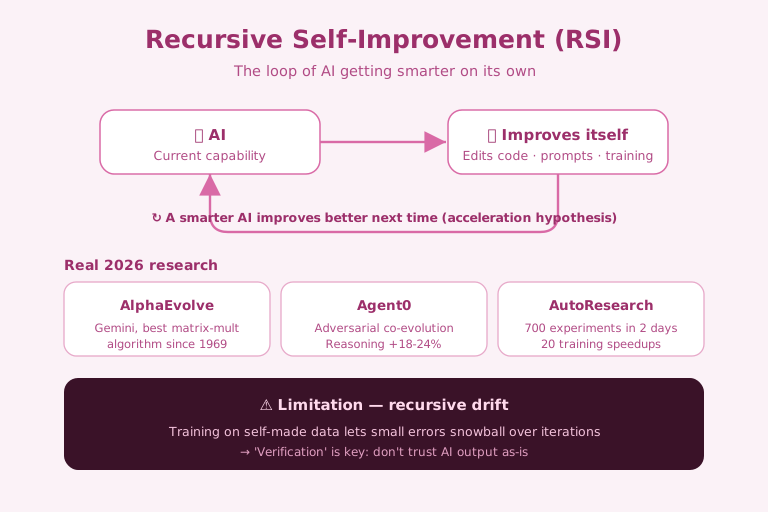
Recursive self-improvement refers to the iterative process in which an AI improves its own performance and then uses that improved capability to improve itself again. Instead of a human stepping in to tune it each time, the picture is one of the model directly editing its own code, prompts, and training data to get better.
There is one easy point of confusion here. Automated hyperparameter search and iterative fine-tuning have existed for a long time. What makes RSI different is the acceleration hypothesis: that an AI which has improved once becomes better at making the next improvement. The output of one improvement becomes the tool for the next, compounding over time. If that hypothesis holds, the slope of the progress curve itself changes, which is exactly why safety and policy researchers take RSI seriously.
Why It Moved From Thought Experiment to Research Agenda
There are two triggers. One is Sam Altman referencing recursive self-improvement capability in connection with GPT-5.6, and the other is ICLR hosting the first dedicated workshop on RSI alone in April 2026. The signal is that a CEO's remark and a dedicated academic track appeared in the same window. It means a concept that used to float around as marketing rhetoric has shifted into a testable research subject.
Cases have indeed appeared of LLM agents rewriting their own code or prompts, and of scientific-discovery pipelines triggering continuous fine-tuning on their own. The debate has moved from "is it possible" to "how far, and how stably, does it go."
How to Read the Cases: What's Striking vs. What Warrants Caution
The most striking case is DeepMind's AlphaEvolve. With Gemini guiding an evolutionary search, it found a faster version of a matrix-multiplication algorithm that had been stuck since Strassen in 1969. As a math problem blocked for over half a century, it shows that RSI gains traction in domains where a machine can clearly verify the result.
The percentages deserve a cooler look. Agent0, through the adversarial co-evolution of two agents posing and solving problems for each other, reported an 18% improvement in math reasoning and 24% in general reasoning. Impressive, but how it feels depends on what baseline and benchmarks those gains were measured against. Karpathy's AutoResearch is reported to have run 700 ML experiments over two days on a single GPU and discovered 20 ways to speed up training. The common thread is clear: RSI works well on narrow problems where correctness can be scored cheaply. The story changes as you move toward open-ended problems where scoring is ambiguous.
ASAP's Take: The Real Bottleneck Is Verification
It's not all rosy. RSI's fundamental hurdle is "recursive drift." When a model trains on data it generated itself, small errors in intermediate reasoning steps accumulate like a snowball over repeated iterations. This is precisely why every case above was a "scorable" problem: the sturdier the grader, the more room there is to catch the drift.
That's why the latest research focuses on "verification." Mechanisms that keep improvement from leaking off in the wrong direction, such as test-time recursive thinking that self-checks without external feedback, or self-alignment combined with symbolic verification, have emerged as the core challenge. As ASAP sees it, the open questions that remain are these: can the verifier itself be trusted, and does that safeguard still work in domains where the right answer is ambiguous?
For the Korean Market and Practitioners
RSI is the entrance to an era of "AI advancing AI." Controlled well, the pace of progress quickens; but if verification is weak, the risk of careening off in a plausibly wrong direction grows just as much. In a domestic environment where training frontier models from scratch is hard, a "verification and evaluation pipeline" can instead be a realistic entry point and point of differentiation.
From a practitioner's viewpoint, the immediate lesson is clear: don't take the results an AI produces on its own (code, data, summaries) at face value; make a habit of adding one more pass of human or separate verification. The smarter the model gets, the more the "value of verification" actually grows.
References: ICLR 2026 RSI Workshop · AI self-improvement 2026 (research roundup)

AI & tech,
read in depth
Beyond the headlines — into the context and the structure
AGI Soon As Possible · asapai.co.kr