
Small Language Models (SLMs): Why They Became the Default
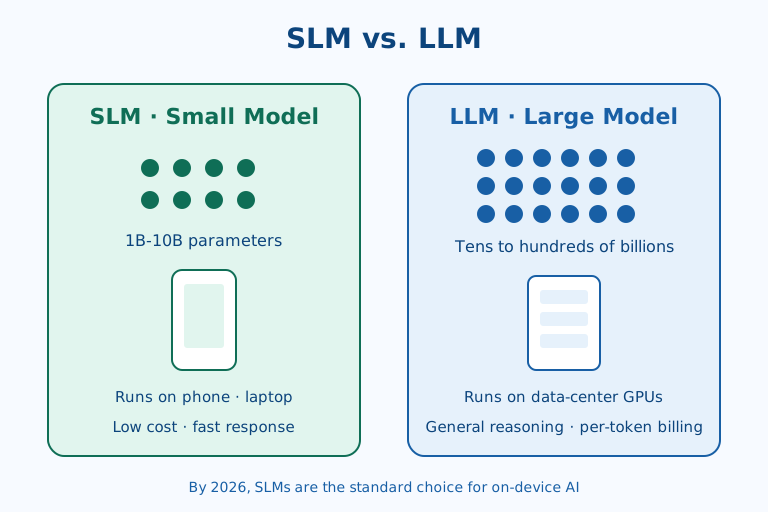
A small language model (SLM) is a language model lightweight enough to run on minimal resources, with roughly 1 to 10 billion parameters. Unlike LLMs that use hundreds of billions of parameters, SLMs took off in 2023 with the arrival of Microsoft's Phi and Google's Gemma, and as of 2026 they have become the standard choice for running inference directly on smartphones, laptops, and industrial devices. The core idea is to use small size to focus on specific tasks and deliver near-LLM quality at far lower cost.
From "Bigger" to "Closer": Why the Direction Flipped
The competition of recent years was a race to grow parameters. SLMs invert that direction. No matter how large you make a model, it never leaves the data center, and per-token billing and latency stay on the user's tab. The 1B-10B range is not an arbitrary number: it is pinned to the boundary where 4-bit quantization shrinks the model to around 2GB, small enough to load whole into a smartphone's or laptop's memory. In other words, an SLM's design goal is not "the smartest model" but "a model that stays on the device." Conceding a little performance in exchange for moving the runtime itself from the data center into your hand is the essence of this shift.
How to Read the Numbers in the Table
| Dimension | Small Language Model (SLM) | Large Language Model (LLM) |
|---|---|---|
| Parameters | About 1B-10B | Tens to hundreds of billions |
| Runtime environment | Smartphone, laptop, single GPU | Data-center GPU clusters |
| Inference cost | Low per-token cost, free locally | High per-token billing |
| Response speed | Fast (low compute) | Relatively slow |
| Strengths | Task-specialized, on-device | General reasoning, long-form generation |
| Representative models | Phi-3, Gemma 2, Llama 3.2 | GPT-4, Claude, Gemini Ultra |
The easy thing to miss here is that "low inference cost" and "fast response" are not free. "Free locally" means no server billing, not free computation, and battery drain and heat surface as a new cost. Speed comes from "low compute," but an SLM is not always faster than an LLM reached over the network. Each row should be read as a list of trade-offs, not absolute advantages. The moment you pick an SLM, you are lowering your own accuracy ceiling in exchange for cost, speed, and privacy.
Korea and On-Device: The Issue Is Data, Not Just Cost
Typical SLM use cases are areas where the task scope is narrow and response speed matters, such as on-device assistants, internal document search, and customer-service chatbots. As of 2026, Apple and Google ship models of around 3B for smartphone message summarization and translation, and companies place SLMs on in-house servers and use them for RAG search to avoid sending sensitive internal data outside. On factory floors, too, SLMs are widely used for single-purpose tasks like code autocompletion and voice-command processing.
From a Korean-market angle, the more decisive variable is data control, not cost savings. In regulated, security-conscious settings where personal data and trade secrets cannot easily be routed through external APIs, an SLM that stays inside the device or the internal network is often the only realistic option, even at slightly lower performance. On top of that, Qwen2.5 has, in 2026, sharply improved its multilingual quality including Korean, largely resolving the language-quality problem that long held back Korean-language local models. This combination is why on-device has crossed from "experiment" to "default option."
The Representative Models and Their Positions
The representative SLM models are four: Microsoft Phi-3, Google Gemma 2, Meta Llama 3.2, and Alibaba Qwen2.5. Phi-3 mini, at 3.8B, delivers excellent reasoning performance for its small size; Gemma 2, in 2B and 9B versions, is widely ported across the open-source ecosystem. Llama 3.2's 1B and 3B see active mobile porting, and Qwen2.5 has, in 2026, sharply improved its multilingual quality including Korean, putting it into real use in local chatbots. The four compete, yet their roles diverge. For reasoning density, reach for the Phi line; for portability and community assets, Gemma and Llama; for multilingual and Korean coverage, Qwen. The point is that this is not a matter of choosing "one SLM," but of choosing the right size and language for the task.
ASAP's View: The Limits and the Open Question
The core limitation of SLMs is that, owing to their small parameter scale, they fall short of LLMs in accuracy on complex reasoning and broad-knowledge tasks. Models with 1 to 10 billion parameters show their limits on the multi-step logic, long-form generation, and specialized-knowledge queries that GPT-4 or Claude, at the scale of hundreds of billions, can solve. Their training-data coverage is also narrow, so hallucinations can increase, which is why as of 2026 most production services combine SLMs with RAG search to shore up accuracy. But saying RAG "shores up" accuracy also means a pure SLM alone has a narrow confidence band. In practice, an SLM is less a standalone brain than one component in a pipeline wrapped with search, rules, and an LLM call when needed. The open question is clear: how much should end on the device, and where should the cloud LLM take over? The success of SLMs hinges not on a race for model size, but on how precisely that boundary is drawn.

AI & tech,
read in depth
Beyond the headlines — into the context and the structure
AGI Soon As Possible · asapai.co.kr