Understanding or Generation Is the Wrong Question: Can One Multimodal Model Do Both Without a "Generation Tax"?
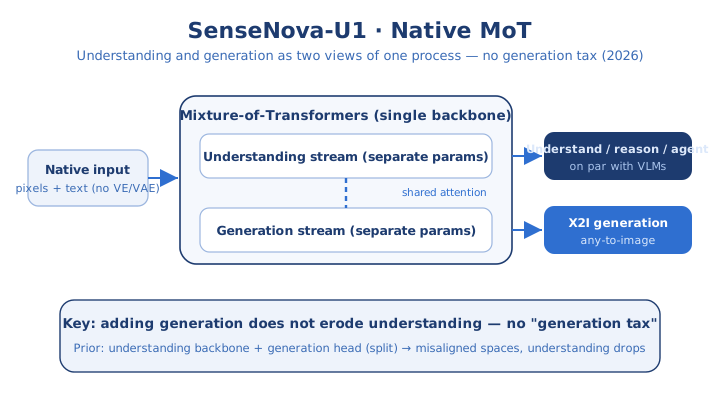
SenseNova-U1 is SenseTime's 2026 native unified model that fuses multimodal understanding and generation into a single process while still matching understanding-only VLMs. Released on May 12, 2026, by Haiwen Diao, Penghao Wu, and colleagues, it argues that bolting a generation head onto an understanding backbone—the standard recipe—leaves the two representation spaces misaligned, and instead uses a native Mixture-of-Transformers (MoT) to treat understanding and generation as synergistic views of one process. The crucial result is that the unified model does not pay the "generation tax" that unified models usually incur.
Unpacking the Term "Generation Tax" First
It helps to pin down the term before anything else. "Generation tax" is a tax metaphor, but what it really names is a performance trade-off: teach one model to draw and its ability to see and reason tends to slip. Most unified models before SenseNova-U1 bolt a separate generation head onto an understanding backbone, which leaves the two representation spaces misaligned as a structural problem.
SenseTime researchers Haiwen Diao, Penghao Wu, and colleagues argue this misalignment is not merely a lack of training but a consequence of the split design. In other words, it is not a problem that disappears by adding more data or training longer; it is a problem of placement, of having put the two abilities in separate rooms from the start. The result is a "generation tax": the more generation capability you add, the more understanding and reasoning performance erodes.
One Backbone, Two Streams: What MoT Is Aiming At
The native Mixture-of-Transformers (MoT) is an architecture that places an understanding stream and a generation stream inside a single backbone while letting them keep interacting through shared attention. Released in 2026, SenseNova-U1 processes pixel and text inputs directly without a separate vision encoder (VE) or VAE, and sits this MoT on top of a native unified paradigm called NEO-unify.
The two streams share the same token sequence and attention structure but use separate parameters for understanding versus generation. At first glance that looks contradictory: if the cause of misalignment was "separation," why split the parameters again? The point of the design is not the parameters but the shared attention. Each ability keeps its own weights yet references the other over the same context, so understanding and generation evolve together as two views of one process.
Its operation can be summarized in three stages:
- Near-lossless visual interface: two-layer convolutional encoding and MLP-like decoding take pixels directly, minimizing information loss.
- Native MoT backbone: the understanding and generation streams are separated internally but linked through shared attention.
- X2I generation: a single model performs any-to-image generation from text, images, or other inputs.
What the Benchmarks Say, and What They Don't
SenseNova-U1 is reported to rival top-tier understanding-only VLMs across text understanding, vision-language perception, knowledge reasoning, agentic decision-making, and spatial intelligence, while simultaneously achieving strong any-to-image (X2I) generation. In short, the central claim is that adding generation capability did not erode the understanding side.
Laid out side by side, the conventional wisdom about unified models flips.
| Aspect | Earlier unified models | SenseNova-U1 |
|---|---|---|
| Architecture | Understanding backbone + generation head (split) | NEO-unify · native MoT |
| Representation space | Misaligned | Aligned via shared attention |
| Understanding | Drops when generation is added (generation tax) | On par with understanding-only VLMs |
| Generation | Separate head | Single-model X2I |
One caveat when reading the table: words like "rival" and "on par" mean different things depending on which understanding-only VLM is the point of comparison. Even at parity with the best, a model can edge ahead on some sub-tasks and fall slightly behind on others, and "no generation tax" is an average impression rather than a guarantee of zero loss on every metric.
At What Scale Was It Released?
SenseNova-U1 is available as two variants built on an 8B dense and a 30B-A3B mixture-of-experts (MoE) understanding baseline, respectively. They are SenseNova-U1-8B-MoT and SenseNova-U1-A3B-MoT, and SenseTime fully open-sourced them.
The scales break down as follows:
- SenseNova-U1-8B-MoT: built on an 8B dense understanding baseline.
- SenseNova-U1-A3B-MoT: built on a 30B-A3B MoE baseline (around 3B active parameters).
- Both: native MoT on top of NEO-unify, with X2I generation built in.
What It Means for Practitioners
Full open-sourcing is especially practical for teams on the ground. The 8B dense variant leaves room to experiment even on single-GPU-class hardware, and the 30B-A3B keeps around 3B active parameters, capturing exactly the MoE advantage of holding inference cost low relative to total parameters. If a pipeline that once ran understanding and generation as two separate models can be collapsed into one, the serving stack and maintenance burden shrink.
The judgment still has to be redone on your own data, of course. Fusing understanding and generation into one model is not always optimal, and how well the gains hold on your language- or domain-specific tasks is something to confirm by reproducing them yourself. Since these results rest on the benchmarks and design claims SenseTime presents, it is safer to assume from the outset that outcomes may vary by task and evaluation.
The real significance of SenseNova-U1 is showing that "understanding or generation" is the wrong question to ask. As of 2026, binding understanding and generation into one process while preserving understanding performance structurally refutes the assumption that unification must come at a cost.

AI & tech,
read in depth
Beyond the headlines — into the context and the structure
AGI Soon As Possible · asapai.co.kr