The real bottleneck in the AI era is not learning but unlearning your existing workflow
As AI makes execution cheap in 2026, the milestone for differentiation is shifting from tool skill to taste and intent. Yet the biggest bottleneck is not learning a new tool but unlearning the existing workflow baked into your habits. The larger the scale and the more complex the workflow, the more steeply this unlearning cost rises. ASAP lays out why this matters now, how it differs from the earlier framing, and how to read it in practice.
Why this bottleneck surfaces now
Until recently, most AI-adoption talk centered on "what should we learn": prompt courses, tool onboarding, internal training. That framing worked because past automation was a local improvement that replaced a single task. But when the cost of execution trends to zero, the axis of differentiation moves to what and why you make. AI now handles the act of producing code, images, video, and documents, so what remains distinctive for a person is the taste that chooses what to make and the intent behind why. As average output quality levels up, the judgment that sets direction becomes the competitive edge. That naturally raises a suspicion: for organizations that lag, the problem may not be a shortage of learning at all.
How the learning frame differs from the unlearning frame
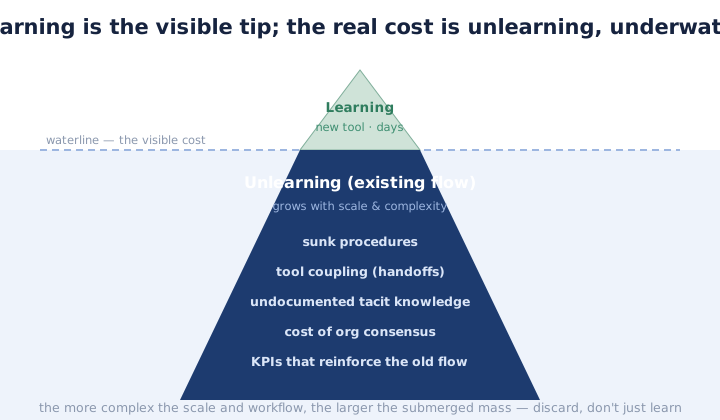
A new tool takes 2-3 days to pick up, but discarding an existing flow takes months. People and organizations are strongly anchored to procedures they have long trusted as efficient, while AI flows demand not incremental improvement but wholesale replacement of those procedures. Here the two frames split. The learning frame counts the cost as an individual's time; the unlearning frame counts it as an organization's inertia. The former is solved by a course, the latter is not. The hard part is not learning but letting go, and this asymmetry is the core reason transitions stall.
Read the curve, not the number
Unlearning cost rises in proportion to the number of workflow steps and the number of people involved. A one-person simple task switches to a new flow instantly, but a workflow with many steps and many people requires agreement, retraining, and tool rewiring at every touchpoint. That is why, paradoxically, the ROI of AI adoption appears later in larger organizations. This is exactly where adoption statistics mislead. Transposing a small team's fast wins onto a large enterprise sets the wrong expectation. What to watch is not a single figure but a cost curve whose slope changes with organization size.
Why complex workflows get more deeply entrenched
Five distinct entrenchment factors are what keep complex workflows from changing even when AI is clearly better. The table also shows why each one resists a learning-only fix.
| Entrenchment factor | What holds it back |
|---|---|
| Sunk procedures | Belief that the steps are proven blocks any change |
| Tool coupling | Existing tools and handoffs are bound together, hard to swap at once |
| Tacit knowledge | Undocumented know-how does not carry into the new flow |
| Organizational consensus | More people means higher cost of agreeing to change |
| Metrics | Old KPIs keep reinforcing the old flow |
How to design for unlearning
Unlearning does not happen on its own, so it must be designed deliberately. The five steps ASAP recommends are as follows.
- Cut it small and retire then rebuild one workflow at a time.
- Explicitly declare the end of the old procedure. Running both in parallel delays unlearning indefinitely.
- Document tacit knowledge first and migrate it into the new flow.
- Replace KPIs to fit the new flow so they no longer reinforce the old one.
- Codify taste and intent as the criteria for the judgment you delegate to AI.
Limits and open questions (ASAP's view)
The frame is powerful but not universal. First, not every old procedure is inertia. Steps that persist for a reason, such as regulatory, safety, or audit requirements, will cause accidents if you mistake them for mere habit and discard them. You need a criterion that separates unlearning from removing a real safeguard. Second, "declare the end of the old procedure" is dangerous advice without a rollback path. Parallel operation does delay unlearning, true, but you must also design a recovery plan for when a full replacement fails. Third, the claim that taste and intent are the milestone leaves the harder question of how you build and validate that taste in the first place. In the end, the AI transition is decided not by what you learn anew but by what you discard fast and safely. Whoever manages the unlearning curve, not just the learning curve, sets the pace of the transition.
AI & tech,
read in depth
Beyond the headlines — into the context and the structure
AGI Soon As Possible · asapai.co.kr