
Amazon Challenges Nvidia by Selling Its Own AI Chip 'Trainium' Externally
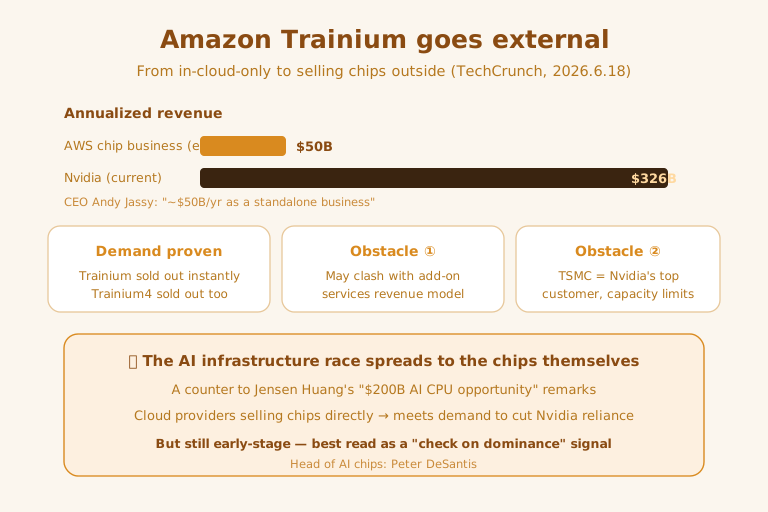
Amazon Web Services (AWS) is in early-stage talks to sell its in-house AI chip, Trainium, to other companies and data centers, marking a shift away from its long-standing practice of keeping the chips inside its own cloud. Reported by TechCrunch on June 18, 2026, the move would break with AWS's tradition of never selling chips externally. CEO Andy Jassy said that selling the chips as a standalone business could generate "roughly $50 billion in annual revenue."
The Weight of Deciding to Sell a Chip It Never Sold
AWS is weighing whether to sell Trainium, its in-house-designed AI training chip, to external customers. This represents a departure from its previous strategy of restricting the chips to use within its own cloud. On the surface this looks like a story about selling one more product, but the real weight lies elsewhere. For a cloud operator, an in-house chip has been a weapon for cutting costs and controlling performance. Hand that weapon to outsiders and even rival clouds could end up running on Amazon's silicon. The mere fact that Amazon is toying with this option signals that the math has shifted: the profit from selling chips now looks large enough to outweigh the advantage of keeping them exclusive to its own cloud.
How to Read the $50 Billion Figure
CEO Andy Jassy said that running the chips as a standalone business could bring in roughly $50 billion in annual revenue, a figure comparable to Intel's annual sales. Yet this number should be read as a potential scale floated by a CEO, not as booked revenue. It is closer to an ambition to grow a single semiconductor business to Intel's league than a result already in hand. Even so, the fact that Amazon aired such a figure publicly reveals its intent to stand the chip business up as an independent profit-and-loss unit rather than an accessory to the cloud.
Why Proven Demand Comes First Here
Demand for Trainium sold out the moment it launched. The first batch of Trainium chips sold out immediately, and the next-generation Trainium4, which had been supply-constrained for over a year, also sold out as soon as it was released. In other words, internal demand alone already stretches supply thin, and selling externally is an attempt to extend that strong demand beyond the cloud. What is worth noting here is the sequence. A new chip usually knocks on the market worrying whether it will sell; Trainium's problem is how to divide up demand that already overflows. Choosing to explore external sales in that situation suggests either enough production confidence to fill internal demand with room to spare, or a strategic reason to lock in a specific large customer.
The Gap With Nvidia, and an Expanding Front
This move takes more direct aim at Nvidia. Nvidia's current annualized revenue run rate is about $326 billion, still a wide gap from AWS's estimated $50 billion. On the numbers alone it looks less like a challenge and more like a chase. But the picture changes when read as a counter to Nvidia CEO Jensen Huang's recent remarks about a $200 billion opportunity in the "AI CPU" market, because it signals that the rivalry between the two companies is now expanding beyond GPUs. A large gap does not mean there is no threat. For Nvidia, the sorest point is not the revenue ranking but the very trend of cloud operators, once its biggest customers, turning into alternative chip suppliers.
What the Obstacles Reveal About the Business
External sales come with structural tension. AWS makes money not only from chip compute but also from add-on services such as storage, security, networking, and monitoring, so selling chips on their own could clash with that model. Manufacturing constraints are also significant. Contract manufacturer TSMC is currently Nvidia's largest customer, making it hard to secure additional capacity. Amazon's head of AI chips is Peter DeSantis. These two obstacles differ in nature. The clash with add-on services is an internal problem Amazon can tune on its own, but TSMC capacity is an external variable that pits it head-to-head against Nvidia for a place in line. In short, the larger bottleneck sits on the side Amazon cannot control.
Why to Read This as a Signal of Pushback
This news shows that the AI infrastructure race is spreading to the chips themselves. Once cloud providers start selling chips directly, the market dynamics shift, dovetailing with demand to reduce reliance on Nvidia. That said, given that this is still an early-stage discussion with clear manufacturing and business-model constraints, it is more accurate to read it as a "signal of pushback against Nvidia's dominance" than as a near-term shake-up. For investors and developers, the right posture now is not to conclude that the board has been fully read, but to watch as an observer for the next signal: whether external sales translate into actual contracts and volume.
References: TechCrunch — Amazon hopes to challenge Nvidia more directly by selling its AI chips (2026.6.18)

AI & tech,
read in depth
Beyond the headlines — into the context and the structure
AGI Soon As Possible · asapai.co.kr