After the Block, Anthropic Opens a Seoul Office — Global AI Converges on Korea
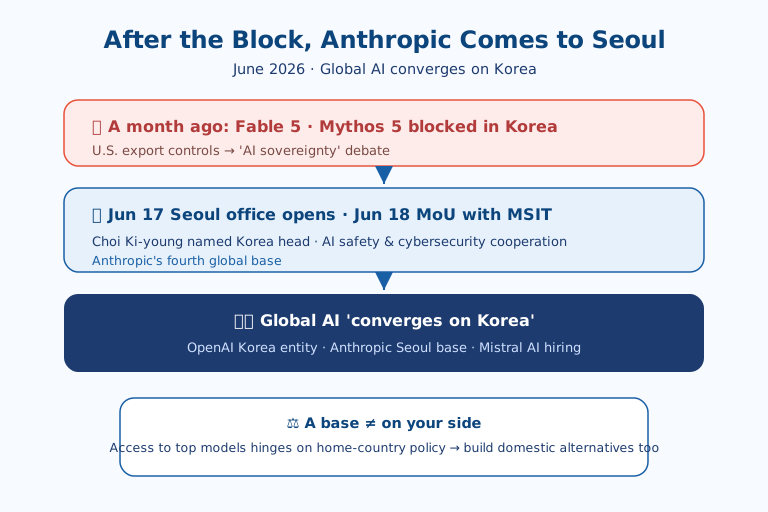
Just a month after rattling Korea by blocking Fable 5, Anthropic has returned with the opposite move. On June 17, 2026, it officially launched its Seoul office, and on the 18th it signed a memorandum of understanding (MoU) with the Ministry of Science and ICT to cooperate on AI safety and cybersecurity. With Anthropic now setting up a base after OpenAI established a Korean entity and Mistral AI began hiring Seoul-based staff, the center of gravity for global generative-AI companies is tilting toward Korea.
Two Events in Twenty-Four Hours
What stands out is the sequence and the speed. Office launch on June 17; an MoU with a government ministry a day later, on the 18th. Earlier, last month, Anthropic had appointed Choi Ki-young as its Korea country head to prepare for the move. Announcing the office opening and the government pact just 24 hours apart reads less like coincidence and more like a staged entry sequence. The Seoul office is reported to be Anthropic's fourth global base, and that ordinal alone hints at how high Korea sits on the company's list.
The telling detail is the subject of the pact. Not a sales contract or a data-center investment, but "securing AI safety and cybersecurity." That is the first card a safety-branded company would play in partnering with a government: establishing legitimacy before commerce, a classic way to enter a market.
The Opposite Move in a Month — What Changed
Only a short while ago, Anthropic fully cut off Korean access to Fable 5 and Mythos 5 under U.S. export controls, sparking an "AI sovereignty" debate. That same company opened a Seoul office and signed a safety agreement with the government in under a month. Blocking the latest models while planting a base — that two-sided picture is the heart of this story.
It looks contradictory, but from Anthropic's side it is consistent. Export controls are a variable Washington sets; market entry is a variable the company sets. By operating control and expansion separately, it can offload regulatory risk onto home-country policy while steadily widening its market relationships. For Korea, "control" and "expansion" arrive at the same time.
Why Korea, and Why Now
The trend of global AI companies flocking to Korea is unmistakable: OpenAI set up a Korean entity, France's Mistral AI is hiring Seoul-based staff, and now Anthropic has established a base of its own. In just one year, major companies have set up bases in Seoul one after another.
Behind this lies Korea's competitive edge in semiconductors and infrastructure and its fast-adopting AI market. With strong demand for data centers and cloud, and rapid uptake across business and the public sector, Korea is seen as highly attractive as both a testbed and a market. That three companies chose the same city in the same window backs up the read. Flip it around and Korea, for a brief moment, holds negotiating leverage: with a bidding war under way, now is the time to ask for terms.
ASAP's View: A Base Is Not an Ally
A local base doesn't automatically make a company "on your side." As the Fable 5 case shows, access to the latest models can be swayed by the home country's policy at any time. The office may sit in Seoul, but the switch that turns models on and off sits in the United States. Even with a base courted, domestic alternatives and homegrown capabilities remain necessary.
In the end, the key is balance. Make use of global companies' investment in Korea, but spread the risk so that critical work isn't locked into a single foreign model. The open questions are clear, too: whether this MoU is a concrete commitment or merely a declaration, and whether the Seoul office houses real R&D or is a sales front, is not yet confirmed. The real gauge is the execution that follows, not the glossy launch announcement.
References: The Korea Economic Daily · Etoday
AI & tech,
read in depth
Beyond the headlines — into the context and the structure
AGI Soon As Possible · asapai.co.kr