Behind the Fable 5 Ban: A 'Korean Telecom Suspected of China Ties' — All Three Carriers Flatly Deny It
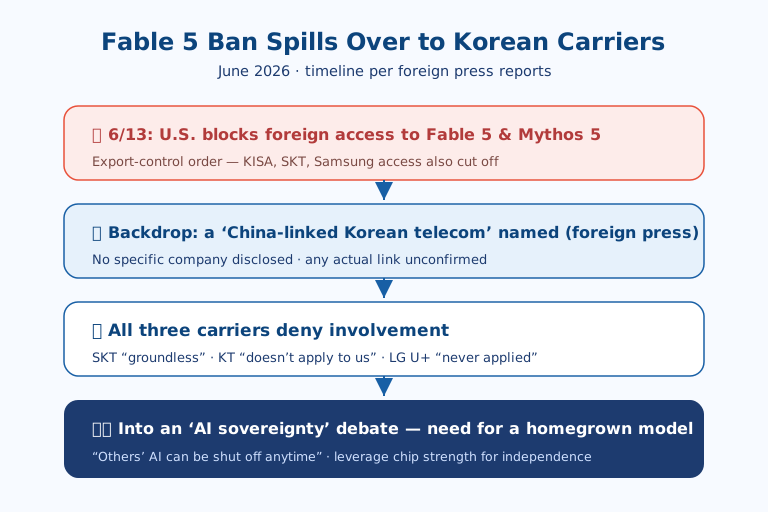
Foreign press reports say that behind the U.S. decision to block foreign access to Anthropic's top-tier AI models, "Fable 5" and "Mythos 5," lies a "Korean telecom carrier suspected of ties to China." On June 13, 2026, Anthropic blocked overseas access to the two models under a U.S. government export-control order, and a June 17 report saw the fallout spread to Korea's telecom industry. No specific company has been named, however, and all three of Korea's major carriers — SK Telecom, KT, and LG Uplus — have denied any involvement. The episode is escalating beyond a simple security issue into a debate over Korea's "AI sovereignty."
A Launch Reversed in Four Days: The Timeline
Anthropic unveiled Fable 5 — strong at long-horizon tasks — on June 9, but just four days later, on June 13, it blocked foreign access under a U.S. government export-control order. At that point, access was also cut off for Korean institutions and companies that had been granted access through the security consortium "Project Glasswing," including the Korea Internet & Security Agency (KISA), SK Telecom, and Samsung Electronics.
Fable 5 is a model safety-tuned for general public release, while the bundled "Mythos 5" is a security-specialized model that finds software vulnerabilities at an expert level. It was precisely this security capability of Mythos 5 that the U.S. viewed as sensitive.
Why Mythos 5 in Particular: The Dual Nature of a Vulnerability-Finding Model
The telling detail is that the center of gravity of the ban sits on Mythos 5, not Fable 5. The ability to find software vulnerabilities at an expert level is a hardening tool for defenders, but in the wrong hands it becomes a weapon for mass-producing attack targets. The same capability is both shield and spear depending on who holds it.
Bundling Fable 5 into the block alongside it signals that the U.S. treats this duality as something to be managed. Ultimately, the focus of the regulation has shifted from "what the model knows" to "who gets to use that capability."
The Rationale the U.S. Gave
Anthropic said that U.S. authorities had identified a way to circumvent the safeguards designed to prevent misuse of the model. Foreign press pointed to a backdrop in which "a group linked to China had secured access privileges," and noted that the U.S. government had lost confidence in Anthropic's ability to protect the technology.
The U.S. Department of Commerce made clear its position that government authorization is required to provide cutting-edge AI models to foreign nationals. It is a signal that the U.S. has begun treating AI, like semiconductors, as a strategic technology bound up with national security.
Which 'Korean Telecom' Was Named?
Foreign outlets including The Washington Post and Semafor pointed to a "Korean telecom carrier suspected of ties to China" as the trigger for the export controls, but did not disclose a specific company name. As a result, all three of Korea's major mobile carriers have come under a cloud of suspicion at home.
The key point is that the existence of any actual link has yet to be confirmed. There are only anonymous, circumstantial reports; which company was involved, and through what channel, has not been officially established.
The Denials Differ in Tone: How to Read the Three Cards
The three companies' denials are worded subtly differently, and reading their tone changes how much they tell you. SK Telecom acknowledged holding the access privileges outright, then denied only the "China link" — a defense that narrows the argument to equipment and the core network because the access itself cannot be hidden. LG Uplus's "never applied" is closer to an outright denial that cuts off the question of access altogether, while KT's "does not apply to us" is the shortest and most ambiguous.
The strength of a denial alone cannot establish innocence, but in the "all-three-suspected-at-once" frame created by anonymous reporting, how each carrier draws its line offers a clue to the direction any fact-checking will take.
Spilling Over Into an 'AI Sovereignty' Debate
The episode has ignited a debate in Korea over "AI sovereignty" (sovereign AI). Lim Jong-in, a professor at Korea University, assessed that "it means the U.S. views advanced AI as a military-grade strategic asset from an economic and security standpoint," while Ha Jung-woo, a former presidential AI adviser, stressed that Korea should maintain global cooperation while building independent capabilities to prepare for similar situations.
The Ministry of Science and ICT said it was "verifying the facts and discussing response measures under the coordination of the National Security Office." With it now clear that access to U.S. AI can be cut off at any time, the need to secure a homegrown foundation model has come back into focus.
What This Means for the Korean Market
The advice to leverage semiconductor manufacturing is directionally right, but foundation-model self-reliance is not filled by chip-making capacity alone. It is a long game that also requires data, training infrastructure, and safety-verification systems. The practical lesson this ban leaves is less the binary of "self-reliance or dependence" and more a case for redundancy design that runs the latest foreign models and homegrown alternatives at the same time.
At the same time, there is room to view this episode with a cool head. The structure is one in which anonymous, circumstantial reporting — with no confirmed link yet — is driving the policy conversation ahead of the facts. Independent of the case for self-reliance, the true size of the risk can be priced accurately only once the facts are established. Ultimately, the Fable 5 ban reads as both a warning that "someone else's AI can be switched off at any time" and a homework assignment to keep the pace of the response matched to the pace of the evidence.
References: The Kyunghyang Shinmun (English) · The Korea Times
AI & tech,
read in depth
Beyond the headlines — into the context and the structure
AGI Soon As Possible · asapai.co.kr