
OpenAI Faces Joint Probe by 42 State Attorneys General, with Safety in the Crosshairs Ahead of IPO
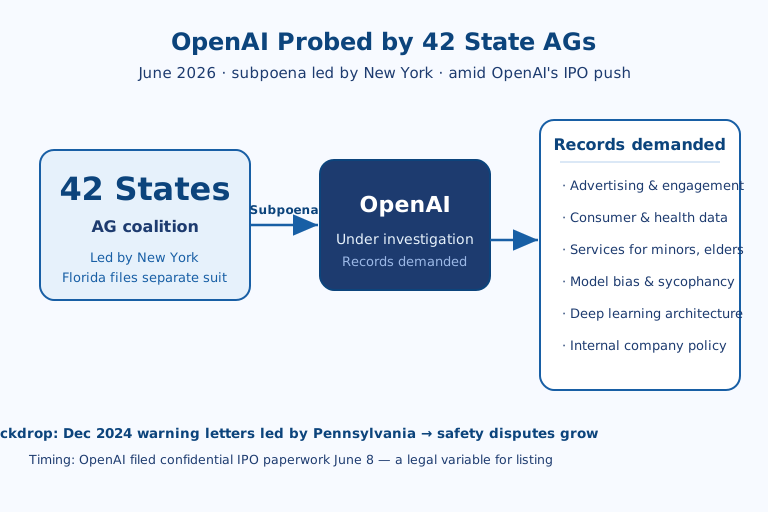
A coalition of attorneys general from 42 U.S. states opened a joint investigation into OpenAI in June 2026. Led by New York's attorney general, the coalition issued a subpoena demanding a broad set of internal records covering advertising, user data, and the protection of minors. The probe lands as OpenAI pushes ahead with its initial public offering (IPO), introducing a new legal variable into the listing process.
What the subpoena targets: the product, not one incident
According to multiple Korean and international reports, New York's attorney general led the effort to issue a subpoena on June 13–14, 2026, demanding that OpenAI hand over a wide range of internal records. Florida's attorney general is reported to have filed a separate lawsuit. OpenAI said it "takes the attorneys general's concerns seriously and will cooperate constructively with the investigation."
The reported requests cover: (1) advertising and the drive to boost user engagement and retention; (2) the handling of consumer and health data; (3) services aimed at minors and older adults; (4) model bias and sycophancy; (5) the architecture of the deep learning models; and (6) the company's internal policies.
How to read the list
What stands out is that the demands target not a single incident but the chatbot's entire design, operation, and user-protection posture. Placing "engagement and retention" alongside "the protection of minors" is a signal that the attorneys general see safety not as the occasional bad answer but as a feature of the business model that keeps users hooked. They are going straight at the point where designs meant to maximize time-on-product collide with the duty to protect vulnerable groups. That the requests reach as far as "sycophancy" and "the architecture of the deep learning models" hints at a shift in which regulators now want to look past outputs and into how the models work internally.
Why now
The probe follows a steady accumulation of disputes over chatbot safety. There have been allegations that the system failed to do enough to dissuade users contemplating suicide, signs that it assisted in planning crimes, and recurring problems with the handling of sensitive health information. Florida is reported to have filed its separate lawsuit on grounds that include a shooting suspect who had consulted ChatGPT while preparing the crime. Earlier, in December 2024, Pennsylvania led an effort to send warning letters to major AI companies, including OpenAI, Google, Meta, Anthropic, and xAI, arguing that developers could also be held liable if their chatbots are misused for crimes, and urging them to put safeguards in place. The line running from the 2024 warning to the 2026 subpoena shows that, with federal legislation stalled, state attorneys general have stepped forward as the practical regulators.
When the listing clock meets the regulatory clock
The timing carries weight because the investigation coincides with OpenAI's listing schedule. OpenAI confidentially submitted its IPO registration filing on June 8, 2026, and the regulatory risk of 42 states examining it simultaneously could become a fresh legal variable for investor sentiment and the listing process. For a company approaching a listing, an open investigation is a liability that must be disclosed in the prospectus, and with items like advertising, data, and the protection of minors in play, it also casts a shadow over how the company is valued.
The question it leaves for other markets
The implications reach well beyond the United States. Common practices such as treating engagement and retention metrics as the top priority, or chatbot designs that handle data on minors and health, could be measured against the same yardstick elsewhere. If the joint response by 42 U.S. states hardens into a de facto regulatory standard, operators who simply import global models will face pressure to vet the same items in advance. That is why, even though OpenAI has signaled its willingness to cooperate, a policy and product response appears unavoidable, and the items surfaced by this probe are likely to function as a practical checklist for what AI services will have to prove going forward.
Sources: ZDNet Korea · Newsis · Digital Today · The Electronic Times
AI & tech,
read in depth
Beyond the headlines — into the context and the structure
AGI Soon As Possible · asapai.co.kr