
NPU vs. GPU: Why AI Chips Won't Merge Into One
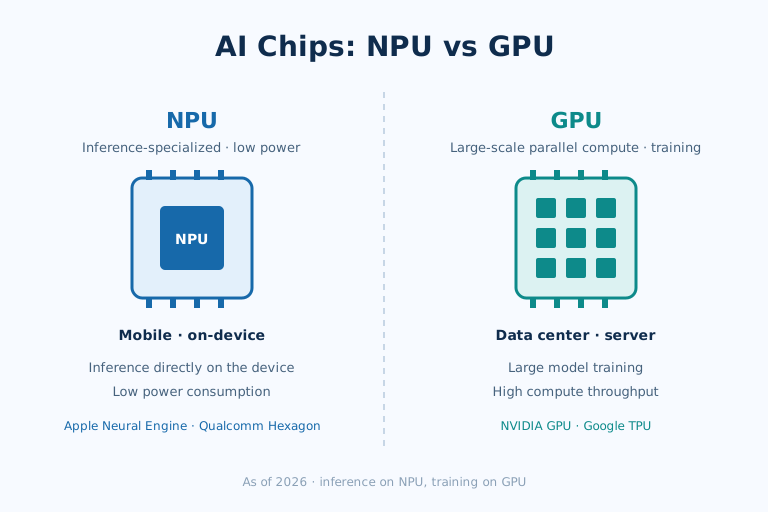
The biggest difference between an NPU and a GPU is their design purpose and the environment they are built for. An NPU is a low-power processor specialized for neural network inference that handles mobile and on-device AI, while a GPU performs large-scale parallel computation for AI model training and data center inference. As of 2026, Apple, Qualcomm, NVIDIA, and Google divide these two domains between them with their respective AI chips.
It Comes Down to Two Markets: Training and Inference
What really separates the two chips is not the spec sheet but the job each does. Training, the work of building a model, requires a massive burst of computation all at once, while inference, the work of using a finished model, requires short, repetitive computation to run continuously at low power. A GPU is a general-purpose accelerator that performs large-scale parallel computation across thousands of cores, suited to the former; an NPU is a dedicated accelerator that handles inference operations such as matrix multiplication and convolution at low power, suited to the latter. So the two are less competing products than occupants of two different markets.
Why It Doesn't Consolidate Into a Single Chip
If the GPU is so powerful, why not just do everything with one? The natural question runs into the constraint of on-device. A GPU has overwhelmingly high computational throughput, but at a great cost in power consumption. In an environment where battery and heat are the limit, like a smartphone, that approach simply does not hold. The fact that an NPU processes data directly on the device rather than sending it to the cloud is not merely a speed matter; it is a design choice that reduces both response latency and the risk of leaking personal data. That is why division of labor, rather than consolidation, persists.
Look at Where the Chip Lives, Not Just the Numbers
When comparing chips, people tend to reach first for raw performance figures, but what actually shapes the experience is location and purpose. The table below lays out that division of labor.
| Category | NPU | GPU |
|---|---|---|
| Primary use | Neural network inference | Model training and large-scale inference |
| Power consumption | Low (low-power) | High |
| Typical location | Mobile / on-device | Data center / server |
| Design characteristic | Optimized exclusively for inference | General-purpose large-scale parallel computation |
| Representative products | Apple Neural Engine, Qualcomm Hexagon | NVIDIA H100/B200 |
Even within "inference," the kind that processes countless requests at once in a data center goes to the GPU, while the kind that must respond instantly in your hand goes to the NPU. The fact that in 2026 a substantial share of the generative AI features on Galaxy and iPhone devices runs on the NPU, and keeps working even when the network is down, illustrates this split well.
What to Choose in Practice
For a practitioner, the decision rule is clear. If you are training a model or running large-scale service inference, GPU-based infrastructure is the answer; if you want to run photo enhancement, speech recognition, or translation offline inside an app, you have to design around an NPU. On-device cuts server costs and privacy exposure, but it leaves you with the homework of NPU performance variation across devices and the need to shrink your models.
Limits and Open Questions
The boundary is steadily blurring. In 2026 the Google TPU is a dedicated chip that handles both training and inference on Google Cloud, which does not fit neatly into the NPU/GPU dichotomy. How long NVIDIA's hold on the majority of the data center AI training market lasts as on-device inference grows, and how far the range of workloads that can move to the device will expand, remain open questions. One thing is clear for now: hardware is split to fit two different jobs, training and inference, and that division of labor underpins the AI ecosystem for the time being.
Source: Apple, Qualcomm, NVIDIA, and Google official product information (2026)

AI & tech,
read in depth
Beyond the headlines — into the context and the structure
AGI Soon As Possible · asapai.co.kr