AI Image Generator Rankings 2026: Top Models Sorted by Blind Vote, Not Taste
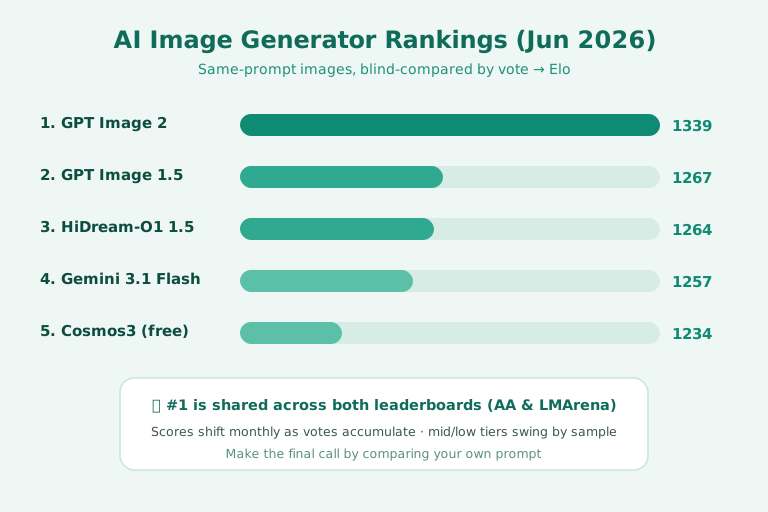
Which AI image generator is better easily turns into an argument about taste. The blind arena is an attempt to end that argument with data. As of June 2026, the Artificial Analysis Text-to-Image Arena has people blind-compare two images made from the same prompt, brand hidden, and vote, assigning Elo scores; the current #1 is OpenAI's GPT Image 2. That said, because scores keep shifting as votes accumulate, they read more accurately as "the current trend" than as a fixed hierarchy.
Why a "blind vote" of all things
Image quality doesn't have a single right answer. Unlike metrics you can measure with a ruler, such as resolution or speed, the judgment that something "looks better" varies from person to person and is easily swayed by brand recognition. So the arena hides the brand, has models compete on the same prompt, and converts human preference into an Elo score. Its core idea is to aggregate, through many eyes, the "sense of polish" that automated metrics can't capture. Put the other way, the score reflects "average taste," not an answer key.
How to read the top scores
#1 is GPT Image 2 (high) at Elo 1340, and it also holds first on the LMArena image arena, so both leaderboards crowned the same model. Below it come MAI-Image-2.5 at Elo 1274, HiDream-O1-Image-1.5 at 1263, GPT Image 1.5 (high) at 1262, and Google's Gemini 3.1 Flash Image ("Nano Banana 2") at 1255.
What deserves attention here isn't the ranking but the gaps. Places two through five are bunched within 20 points. In that band, differences driven by the prompt and use case matter more than any ranking of one model over another. The gap between #1 and #2, by contrast, is more than 60 points, which reads as GPT Image 2 leading evenly on prompt comprehension and overall polish. In practice, then, it's more useful to treat #1 as "a notch above" and #2 through #5 as "effectively a tie." (The latest ranking is kept current on ASAP's [AI Leaderboard](/leaderboard/image-generation/).)
Free open weights as a second axis
Among open-weight models—those whose weights are public so you can run them yourself for free—Cosmos3-Super-Text2Image ranks #1 at around Elo 1226, followed by HiDream-O1-Image-Dev and the Flux 2 family (Black Forest Labs). That they sit roughly 100 points behind the top closed models is a signal that open weights are no longer a "grade you tolerate because it's free," but one you can seriously choose based on the task. The advantage is running them on your own server at no cost with fine-grained control; the condition attached is that you clear the entry barrier of installation and PC specs yourself.
What it means for Korean practitioners
In Korea, two variables come up most often: one is rendering Korean-language text, the other is handling commercial copyright. Even the overall #1 is a non-starter in real work if the Korean text meant for a poster comes out mangled, and in these fine-grained areas another model may come out ahead. Open weights, which can run in-house without sending data outside, can even be the top axis for organizations sensitive about security and copyright. Rather than adopting the leaderboard's #1 as-is, it's better to define the constraints of your own work first.
Limitations and open questions
The rankings differ slightly from leaderboard to leaderboard. Artificial Analysis uses Elo while the LMArena family uses something like TrueSkill—the scoring methods differ—and the voting samples and candidate rosters differ too. A model that multiple sources commonly crown #1 is highly reliable, but mid- and lower-tier rankings swing with the sample. Beyond that, a blind vote captures "first-impression preference" well but tends to miss flaws like finger counts or text accuracy. So use the rankings only as a starting point for narrowing candidates, and make the final call by running your own prompt yourself.
Compare them yourself with the same prompt
The final check is feeding the same prompt to several models and comparing with your own eyes. If you generate them all in the same horizontal 16:9 ratio, the sizes are uniform—handy for laying results side by side or bundling them into a card-news format.
[Korean] A person working on a laptop at a rooftop cafe at
sunset, warm golden-hour light, a coffee cup with the text
"ASAP", photorealistic, cinematic, 16:9 landscape ratio.
[English] A person working on a laptop at a rooftop cafe at
sunset, warm golden-hour light, a coffee cup with the text
"ASAP", photorealistic, cinematic, 16:9 landscape ratio.
You can try each model directly on the pages below. Feed in the same prompt and see how the text ("ASAP"), the lighting, and the composition of the person differ—the differences jump out at a glance.
- GPT Image 2 · 1.5 (OpenAI) — generate images in ChatGPT
- Gemini 3.1 Flash Image (Google) — Gemini or Google AI Studio
- Flux 2 (Black Forest Labs) — the official playground at bfl.ai/play
- HiDream — weights at hidream.org or Hugging Face
- Cosmos3 and other open weights — run them directly on Hugging Face
References: Artificial Analysis - Text to Image Leaderboard · LLM-Stats - Best AI for Image Generation

AI & tech,
read in depth
Beyond the headlines — into the context and the structure
AGI Soon As Possible · asapai.co.kr