Best AI Video Generators 2026, Compared: Veo 3.1, Kling 3.0, and Sora 2 — Which Should You Pick?
With AI video generators, "which is best?" is really the wrong question. As of 2026 the top tier is three models—Google Veo 3.1, Kling 3.0, and OpenAI Sora 2—with Runway Gen-4.5 close behind, but the four solve different problems. Veo leads on quality, Kling on value and series production, and Sora on physics and cinematic texture. In this piece ASAP lays out each model's one-line verdict, strengths, and pricing—and, past the numbers, points to which kind of creator each one actually favors and why.
The "overall #1" trap
Pick a tool by reading only the top row of a benchmark table and you'll usually regret it. AI video generators vary widely from model to model in quality, price, control, and speed, and those axes trade off against one another. The moment you line up models whose per-second price differs fivefold under a single "average score," the very axis your project depends on gets erased.
So the starting point is three questions. Is this a polish-first ad shot, a high-volume job where you're churning out many shots on a budget, or a physically realistic simulation? Each converges on a different model.
If you're buying quality — Google Veo 3.1
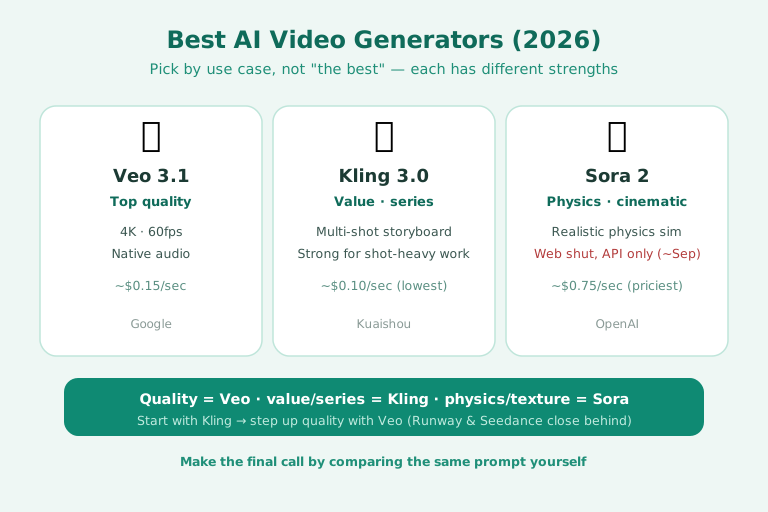
Veo 3.1 is widely regarded as the most technically advanced model as of 2026. On top of video up to 3840×2160 (4K) at 60fps, its core strength is native audio that generates dialogue, sound effects, and ambient sound in a single pass. That matters more in practice than it sounds: when the post step of dubbing sound onto finished video disappears, per-shot turnaround and editing cost drop together.
At roughly $0.15 per second in fast mode, it's also considered strong value for the quality. If "the most consistently high level of polish" is the goal, it belongs at the top of the list.
If you're buying cost and continuity — Kling 3.0
Kling 3.0, released in February 2026, sits among the cheapest premium models at about $0.10 per second. The per-second gap with Veo looks small, but on a series where shot counts climb into the dozens, that gap simply compounds.
The real differentiator is the multi-shot storyboard. You define the prompts, camera work, and transitions for multiple shots at once and generate them as a single continuous sequence. Generating each shot separately and forcing them together tends to make characters and lighting jump between cuts; this feature attacks that seam problem up front. It's especially useful for shot-heavy work that must hold a consistent tone, like music videos.
If you're buying realism — OpenAI Sora 2
Sora 2 is still regarded as a benchmark for the realism of physics simulations involving objects, fluids, and gravity. It captures natural physical interactions well in 15-second clips, making it strong for scenes where realism is the point.
There's one thing you must flag, though. OpenAI shut down the Sora web and app on April 26, 2026, and the API is reportedly available only through September. At roughly $0.75 per second, it's also the most expensive of the three. In other words, Sora 2 is less "a tool to build a new workflow on right now" and more an option with a shutdown clock attached. Validating a replacement in advance is the safer move.
So how should a creator read this?
These numbers are framed in dollars and global availability, so they run a degree or two off from real-world use in any local market. Per-second pricing feels different once you factor in currency conversion, payment methods, and a plan's free tier. And when a model's access path itself is wobbling—as with Sora—whether you can even wire it in reliably becomes a separate variable. The leading order also flips every quarter, so pinning a workflow to a single model is risky.
Runway Gen-4.5 sits just below the top tier (A-grade) with an edit-friendly workflow that's highly practical, and China's Seedance 2.0 frequently enters the value-and-quality conversation. Keeping two or more options open is, in the end, the insurance.
ASAP's take
When the goal is clear, the choice is simple. Top quality, 4K, and audio → Veo 3.1; many shots or a series on a budget → Kling 3.0; physical realism and cinematic texture as the priority → Sora 2. If you're just starting out, begin with Kling 3.0—light on both multi-shot complexity and price—then step up quality with Veo once you've seen results. A spec sheet only narrows the field; the final call always comes down to running two or three models on the same prompt, under the same conditions, and comparing them yourself.
References: Get AI Perks - Best AI Video Generators 2026 · AI/ML API Blog
AI & tech,
read in depth
Beyond the headlines — into the context and the structure
AGI Soon As Possible · asapai.co.kr