
Open-Source vs. Proprietary LLMs: It Comes Down to What You Control
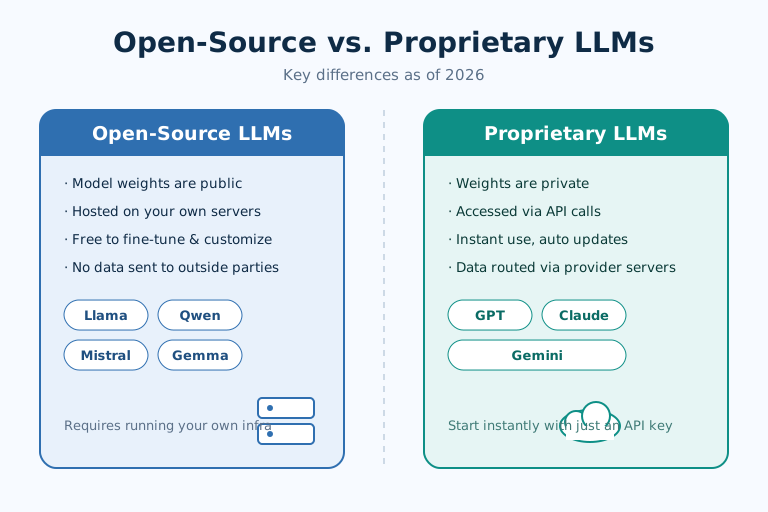
The biggest difference between open-source and proprietary LLMs comes down to whether the model weights are public and how the model is operated. Open-source LLMs—such as Meta's Llama, Alibaba's Qwen, Mistral, and Google's Gemma—release their weights, so you can host and fine-tune them on your own servers. Proprietary LLMs—such as OpenAI's GPT, Anthropic's Claude, and Google's Gemini—keep their weights private and are accessed only through an API. As of 2026, the two approaches diverge clearly in cost structure, data security, and operational complexity.
| Category | Open-source LLMs | Proprietary LLMs |
|---|---|---|
| Representative models | Llama, Qwen, Mistral, Gemma | GPT, Claude, Gemini |
| Weights | Public | Private |
| Delivery method | Self-hosting | API calls |
What "open-source" actually means here
The most misread word in this debate is "open-source" itself. What gets released is usually the trained weights, not the full training data or training code. In other words, you gain the freedom to download, run, and fine-tune a finished model, but the story of how it was built is rarely open too. Leading examples are Meta's Llama (first released in 2023), Alibaba's Qwen, France's Mistral, and Google's Gemma. In practice, then, an open-source LLM is less "free software" and more "a model you can run on your own infrastructure." Because the scope of commercial use varies by license, it is essential to check the terms before deployment.
| Item | Characteristics of open-source LLMs |
|---|---|
| Accessibility | Public weights, downloadable |
| Representative models | Llama, Qwen, Mistral, Gemma |
| Modification | Free to fine-tune and retrain |
| Operation | Hosted on your own infrastructure |
A proprietary API sells operations, not just a model
A proprietary LLM is a large language model whose provider keeps the weights private and sells access as an API or web service. Leading examples are OpenAI's GPT, Anthropic's Claude, and Google's Gemini, all of which continued to be updated steadily through 2025. What you really buy is not just access to the model but the offloading of a burden: server operations and model updates. Rather than building infrastructure, users simply obtain an API key and call the model immediately on per-token pricing. The barrier to adoption is low, but the control over which model you can use, and for how long, stays in the provider's hands.
| Item | Characteristics of proprietary LLMs |
|---|---|
| Accessibility | Private weights, API access |
| Representative models | GPT, Claude, Gemini |
| Modification | Limited options, prompt tuning |
| Operation | Provider handles all infrastructure |
The scale that trades control for convenience
The two approaches split along a clear line: open-source leads on control, while proprietary leads on convenience and out-of-the-box performance. This is not a question of which is correct but of what you give up to hold on to something else. Llama and Qwen have the edge in self-hosting and data control, but in exchange you shoulder the infrastructure and operational burden. GPT and Claude let you use the latest performance immediately with no operations to run, but you hand the provider the decisions over your data path and the model's lifespan.
| Comparison | Open-source LLMs | Proprietary LLMs |
|---|---|---|
| Public weights | Public | Private |
| Data control | Can be kept in-house | Routed through provider |
| Customization | Free to fine-tune | Limited |
| Initial adoption | Requires building infrastructure | Instant via API |
| Operational responsibility | The user | The provider |
| Representative models | Llama, Qwen, Mistral | GPT, Claude, Gemini |
How to read the costs a table won't show
Cost for open-source depends on the scale of your operations, while proprietary cost scales with usage; security comes down to where your data resides. The trap here is looking only at an API's per-token price and concluding proprietary is cheaper. Open-source LLMs carry fixed infrastructure costs—GPU purchases, electricity, staffing—but data stays inside your own servers, which is advantageous for controlling sensitive information. Proprietary LLMs require no upfront investment and, even in 2026, let you start on pay-as-you-go per-token pricing, but your input data passes through the provider's servers. The absolute dollar figures vary by usage and contract, so they are hard to pin down, and the hidden costs of self-hosting—staffing and maintenance—rarely show up in a table.
| Category | Open-source LLMs | Proprietary LLMs |
|---|---|---|
| Cost structure | Centered on fixed infrastructure costs | Pay-as-you-go by usage |
| Initial cost | High (GPUs, staffing) | Low (API key) |
| Data location | Your own servers | Routed through provider's servers |
| Compliance | Advantageous for direct control | Dependent on provider policy |
What to weigh first, on the ground
The deciding rule: choose open-source if data control and customization matter most, and proprietary if fast adoption and top-tier performance matter most. On the ground, one more axis often applies: where the data is allowed to live. Healthcare and financial organizations that cannot send sensitive data outside their own infrastructure are safer self-hosting Llama or Qwen. Conversely, small teams that need a fast launch are better served starting with the GPT, Claude, or Gemini APIs, which carry no operational burden. The realistic middle ground is a hybrid: route general tasks through a proprietary API for speed, and split off only sensitive tasks to your own open-source model to keep control. In the end there is no single answer—it comes from what your organization cannot afford to give up.
| Priority | Recommended approach | Best fit |
|---|---|---|
| Data security and control | Open-source LLMs | Healthcare, finance, confidential data |
| Fast adoption and top performance | Proprietary LLMs | Small teams, rapid launch |
| Predictable cost | Hybrid strategy | Split operations by task |

AI & tech,
read in depth
Beyond the headlines — into the context and the structure
AGI Soon As Possible · asapai.co.kr