
Fine-Tuning vs. RAG: What's the Difference?
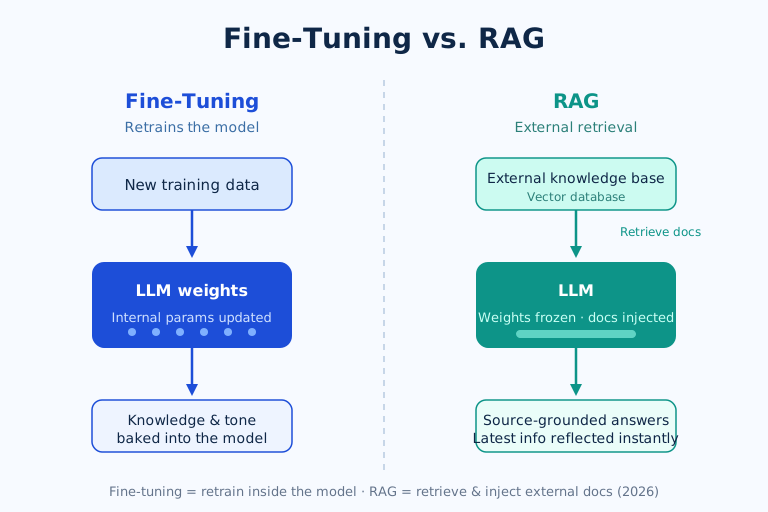
The biggest difference between fine-tuning and RAG is that fine-tuning retrains a model's internal weights, whereas RAG retrieves external knowledge and injects it at answer time. Fine-tuning retrains a model such as GPT or Claude on new data, embedding knowledge and writing style inside the model itself, while RAG (retrieval-augmented generation) looks up documents in a vector database just before answering and supplies them as supporting evidence. As of 2026, splitting the two techniques by use case — or combining them together — has become the standard approach in enterprise AI adoption.
What Is Fine-Tuning?
Fine-tuning is a technique that further trains an already-trained large language model on new data to adjust the model's internal weights. A foundation model with general knowledge from pretraining — such as GPT or Llama — is retrained on hundreds to tens of thousands of domain documents or conversation examples to change the model's behavior. As of 2026, LoRA and QLoRA, which fine-tune only a subset of parameters rather than all the weights, are widely used because they sharply reduce cost. Because the knowledge and tone learned this way are inscribed into the model itself, no separate retrieval is needed at inference time.
What Is RAG?
RAG is a technique that has a model retrieve relevant documents from an external knowledge base before generating an answer, so it answers grounded in that content. First proposed by Meta AI researchers in 2020, it is, as of 2026, the core architecture adopted by Perplexity and most enterprise chatbots. It converts a user's question into a vector, finds semantically close documents in a vector database, and inserts those documents into the prompt alongside the question so the LLM can answer. Because you only need to update the knowledge base while leaving the model weights untouched, the latest information can be reflected instantly.
The Difference Between Fine-Tuning and RAG
The difference between fine-tuning and RAG comes down to whether knowledge is inscribed inside the model or retrieved from the outside and injected. Fine-tuning internalizes writing style and domain knowledge into the model through weight retraining, while RAG supplies retrieved documents as evidence in real time. A comparison of the two approaches across key dimensions is as follows.
| Dimension | Fine-Tuning | RAG (Retrieval-Augmented Generation) |
|---|---|---|
| How knowledge is injected | Retraining of model weights | Retrieval and injection of external documents |
| Knowledge updates | Requires retraining (hours to days) | Swap documents only; reflected instantly |
| Cost structure | High GPU training cost | Cost of operating retrieval infrastructure |
| Source attribution | Hard to trace sources | Citable via retrieved documents |
| Strengths | Tone, format, domain writing style | Q&A on frequently changing facts |
The rows worth dwelling on are "updates" and "attribution." The more often an organization's knowledge changes, the more the hours-to-days retraining lag turns into an operational risk. Baking a wrong fact into the weights means yet another training run to remove it, whereas RAG resolves the same problem by swapping a single document in the knowledge base. Attribution, too, is more than a convenience in practice. In regulated industries and customer-facing answers, teams often have to justify "why did it answer this way" with a document — and knowledge dissolved into the weights carries the structural weakness of being hard to trace back.
When to Use Which
Fine-tuning is suited to when you need to lock in a model's tone or output format, while RAG is suited to when you need to answer frequently changing facts accurately. When you need to change behavior itself — such as the consistent tone of a customer-service chatbot or the specialized style of a particular industry — fine-tuning has the edge. Conversely, when you need to provide knowledge that is updated frequently — such as internal manuals, the latest news, or product specifications — along with its sources, RAG is the better fit. In enterprise settings in 2026, organizations weigh both cost and update frequency when choosing between the two.
Three Questions to Guide the Choice
When you're torn between the two techniques, narrowing the decision down to these three questions tends to speed it up. What follows is an interpretation that recasts the facts above as practical judgment calls.
- Is what you're changing "what it knows" or "how it speaks"? If the problem is expanding or updating factual knowledge, lean toward RAG. If the problem is changing behavioral patterns themselves — tone, format, persona — fine-tuning is the straightforward path, because RAG injects documents through the prompt and struggles to enforce a consistent voice.
- How often does the knowledge change? When freshness is critical — policies that shift each quarter, inventory or prices updated daily — RAG is effectively the only realistic choice. For domain style or classification rules that barely change, fine-tuning once removes the retrieval latency and infrastructure cost from the inference step.
- Do you have to justify sources? If you must present the basis of an answer to users or auditors, RAG's citability — as shown in the table — becomes a decisive advantage. The stronger this requirement, the heavier a fine-tuning-only setup becomes.
When the answers to these three questions point in different directions, that is precisely the signal to combine the two techniques.
How to Use Fine-Tuning and RAG Together
Using fine-tuning and RAG together lets you lock in the model's tone with fine-tuning and inject factual grounding with RAG, combining the strengths of both. As of 2026, the recommended sequence for combining them is as follows.
- Separate the goals — If what you want to change is tone or format, use fine-tuning; if it's factual knowledge, use RAG, dividing the roles between them.
- Fine-tune the foundation model — Train it on the domain writing style and response format to lock in the model's behavior first.
- Build the knowledge base — Embed frequently changing documents and index them in a vector database.
- Combine with RAG — Inject retrieved documents into the fine-tuned model's prompt to generate source-grounded answers.
- Evaluate and refresh — Measure answer quality and update the knowledge base periodically to keep it fresh.
Limitations and a Critical Read
It is worth stating plainly that neither technique is a cure-all. Because fine-tuning inscribes knowledge into the weights, it has to go through another retraining run — hours to days — whenever a new fact emerges or existing information turns out to be wrong, and the structural limitation of hard-to-trace sources remains throughout. RAG, by contrast, is flexible because it leaves the model weights untouched, but if retrieval pulls the wrong document, the answer is built on faulty grounds all the same. In other words, RAG's answer quality is bound to the knowledge base and retrieval accuracy — a management concern separate from the model's own performance. Ultimately, the moment you pick one technique, you take on one of the burdens: fine-tuning's "retraining cost and source tracing," or RAG's "retrieval quality and infrastructure operation." Behind the fact that combining the two has become standard practice in 2026 lies the recognition that neither one alone fully resolves this trade-off.

AI & tech,
read in depth
Beyond the headlines — into the context and the structure
AGI Soon As Possible · asapai.co.kr