An AI vulnerability researcher validated 200+ flaws: Wiz Atlas ranks #1 on CyberGym at 90.9%
Where the 200 findings actually came from
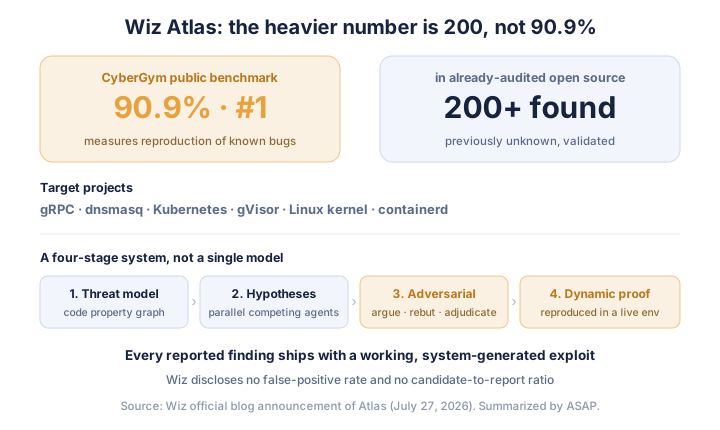
The 200-plus previously unknown vulnerabilities Atlas surfaced came from infrastructure codebases that sit among the most heavily audited software in existence. Wiz names gRPC, dnsmasq, Kubernetes, gVisor, the Linux kernel, and containerd. What these projects share is that they form the floor of cloud execution environments while having been targets of fuzzers, static analyzers, and standing bounty programs for years. Wiz says it is responsibly disclosing every finding to the relevant maintainers and is withholding technical details until fixes are available. CVE-2026-3854, called out separately, is a critical remote code execution flaw in GitHub, and it was not a solo result: an early version of Atlas assisted a human researcher.
90.9% scores reproduction, not discovery
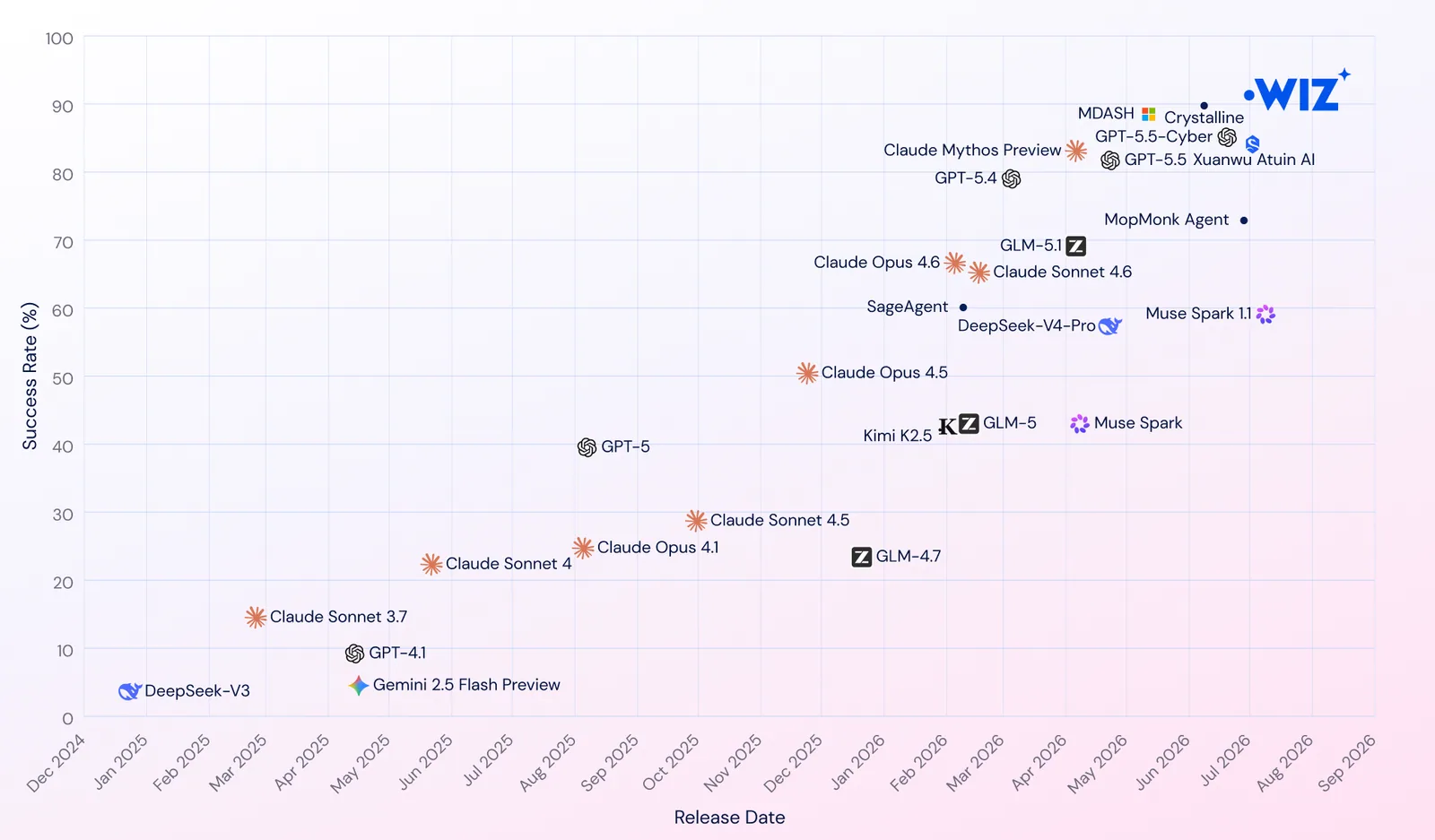
The most important thing to understand about the 90.9% figure is what the benchmark asks. Each CyberGym task supplies a known vulnerability along with its description and the relevant code, then evaluates whether the system produces a working proof of concept that triggers the bug. That is reproduction of a problem whose answer already exists, and it differs in kind from finding an unknown flaw in a blank codebase with no description attached. What deserves attention is that Wiz stated this limit itself. The company wrote that CyberGym measures reproduction of known vulnerabilities, which is arguably easier than discovering unknown ones, and added that no public benchmark fully measures real-world discovery, validation, and reproduction. In effect Wiz published a number and narrowed its valid range in the same breath. That makes the substantive evidence here the 200 findings in audited code rather than the 90.9%. The leaderboard is the marketing sentence; the verifiable claim lives in the vulnerability list.
The result comes from splitting the work into four stages
Wiz describes Atlas as a system rather than a model because the pipeline is separated into four distinct stages. In threat modeling, the system builds a code property graph to structure the entrypoints where untrusted input arrives, the data flow paths, and the dangerous operations reachable from those inputs. In the second stage, multiple agents develop competing theories about vulnerability paths in parallel, which Wiz says catches subtle multi-step bugs that a single pass would miss. In adversarial validation, one agent argues that a candidate is exploitable, another argues against it, and a third adjudicates, with semantically identical findings merged to reduce duplication. The final stage refuses to stop at static analysis: Atlas builds a dedicated execution environment, installs the necessary dependencies, and runs the triggering input to validate the security-relevant behavior dynamically.
The four design principles point the same way. Use the right model for each task; make depth cost-efficient by routing complex reasoning to frontier models while smaller models handle well-scoped work at scale; build for constant model change so the architecture stays stable as models are swapped; and validate every result end to end. In Wiz's framing, the system compounds the value of the model, and what turns frontier-model capability into reliable security outcomes is scoping, orchestration, validation, and proof.
Requiring a working exploit targets the real failure mode
The most consequential choice in the Atlas design is that every reported finding ships with a working exploit the system generated. This is precisely where attempts to attach LLMs to security work have repeatedly stalled. Generating plausible vulnerability narratives at volume became easy long ago, and the problem was that the human cost of checking each one exceeded the value of the discovery. Wiz calls adversarial validation the biggest lever it has on keeping the false-positive rate down, but it publishes no false-positive figure. That gap is not trivial. The announcement also does not say how many candidates the 200 findings were filtered from, or what human review occurs before a report reaches a maintainer. Demanding a reproducible proof is the right direction, but the operating cost of such a system shows up in the rejection rate, not the pass rate.
Nobody priced the burden on the receiving end
When automated vulnerability discovery scales, the cost shifts from the party finding flaws to the party fixing them. Most of the projects Atlas targeted are open-source efforts held up by a small number of maintainers working under near-volunteer conditions, and the volume of incoming reports already tests what they can absorb. Attaching a reproducible proof is a clear improvement here, because it removes verification time. Still, if one company's system extracts 200 findings from already-audited codebases, the question of how much reporting the ecosystem can absorb once several organizations run the same approach concurrently is a separate one. The capability is also directionless. A pipeline that locates entrypoints, constructs paths, and produces an executable proof is technically the same artifact whether it is pointed at defense or at offense. Wiz's explicit commitment to responsible disclosure and to withholding details until fixes ship reads as recognition of that asymmetry.
Three checks for security teams reading this
The immediate action item from this announcement is not tool procurement but readiness. First, inventory how far gRPC, Kubernetes, containerd, and gVisor reach into the infrastructure layer your code and container images depend on, and confirm the patch delivery path. These 200 findings will be disclosed progressively, so the speed of applying fixes as they land is what determines exposure time. Second, if you are evaluating LLM-based code auditing internally, grade candidates on the share of findings that arrive with a reproducible proof rather than on raw detection counts. What distinguished Atlas was a structure that forces validation, not a choice of model. Third, before a benchmark ranking becomes a procurement justification, document a step that checks whether the benchmark measures reproduction or discovery. Even when a vendor discloses that limit itself, the caveat frequently drops out as the number gets repeated downstream.
The next real test is a benchmark that measures discovery
A verdict on Atlas becomes possible once an evaluation exists that measures discovery of previously unknown vulnerabilities. Three things are established now: a 90.9% success rate placing first on the public CyberGym benchmark, more than 200 validated previously unknown vulnerabilities across six audited open-source projects, and an early version's contribution to CVE-2026-3854, a critical remote code execution flaw in GitHub. Wiz says it plans to incorporate Atlas into Wiz Code as part of a continuous code security scanning platform. That automation increases the total volume of vulnerabilities found is no longer in dispute, and the open question is the capacity of the side that has to convert those findings into fixes.
Source: Wiz official blog announcement of Atlas (July 27, 2026), specifying the 90.9% CyberGym success rate and #1 ranking, 200+ previously unknown vulnerabilities, target projects gRPC, dnsmasq, Kubernetes, gVisor, the Linux kernel and containerd, the four-stage pipeline and four design principles, the contribution to CVE-2026-3854, the responsible disclosure process, and planned Wiz Code integration. Summarized by ASAP.
Related
Kiro Crew Goes Open Source: The Async Agent Workspace 39,000 Amazon Builders Used First
CONCEPTWhy AI-written text is full of commas and dashes: 93.7% of GPT-3's training documents were English
Anthropic launches Claude Science: not a new model, but a science workbench

Base44 launches its own model 'Base1': the vibe-coding race for defensibility

AI & tech,
read in depth
AGI Soon As Possible · asapai.co.kr