Kiro Crew Goes Open Source: The Async Agent Workspace 39,000 Amazon Builders Used First
The Unit of Work Is a Session Chain, Not a Chat
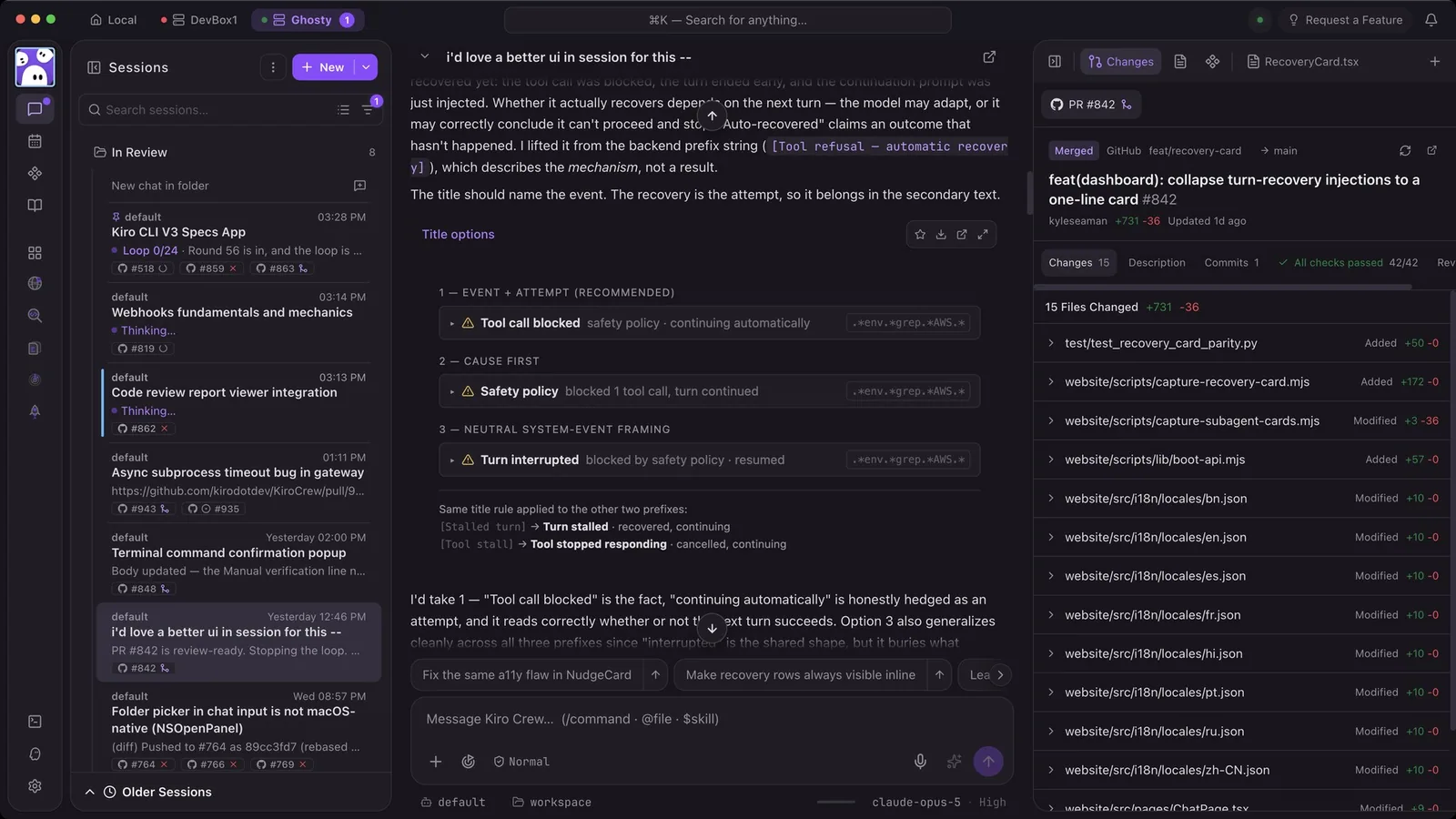
The design unit in Kiro Crew is a workflow that spans days rather than a single conversation. The examples in the announcement are an incident investigation across several repositories, a multi-hour migration that runs while nobody is at the keyboard, and a morning update that checks open pull requests and fixes flaky tests before the team logs on.
Three pieces support that. Memory carries preferences, active-project context, and relevant history into new sessions so work does not start cold. Corrections become durable lessons that change later behavior, including lessons scoped to a single workspace. Repeated patterns become reusable skills that a developer can inspect, edit, or remove.
Schedules and webhooks sit on top. Recurring jobs run on defined intervals, a heartbeat watches a pull request or deployment until its state changes, and an authenticated webhook starts work when an external event arrives. One detail stands out: jobs that need no reasoning run as plain scripts or commands without a model call. That choice keeps both cost and failure rate down in long unattended runs, which is where agent systems usually bleed on both counts.
How an Internal Side Project Became the Case for Opening It
The argument for open-sourcing Kiro Crew is an internal adoption curve rather than a performance number. The announcement presents the spread of a tool built by three engineers, Bolin Chen, Zejiang Guo, and Zezhen Xu, as the reason for release. Other builders did not merely use it; they added the pieces their own workflows needed, and those pieces stayed for everyone who came after.
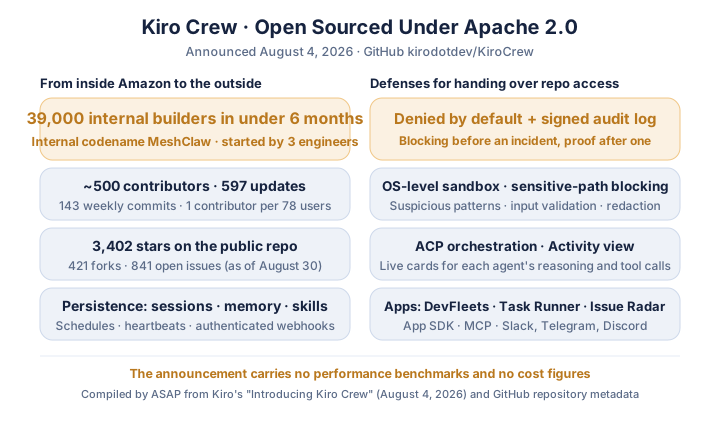
The real information in that story is density: about 500 contributors shipping 597 updates within six months. That ratio explains the tool better than the 39,000-user figure does. It works out to roughly one contributor per 78 users, and internal tooling rarely reaches that. As the announcement notes, most of those contributions were the narrow edge cases and quality-of-life fixes that would otherwise have sat in a backlog forever.
The strategic read is that the Kiro team is publishing its extension surface ahead of its features. Skills, Apps, MCP connections, and the orchestration layer itself are all surfaces a user can modify, and the team confirmed those surfaces worked internally before opening them. The product being shipped is modifiability.
The Defenses on a Tool That Takes Real Repository Access
Kiro Crew ships defense in depth from the first commit, according to the announcement. The list covers an OS-level sandbox, denied-by-default command execution, suspicious-pattern blocking, input validation, sensitive-path blocking, credential redaction, and a signed audit log of every action. The dashboard binds locally by default, and tool requests can require approval.
Two items on that list carry more weight than the rest: the signed audit log and denied-by-default execution. Most of the others amount to detection, while these two define accountability before an incident and after one. The moment an agent holds repository and CI access, the operative question stops being what was blocked and becomes whether you can prove afterward what happened.
Observability sits on the same axis. Kiro Crew orchestrates agents behind the Agent Client Protocol (ACP), and an Activity view surfaces each agent's reasoning, every tool call, and the results live as one card per agent. Being open source earns its keep here, because the blocking layers can be checked against the source rather than trusted.
Apps: Interfaces That Leave the Chat Window
Kiro Crew moves some work out of chat and into Apps, shareable purpose-built interfaces. An App combines custom UI with agents, skills, schedules, integrations, and backend services. The launch set includes DevFleets for worktree management, Task Runner for long-running tasks, and Issue Radar for triaging issues and pull requests, and developers can build their own with the App SDK.
The announcement's worked example is a LaunchDarkly App. A developer browses, searches, creates, and updates feature flags across any project or environment without leaving the workspace, while an agent finds flag references in code, implements a change behind a flag, and hands the rollout controls back to a person.
This direction runs against the last two years of agent UI. While most tools have been collapsing every task into a single conversation window, Kiro Crew pulls work that needs a queue, a reading pane, and state transitions back into dedicated screens. The underlying judgment is that triaging 200 tickets is a bad fit for a chat transcript.
Publishing the Governance Alongside the Code
Kiro Crew publishes how the project is run, not only what it does. A steering committee of maintainers is listed in MAINTAINERS.md under a deliberately minimal governance model, proposals are filed as pull requests and debated in the repository, and decisions are documented there. Contribution, discussion, governance, and roadmap planning all happen in the open.
The notable clause concerns competitors. The Kiro team states that it accepts community contributions of every kind, including integrations with other AI coding tools and providers, and that a contribution belongs in the project if it helps developers regardless of whether it maps to Kiro's own product strategy. Skills built for other open standards-based agent platforms run without modification.
That clause is uncommon in corporate open source. Whether it holds is verifiable from the merged pull request list, which makes it a better early indicator for this project than the star count.
Reading the Gap Between 3,402 and 39,000
The distance between 39,000 internal Amazon users and 3,402 first-month GitHub stars is the clearest marker of where this release currently stands. The internal figure came from a single organization's tool chain, authentication systems, and internal standards. Whether the same adoption curve reproduces outside those conditions is unanswered.
The 841 open issues read the same way. An issue surge early in an open-source release signals attention and simultaneously catalogs the friction that appears outside the original environment. The repository was created on July 16, 2026 and was still receiving pushes on August 30, 2026.
For a team evaluating adoption, two axes matter. First, whether Slack, Telegram, and Discord integrations plus the local-binding default fit an existing security policy. Second, whether the tools already in use can attach over MCP. The fact that Kiro Crew runs on the Kiro CLI and reads existing .kiro configuration, steering files, and skills is an onboarding cost rather than a benefit for teams that do not already use Kiro.
What the Announcement Does Not Answer With Numbers
The Kiro Crew announcement of August 4, 2026 is a release note without a single performance benchmark in it. It publishes no success rate for long-horizon tasks such as incident investigation or migration, no human-intervention rate, and no recovery cost when a run fails. The 39,000-builder figure signals that the tool is useful, not that autonomous execution quality was measured.
Pricing and operating cost are absent as well. The code is open under Apache 2.0, but the model calls an agent makes are billed to the user, and in a system built around schedules and heartbeats for unattended runs, that line item sits at the center of any adoption decision. What is established today is that Amazon opened an agent workspace it ran internally for six months, and whether the result holds outside that organization is a question the incoming pull requests and issues will answer.
Source: Kiro, "Introducing Kiro Crew" (Bolin Chen, Zejiang Guo and Zezhen Xu, August 4, 2026; internal codename MeshClaw, adoption by more than 39,000 Amazon builders in under six months with nearly 500 contributors, 597 updates and 143 weekly commits on average, orchestration behind the Agent Client Protocol with parallel subagents and an Activity view, memory, durable lessons and reusable skills, schedules, heartbeats, authenticated webhooks, checkpoints and retries, OS-level sandbox, denied-by-default command execution, suspicious-pattern blocking, input validation, sensitive-path blocking, credential redaction, signed audit logs and local binding by default, desktop app, web dashboard and TUI with Slack, Telegram and Discord integrations, MCP connections, launch Apps DevFleets, Task Runner and Issue Radar plus the App SDK and the LaunchDarkly App example, steering-committee governance via MAINTAINERS.md, and operation on the Kiro CLI reading existing .kiro configuration) and GitHub repository metadata for kirodotdev/KiroCrew (Apache 2.0 license, primary language Python, created July 16, 2026, and 3,402 stars, 421 forks and 841 open issues as checked on August 30, 2026), compiled by ASAP.
Related
An AI vulnerability researcher validated 200+ flaws: Wiz Atlas ranks #1 on CyberGym at 90.9%
CONCEPTWhy AI-written text is full of commas and dashes: 93.7% of GPT-3's training documents were English
Anthropic launches Claude Science: not a new model, but a science workbench

Base44 launches its own model 'Base1': the vibe-coding race for defensibility
AI & tech,
read in depth
AGI Soon As Possible · asapai.co.kr